If you have a PayPal account, please send your donation directly to linhdinh99@yahoo.com, to save me the fees. Thanks a lot!

Sample article at SubStack, "Peak Stupidity, If Only."
Showing posts with label Atlanta. Show all posts

Tuesday, April 20, 2021

Flannery O’Connor’s White Trash

As published at Unz Review, 4/19/21:


Though Flannery O’Connor didn’t live long, she left us some of the best stories ever written. It’s impossible to overpraise “A Good Man Is Hard to Find,” “The Life You Save May Be Your Own,” “The Displaced Person,” “The Artificial Nigger,” “Good Country People,” “Everything That Rises Must Converge” and “Revelation.”

O’Connor’s liberal usage of the word “nigger” has always made many people uncomfortable, however, and considering today’s politically correct climate, she’s likely to have been canceled from most college syllabi.

Most damningly, there are passages from O’Connor’s correspondences that even her staunchest defenders can’t whitewash. On May 3rd, 1964, just three months before her death from lupus, O’Connor wrote to Maryat Lee, “You know, I’m an integrationist by principle and a segregationist by taste anyway. I don’t like negroes. They all give me a pain and the more of them I see, the less and less I like them. Particularly the new kind.”

So O’Connor allowed or forced herself to think one way, but felt otherwise. On May 21st, O’Connor elaborated to Lee, “About the Negroes, the kind I don’t like is the philosophizing prophesying pontificating kind, the James Baldwin kind. Very ignorant but never silent. Baldwin can tell us what it feels like to be a Negro in Harlem but he tries to tell us everything else too […] If Baldwin were white nobody would stand him a minute.”

Negroes shouldn’t philosophize, prophesize or pontificate, you see. It’s a white thang.

O’Connor’s disdain and condescension towards blacks don’t show up in her fiction, however. Integrationist by principle, she’s not a racist against blacks in her art.

In O’Connor’s stories, blacks are generally dignified and likable, unlike her idiotic, freakish or criminal white trash. When O’Connor’s blacks transgress, it’s rather harmlessly, like stealing a turkey. They’re not smug idiots, confidence tricksters or murderers, like her white trash.

Unlike the one-armed white trash in “The Life You Save May Be Your Own,” O’Connor’s blacks don’t steal your car and abandon your deaf daughter at a roadside diner, miles from home. Unlike the three coolly depraved white trash in “A Good Man Is Hard to Find,” they don’t shoot your grandchildren, including a baby, before finishing you off.

In “The Artificial Nigger,” a brainless rural white trash, ironically named Mr. Head, takes his grandson to Atlanta, to teach him an important lesson, “Mr. Head meant him to see everything there is to see in a city so that he would be content to stay at home for the rest of his life.”

To Mr. Head’s dismay, the boy, Nelson, was doggedly proud to have been born in Atlanta. An orphan, Nelson had spent his first six months there.

Even on the train there, Mr. Head behaved moronically. Rudely waking other passengers, he read aloud everything on his ticket. Later, Mr. Head declared the name of each passing building, forcing Nelson to hiss, “Hush up!” The boy had more innate dignity than his grandpa.

At home, Mr. Head had stressed to Nelson that Atlanta was “full of niggers,” and since the boy had never encountered one, he was totally unprepared for this nightmare. Now on the train, three blacks appeared.

O’Connor, “A huge coffee-colored man was coming slowly forward. He had on a light suit and a yellow satin tie with a ruby pin in it. One of his hands which rode majestically under his buttoned coat, and in the other he held the head of a black walking stick that he picked up and set down with a deliberate outward motion each time he took a step. He was proceeding very slowly, his large brown eyes gazing over the heads of the passengers. He had a small white mustache and white crinkly hair. Behind him there were two young women, both coffee-colored, one in a yellow dress and one in a green. Their progress was kept at the rate of his and they chatted in low throaty voices as they followed him.”

Much classier than Mr. Head and Nelson, the blacks were headed for the dining car. Later, Mr. Head also took his grandson there, but only to look. They couldn’t afford it.

Shooed away after they had tried to poke into the kitchen, Mr. Head cracked a loud joke about cockroaches that got everyone laughing. Triumphant, they returned to their seats.

For lunch, Mr. Head had brought a paper bag with some biscuits and a can of sardine, but in their excitement to get off the train, they forgot all about it, so went hungry for the rest of the day.

Tossed into the swirling city, both of them were overwhelmed, but grandpa had a strategy, “Mr. Head was determined not to go into any city store because on his first trip here, he had got lost in a large one and had found his way out only after many people had insulted him.”

Walking along, they browsed stores and even inspected the sewer, for Nelson’s much needed edification. Soon enough, though, they were lost. The houses had become much shabbier, and there were blacks everywhere.

O’Connor, “There were colored men in their undershirts standing in the doors and colored women rocking on the sagging porches. Colored children played in the gutters and stopped what they were doing to look at them. Before long they began to pass rows of stores with colored customers in them but they didn’t pause at the entrances of these. Black eyes in black faces were watching them from every direction.”

In this “nigger heaven,” Mr. Head was too intimidated to ask for directions, so it was left to the boy to approach a woman.

During their brief exchange, the motherless boy was overtaken by a painful, deeply smothered yearning, “He suddenly wanted her to reach down and pick him up and draw him against her and then he wanted to feel her breath on his face. He wanted to look down and down into her eyes while she held him tighter and tighter. He had never had such a feeling before.”

Unaware of this turbulence, the sweet woman merely responded, “You can go a block down yonder and catch you a car take you to the railroad station, Sugarpie.”

Since Mr. Head had never taken a streetcar, they didn’t board one, but merely follow the tracks. When you’re so ignorant yet proud, everything is impossible. Too exhausted and hungry to go on, Nelson had to sit down on the sidewalk, and when he dozed off, Mr. Head had an inspiration.

O’Connor, “He looked at the sprawled figure for several minutes; presently he stood up. He justified what he was going to do on the grounds that it is sometimes necessary to teach a child a lesson he won’t forget, particularly when the child is always reasserting his position with some new impudence. He walked without a sound to the corner about twenty feet away and sat down on a covered garbage can in the alley where he could look out and watch Nelson wake up alone.”

Wilson’s latest impudence was to ask that black lady for help. He needed to be taught a lesson for showing up his grandpa. White trash on a trash can, Mr. Head waited for Nelson’s waking terror.

The boy slept on. Impatient, Mr. Head finally kicked the trash can to jolt Nelson awake.

O’Connor, “Nelson shot up onto his feet with a shout. He looked where his grandfather should have been and stared. He seemed to whirl several times and then, picking up his feet and throwing his head back, he dashed down the street like a wild maddened pony.”

Chasing after, Mr. Head lost sight of Nelson. After the third intersection, he came upon this scene, “Nelson was sitting with both legs spread out and by his side lay an elderly woman, screaming. Groceries were scattered about the sidewalk. A crowd of women had already gathered to see justice done and Mr. Head distinctly heard the old woman on the pavement shout, ‘You’ve broken my ankle and your daddy’ll pay for it! Every nickel! Police! Police!’ Several of the women were plucking at Nelson’s shoulder but the boy seemed too dazed to get up.”

Instead of running to his grandson, Mr. Head hid behind a “trash box” to “get his bearings.” Again, the trash motif. Finally, he approached Nelson, “but only at a creeping pace.”

O’Connor, “The women were milling around Nelson as if they might suddenly all dive on him at once and tear him to pieces, and the old woman continued to scream that her ankle was broken and to call for an officer. Mr. Head came on so slowly that he could have been taking a backward step after each forward one, but when he was about ten feet away, Nelson saw him and sprang. The child caught him around the hips and clung panting against him.”

With the enraged women’s attention turned on him, Mr. Head did something so horrible, it’d sear and shame him forever.

O’Connor:
Mr. Head sensed the approach of the policeman from behind. He stared straight ahead at the women who were massed in their fury like a solid wall to block his escape, “This is not my boy,” he said. “I never seen him before.”

He felt Nelson’s fingers fall out of his flesh.

The women dropped back, staring at him with horror, as if they were so repulsed by a man who would deny his own image and likeness that they could not bear to lay hands on him. Mr. Head walked on, through a space they silently cleared, and left Nelson behind. Ahead of him he saw nothing but a hollow tunnel that had once been the street.
Throughout this story, Mr. Head had strangely competed against Nelson, such was his smallness, but with this cowardly act, he became less-than-nothing, but what do you expect from an O’Connor’s white trash? They’re simply the worst.

In another story, “Revelation,” O’Connor reemphasizes this point:
Sometimes at night when she couldn’t go to sleep, Mrs. Turpin would occupy herself with the question of who she would have chosen to be if she couldn’t have been herself. If Jesus had said to her before he made her, ‘There’s only two places available for you. You can either be a nigger or white-trash,’ what would she have said? ‘Please, Jesus, please,’ she would have said, ‘just let me wait until there’s another place available,’ and he would have said, ‘No, you have to go right now and I have only those two places so make up your mind.’ She would have wiggled and squirmed and begged and pleaded but it would have been no use and finally she would have said, ‘All right, make me a nigger then—but that don’t mean a trashy one.’ And he would have made her a neat clean respectable Negro woman, herself but black.
Born and raised in Georgia, O’Connor went to Iowa for grad school, then spent a couple of years in New York and Connecticut, before returning to Georgia, where she spent her last 13 years.

It was in the North, then, that O’Connor came into being as a writer, and most of her earliest champions, Paul Engle, Sally and Robert Fitzgerald, Robert Lowell, etc., were Northerners, as was her publisher, Robert Giroux. Though rooted in the South, O’Connor was also orientated towards the North, with its mores, taste and, yes, attitudes towards race.

From that angle, the South has been little more than a stinking mudhole of white trash, so down the decades, we’re served with Deliverance, Easy Riders, Honey Boo Boo and, yes, also Flannery O’Connor. As great as she is, O’Connor contributes to that relentless calumny.

In 2020, there was an article by Paul Elie in The New Yorker, “How Racist Was Flannery O’Connor?”

I’d say pretty damn racist, against poor whites.

In 2021, the term “white trash” has been compacted to just “whites,” so it’s not just the South that is overrun with assorted Mr. Heads and Misfits, but pretty much the entire country, save for half of Manhattan, chunks of California and perhaps Seattle.

It is deplorable. That’s why the US must be rigorously reeducated and deformed, if not destroyed, for the benefit of all trash, of any color.

First they came for the white trash, and no one said nothing…


Sunday, March 19, 2017

Postcard from the End of America: Atlanta

As published at Unz Review and Intrepid Report, 3/20/17:


Knowing you can’t run from their jokes, bus drivers will crack a few, so on the endless leg from Washington to Atlanta, the driver intoned, “I don’t believe in Lost and Found, ladies and gentlemen, only eBay. If you forget something on this bus, you can find it on eBay.” Later, he chastised us all because someone had pissed on the toilet’s floor.

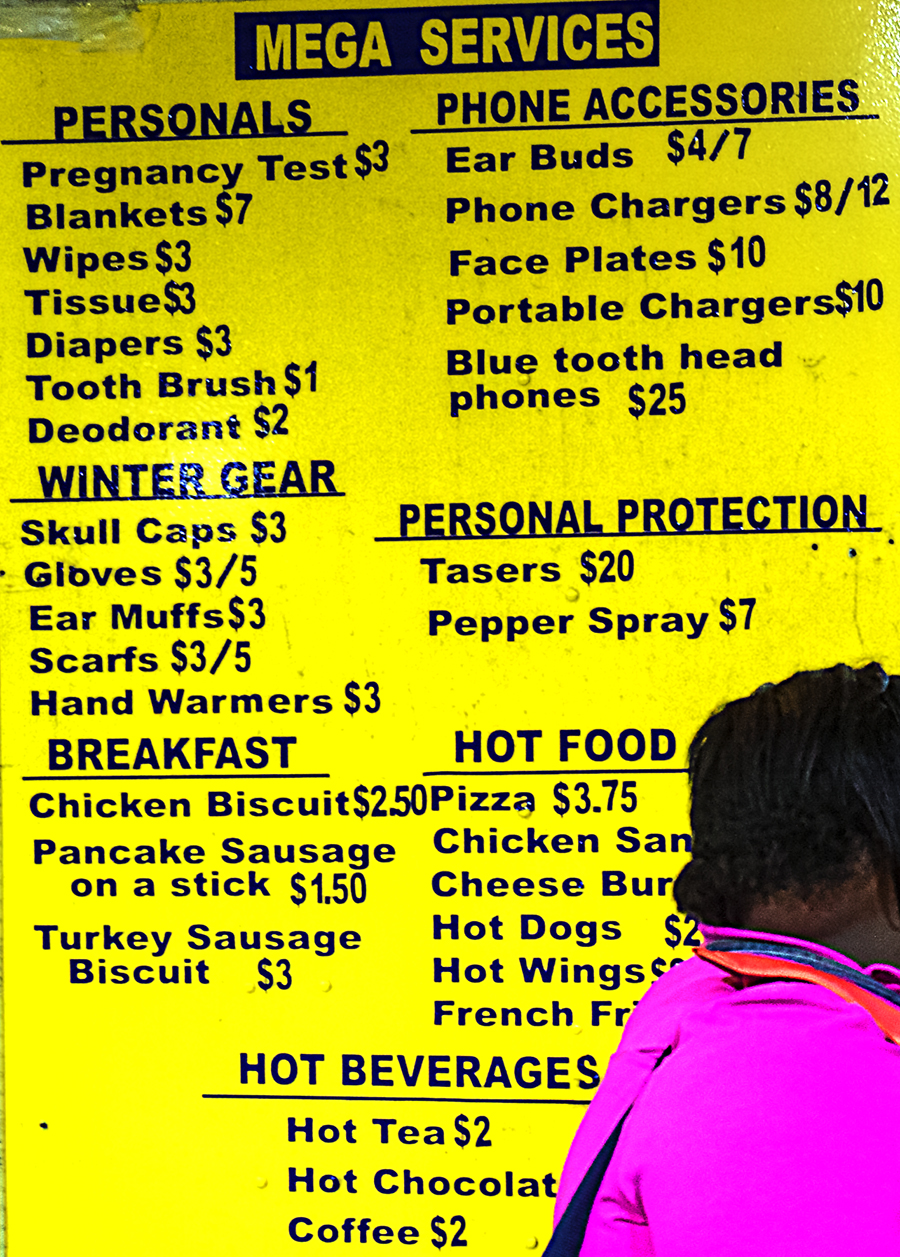
As the cheapest means of traveling long distance, MegaBus is bare-boned. Most stops have no shelter, so no bathrooms. Riders may have to wait for their bus, which may be quite late, in withering heat, snow, sleet or hurricane. In Atlanta, however, there’s the amenity of a MegaBus snack truck that also sells pregnancy tests ($3), tasers ($20) and pepper sprays ($7).

What perils could possibly befall these downtrodden or cheapskate travelers? Use your imagination. If Donald Trump sat next to you and grabbed your pussy, wouldn’t you be glad you had bought that pepper spray or taser? If these failed to dissuade our commander-in-chief, you could use your pregnancy test in the bus’ john. Of course, those in the middle class or above would likely shudder at the thought of riding Greyhound, much less MegaBus.

On the bus, there was an actual comedian, Chris Thomas. As “The Mayor,” Thomas had hosted Rap City, a show on Black Entertainment Television. His best loved joke, “I saw this little white girl the other day. She said, ‘You have such big lips! I wish I had lips like yours!’ I said, ‘Bitch, hold still,’” and Thomas bunches his fist. Soft spoken, The Mayor never aimed for humor before getting off in Charlotte.

The MegaBus stop in Atlanta is right outside the Civic Center subway station, and when it’s very cold, passengers go underground to escape the wind. I saw a ragged, middle-aged black man, likely homeless, dancing quite cheerfully. Laughing, a woman joined him. They jerked and twisted. “I’m dreaming of a black Christmas!” she growled.

There is much to love about the South, and not the least is its food. Soon after arriving in Atlanta, I had some excellent collard greens and mac and cheese with my meatloaf at Metro Deli Soul Food. About half of the merchants inside Sweet Auburn Curb Market were black, but there were also several Korean grocers.

The new South is more diverse than you think. In North Charleston in 2012, I chanced upon Lion’s Den, a bar in a black neighborhood that was owned by an Indian-American. Living there since 1982, the confident, affable man had even run for city council. He boasted of carrying four passports, American, English, Kiwi and Indian, and had visited 53 countries. His bar was decorated with a “WE SUPPORT OUR TROOPS” banner and statues of Shiva, Parvati and Buddha.

Of course, two Southern states, Louisiana and South Carolina, gave us our first two Indian-American governors.

In the hills of Tennessee, and old, befuddled lady told me, “My doctor, you know, he’s not black. He’s something.” She meant Indian.

Each time I travel through the South, I’m struck by the waning of its accent. Attending high school in Northern Virginia from 1978-81, I heard Southern accents much more often than I have in recent trips to Georgia, North Carolina, South Carolina, Mississippi, Louisiana and Tennessee. True, I haven’t wandered into rural areas, but it’s sad that natives of Savannah, Raleigh or Charleston, for example, should sound more or less like Yankees.

While television and movies have homogenized American English, the disappearance of the Southern accent can also be attributed to the national media’s relentless shaming of the South. Tired of being depicted as racist morons, many Southerners have neutered and deformed their speech.

The South still knows that Washington is the enemy, but this cognitive advantage is canceled out if you hate yourself. In Durham, I saw a sticker, “GOOD NIGHT WHITE PRIDE,” with one man about to slam a bicycle on another man, sitting on the ground. I had seen the same sticker in Leipzig, Germany.

How bad can the South be if blacks from all parts of the country are moving there? Often referred to as the capital of Black America, Atlanta has many thriving black businesses, including a bank, Citizens Trust, and a car dealer, Wade Ford Inc, that rakes in half a billion bucks yearly.

In Sweet Auburn, I encountered a tiny yet remarkable business owned by one Big Mouth Ben. What attracted me to it was a bicycle that was mostly wrapped in bright yellow tape, with an orange sign above it, “DREAMS AHEAD / PROCEED WITH DETERMINATION.”

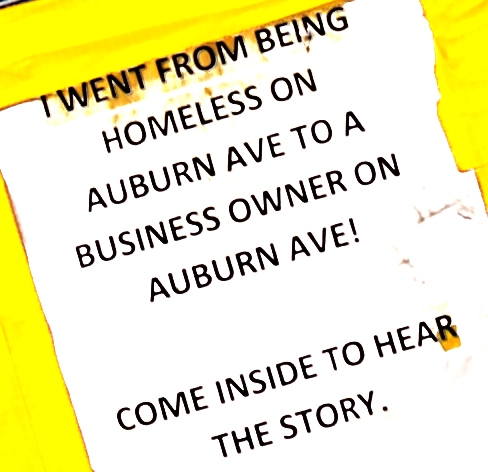
There was also a flyer, “I WENT FROM BEING HOMELESS ON AUBURN AVE TO BEING A BUSINESS OWNER ON AUBURN AVE! COME INSIDE TO HEAR THE STORY.”

At six-years-old, Big Mouth Ben saw, at a gas station, a man return a Coke bottle for ten cents, “My eyes got that big!” so he filled his red cart that day with empties and made two bucks.

Though scoring 98 on his ASVAB to join the Air Force, Big Mouth Ben was also accepted by the University of Georgia, so he attended and thrived, but dropped out after three years to become a rap star, for he had made a name for himself in Athens.

Back in Atlanta, Big Mouth Ben floundered as a rapper, so he secured a government office job, but quit to co-found a mail-order business. He wanted to be a millionaire by 30, and a billionaire by 40. After thriving for several years, his cash cow was poleaxed by online shopping.

Destitute, Big Mouth Ben sold drugs and got hooked himself. Still, he managed to find work as a garbage man, and actually “loved it,” until a reckless car crushed his pelvis. “It was excruciating pain. If you offered me billions of dollars to go do that again, I wouldn’t do it,” he told Wesley Shelby Jr., a television host.

After willing himself through rehabilitation, Big Mouth Ben could swagger again, so used his wheelchair as a cart to peddle soft drinks, water and snacks on the streets. Always a hustler, he also sold add spaces on his modest wheels. “If you want to sell it, let me tell it.”

Wheelchairs can’t fly, however, so Big Mouth Ben switched to a bicycle, and this he wrapped in bright yellow tape, for it represented sunshine. Now, Big Mouth Ben could push refreshment in The Bluff, West End, Kirkwood, College Park and Riverdale, etc. Our hero was everywhere. A recent rap explains:

Man, I love these streets,
But, man, these streets,
They f$$k wit me.
East Point, they f$$k wit me.
Decatur, they f$$k wit me.
[…]
Big Mouth Ben loves the streets.
The streets love Big Mouth Ben.
I show you nothing but love,
And most of them are my friends.
Man, I’m well connected.
Man, I’m well respected.
[…]
Robbing me, you might get jumped
By these bystanders.
[…]
Keep my foot on the pedal.
I hustle so hard,
I deserve a gold medal.
Keep money in my pocket.
I know that’s what you don’t like.
I ain’t worried about you, though.
I got it all on my bike.
[…]
I stayed down and I prayed.
I stayed down and I made.
My dream now a reality,
I got it made in the shade.
[…]
Atlanta is my city,
For all the love they show me.

Big Mouth Ben couldn’t quite shake his drug habit, however, so he ended up homeless and curled up, on cardboard, under an overpass. “What turned everything around was a spiritual awakening.”

God leveled with Big Mouth Ben, “I promised to love you, regardless. If you want to be under the bridge, I’ll love you under the bridge. If you want to go to prison, I’ll love you in prison. But it’s up to you, where you want to be loved.”

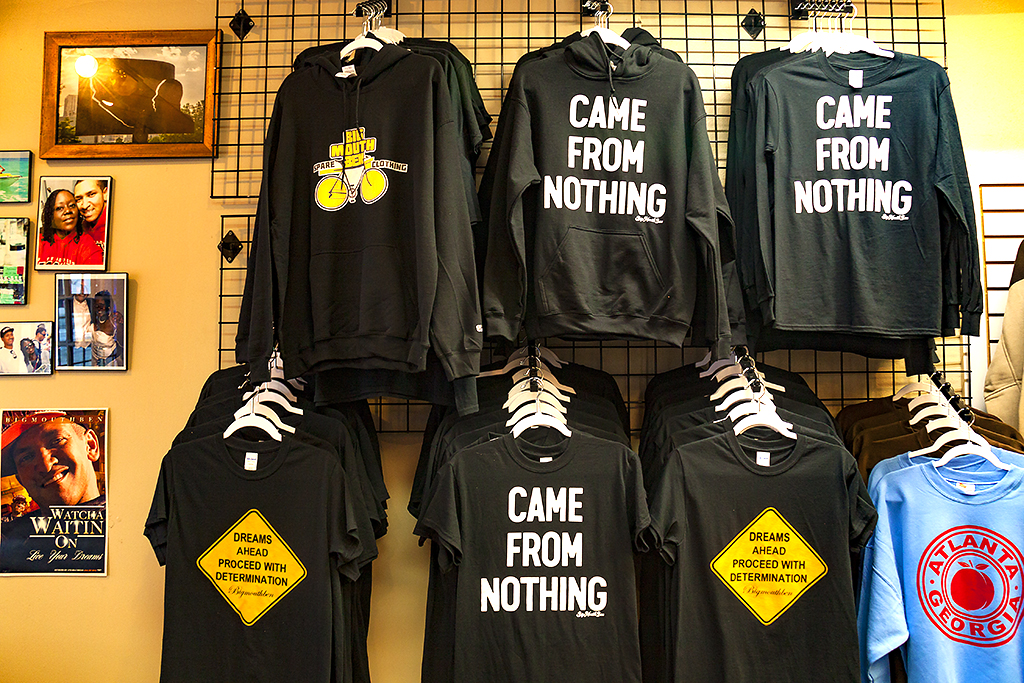
Big Mouth Ben got clean, applied himself and the result is a convenience store that also sells hoodies and T-shirts that say, “CAME FROM NOTHING.” Big Mouth Ben raps, “I really want success, so I act like it. I want to see a million, so I act like it […] Determination is my weapon, so I’m acting like it.”

What a pleasure it was to meet this gentle and gregarious man with a crooked mouth. I also caught a glimpse of Tanya, his college sweetheart and wife.

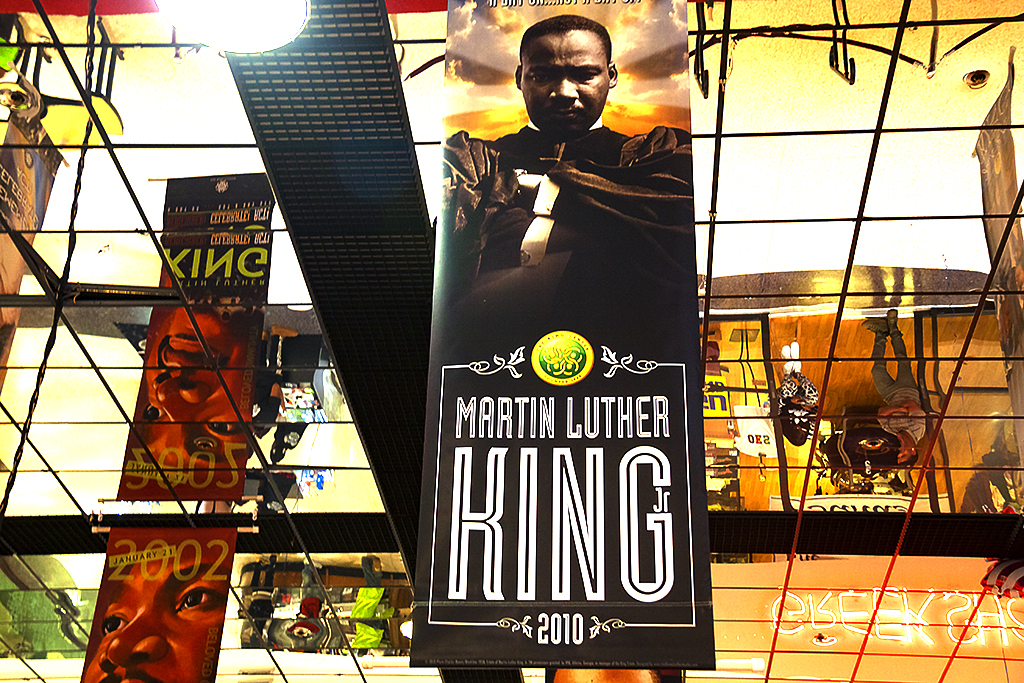
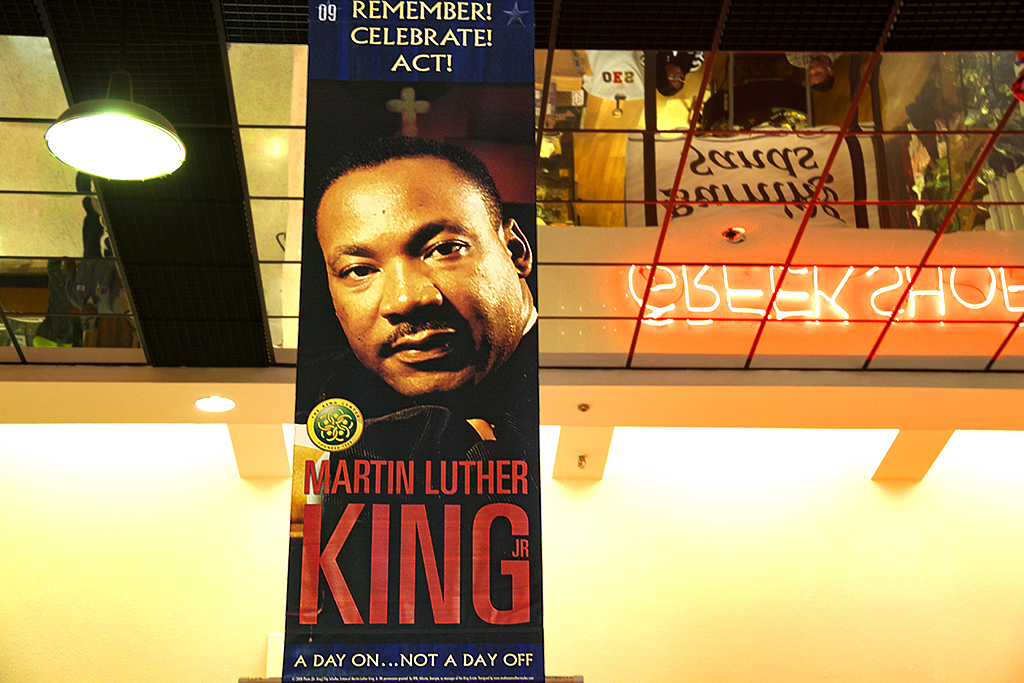
Continuing down the street, I entered Ebenezer Baptist Church. Smallish and plain, it has a grand place in American history thanks to its former pastor, Martin Luther King Jr.

There were less than a dozen visitors in the dimly lit church. Settling into a pew, I listened to a recorded sermon which spoke of being fiscally responsible.

King always preached personal responsibility. In a 1957 sermon about “loving your enemies,” King said, “We must face the fact that an individual might dislike us because of something that we’ve done deep down in the past, some personality attribute that we possess [...] and we’ve forgotten about it; but it was that something that aroused the hate response within the individual. That is why I say, begin with yourself. There might be something within you that arouses the tragic hate response in the other individual.” Examine yourself first, King advised. In contrast to our political correctness, King never absolved nor indicted an entire race.

King was a father-figure not just to his flock, but to millions of Americans as he rose in stature. To his critics, though, he was just a sex maniac and plagiarist, just a hypocrite and phony, in short, but what they really object to, I believe, is King’s vision of a colorblind, post-racial America. Not only that, they don’t think it’s possible.

King didn’t just focus on race but class, and he charged that the state robbed its citizens to wage war endlessly, so of course it killed him. Its nemesis silenced, the state then named streets after King, honored him with a national holiday, erected a huge Made-in-China statue of him in DC and, most ironically, deforms his legacy to ensure ongoing racial division and strife. Since identity politics enrages all of us all the time, it’s a most useful tool for the state. Fragment and strangle. Dead, King serves the state.

After eight years of our first black or, rather, biracial president, the country is riven by racial divisions, with the media looking everywhere for evidence of white racism only. Everybody else is a victim, for they’re all penned together, most racistly, as “people of color.”

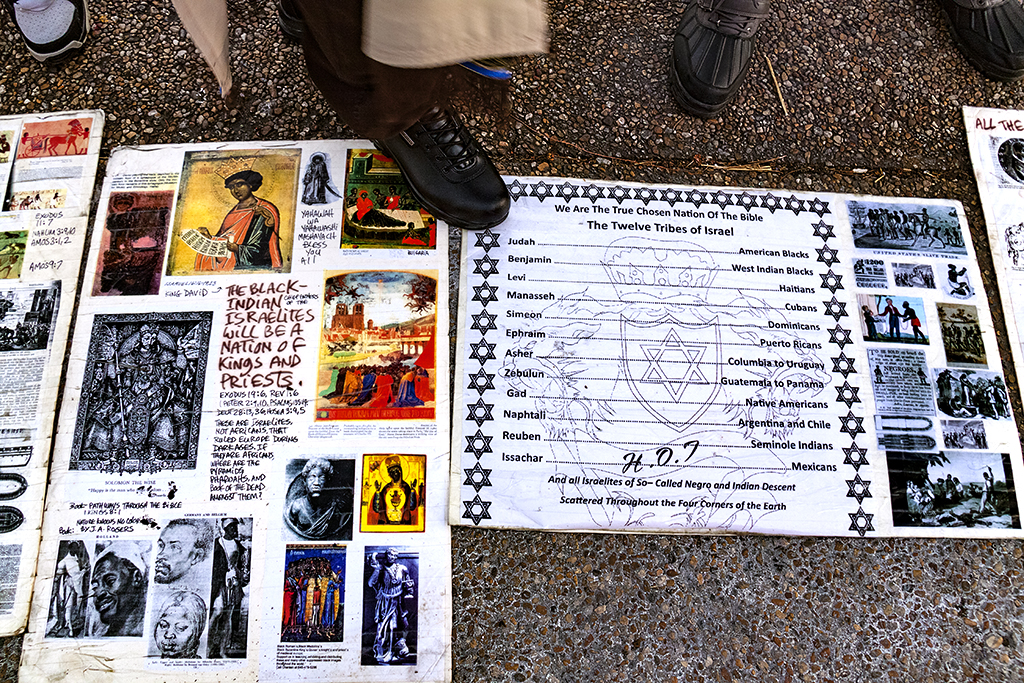
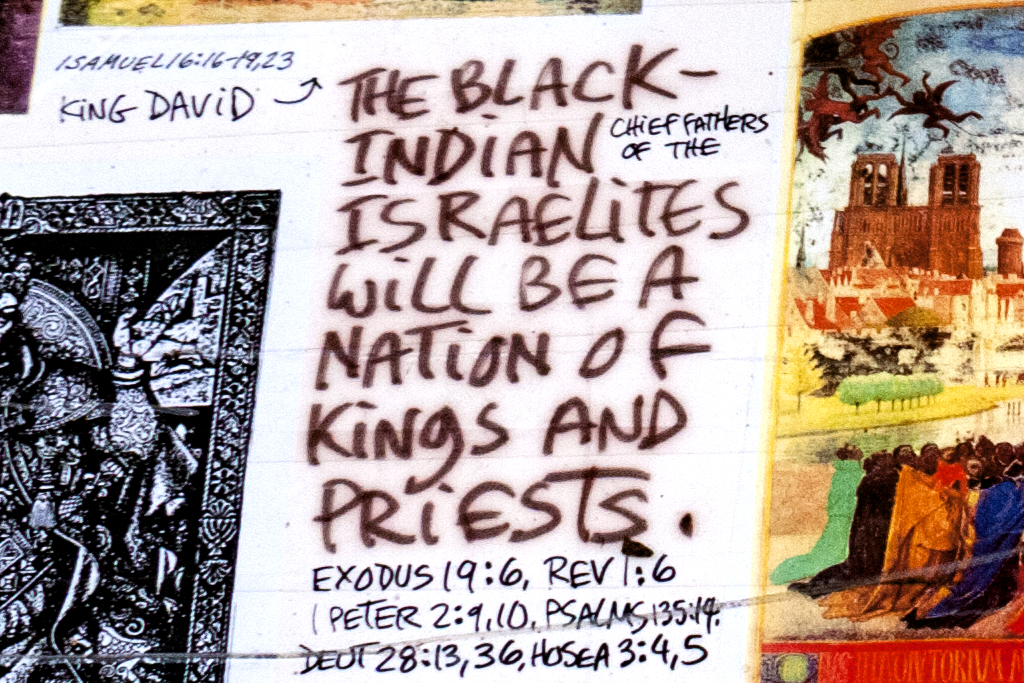
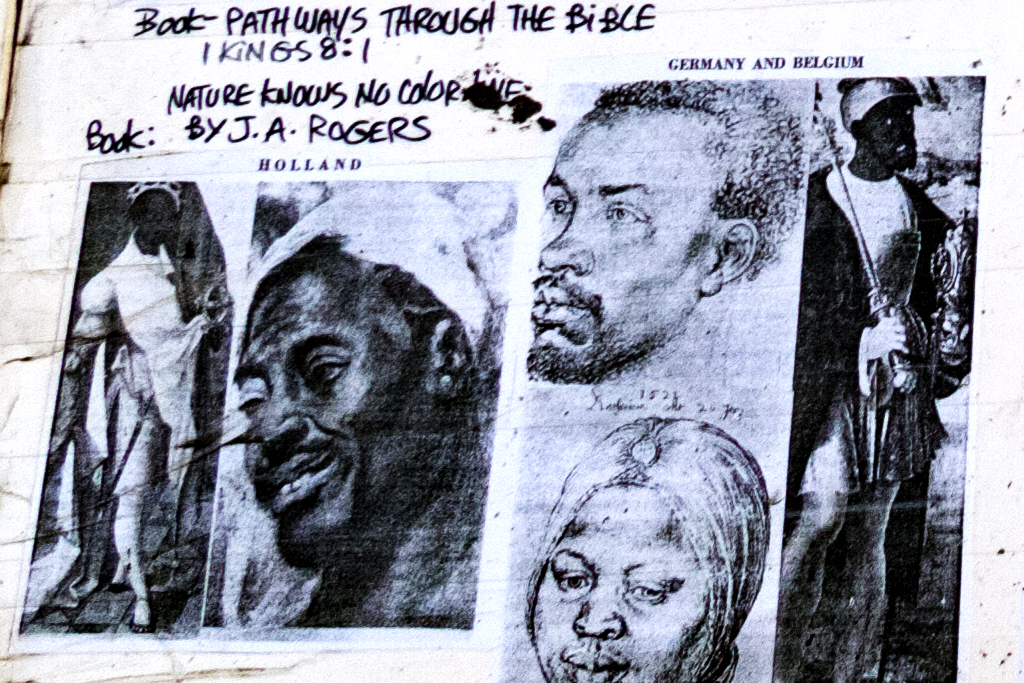
That evening, I went to Little Five Points to check out its lively cluster of shops and bars. At Finley Plaza, I encountered half a dozen Black Israelites, preaching. I had seen their brethren in Philly, Washington and Minneapolis. Like Black Muslims, they also believe whites are devils, thus unredeemable. Between strident outbursts, a Black Israelite calmed down, chuckled and explained to another black man, “Of course, I’d like to kill most of them, and keep the rest as slaves, but until then, I can only spread the good words.”

At his feet was a sign, “We Are The True Chosen Nation Of The Bible / The Twelve Tribes of Israel,” with each of them black, Hispanic or Native American. Beware of any “chosen people,” for what could be more supremacist or racist? Such a concept, seriously embraced, allows any man, tribe or nation to enslave, loot or murder with righteousness.

In the mild weather, I strolled among the bar hoppers, heard their laughter and noticed stores named Fearless Weirdos, Criminal Records, Posse Riot and World Piece. At a wig shop, there was a flyer, “NO! In the Name of Humanity, We REFUSE to Accept a Fascist America.” Nearby, a young beggar sat in the semi-dark, his cup empty.

After two pints in Brewhouse Cafe, I exited to discover I was gravely underdressed, for the temperature had plummeted. Heading for the train, I passed two gutter punks lying on grass, with only one in a sleeping bag.


.

Wednesday, March 15, 2017

Tuesday, March 14, 2017

.


mega snacks--Atlanta


mega snacks--Atlanta (detail)


mega snacks--Atlanta (detail 2)


[this truck serves MegaBus riders]


.
.


Sleeping homeless person and two trash cans--Atlanta


.
.


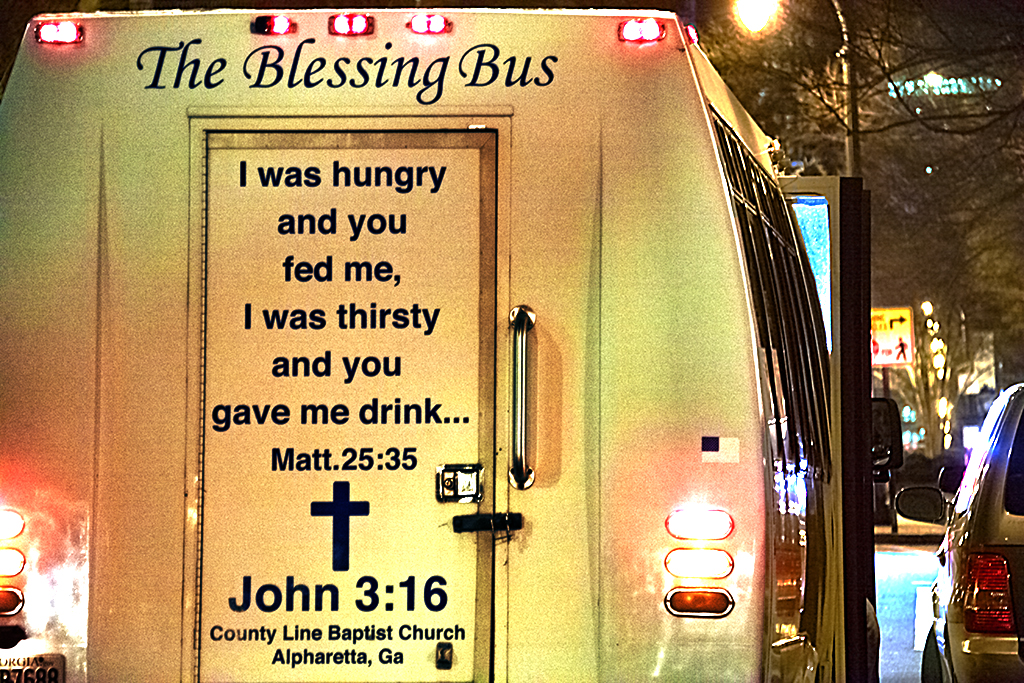
The Blessing Bus--Atlanta


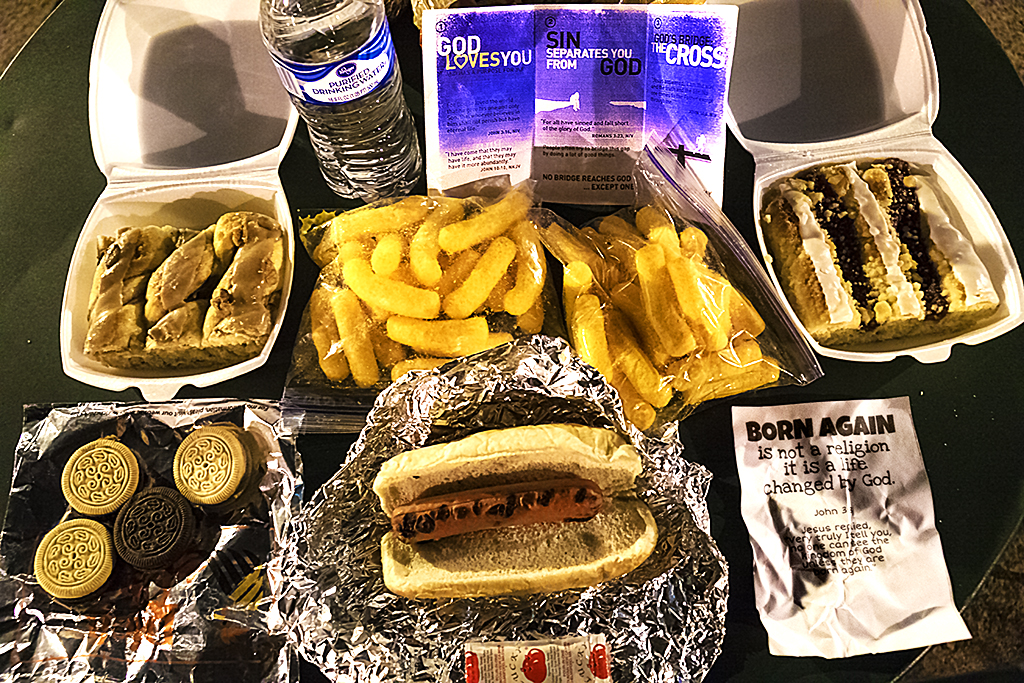
Free food from The Blessing Bus--Atlanta


2/25/17. Ian Keenan and I were just shuffling along, minding our own business, but we looked and smelled homeless enough, apparently, that The Blessing Bus gave us some food. "Sure, we'll take it!" and we went to a nearby park to chow down. Everything that was given to us was of the lowest possible quality, however, it was truly ungodly, so neither one of us could eat anything. We only drank the water. Ian and I are the opposite of fussy, I must add. I have eaten some of the worst food you could imagine.


.