If you have a PayPal account, please send your donation directly to linhdinh99@yahoo.com, to save me the fees. Thanks a lot!

Sample article at SubStack, "The Unliving."
Showing posts with label Gramsh. Show all posts

Saturday, January 15, 2022

Covid Feuilleton #10

As published at SubStack, 1/15/22:


[Fier, 5/14/21]


By February of 2021, there weren’t just rumors of certain countries reopening soon, but online whispers the entire world might be locked down presently, thus stranding everyone indefinitely wherever. It wasn’t that farfetched. With hardly any flights in or out of most countries, hundreds of thousands of tourists had already been stuck, resulting in loss of jobs, unpaid mortgages and drained wallets, not to mention separation from family. Millions of third-worlders working abroad also couldn’t go home.

That dream Namibian safari which took so long to save up for suddenly turned into a sustained elopement with lions, hippos and wildebeests. It’s never too late to learn Khoekhoe. Endless summer in an Icelandic village at the end of the roughest road became the longest, darkest winter catching up on Bill Gates, Klaus Schwab and Yuval Noah Harrari.

Though there were repatriation flights arranged by governments, their announcements were usually abrupt, seats were limited and prices often too high. At least no one had to claw and kick compatriots out of the way to get onto a plane, while avoiding being sucker punched in the face by a stern captain.

Vietnamese working illegally in China simply trekked home, if they were close enough to the border. Hundreds of thousands, mostly legal, were stranded in South Korea and Japan, with many also losing their jobs in these Covid-ravaged economies. Out of food, they had to be fed by Buddhist temples.

There’s a 3/28/20 BBC video of two young English women living in a Sydney garage, and three more Brits stuffed into a camper at a Kiwi campsite, with their money quickly running out. A Brit working in China was traveling when Covid erupted, so ended up spending a year and a half in Tonga, a white-sanded paradise which quickly bored her, because no one likes to be stuck anywhere, she stressed.

Even if never taken advantage of, freedom of movement is essential to one’s well being and self-respect. Monotonous months cooped up in an office cubicle is made more bearable by the prospect of two weeks far away, or just weekend drives to nearby towns. As a teenaged worker at McDonald’s in northern Virginia, I’d treat myself to ballgames in Baltimore, an hour away in my used Mustang II. If carless, a grinding Greyhound trip to relatives means freedom. Even before conception, life is movement.

After five weeks in Egypt, I decided to fly to Albania, because it had no Covid-related entry requirements. Most crucially, Americans could stay there for up to a year. With adjacent North Macedonia and Montenegro still wide open, I could run around a bit without too much effort, and should Italy reopen, I could take a ferry to where I had spent the best two years of my life.

Every nation’s history is determined primarily by its geography. Though the Albanians are smack in the middle of Europe, they’re somehow seen as borderline Europeans, or not even European at all, by morons, obviously. Squeezed between Greece and Rome, they were often dismissed as just a bunch of mountainous, barely civilized tribesmen. With their mass conversion to Islam under the Ottomans, they became even more alien. (Keep in mind, though, that 17% of Albanians are still Christian.)

Though they’ve produced two Roman emperors, Diocletian (244-311) and Constantine the Great (272-337), and the founder of modern Egypt, Muhammad Ali (1769-1849), Albanians are still perceived as inferior and even stupid, an absurd judgement, frankly, for during my six months in Albania, I was surrounded by some of the most gracious people I’ve ever met. Gentle and intelligent, they’re simply beautiful. I saw better books sold on Tirana sidewalks than in most American bookstores. There was much that was eye-opening, and that’s why one travels. Nowhere is as expected.

[Sarande, 5/26/21]


In my Tirana building, a man said I shouldn’t hesitate to knock on his door, one floor up, if I ever needed help with anything, and he said this on our third encounter in the hallway, after only one conversation. In Gramsh, a town of less than 10,000, I wasn’t sure where to wait for a van to Korce, so I asked two passersby, in English then Italian. Scrupulous, the second even instructed a third man to look after me on the van itself, and none of them wanted anything from me. Before getting off in mountainous Moglice (pop. 1,000), this last man pointed forward then gave me a thumbs up, with a nod and a smile, to indicate I was fine moving forward. He even said something to the driver.

In early 1991, the Hoxha statue in Tirana’s Skanderbeg Square was finally toppled. In 1994, Paul Theroux landed in Durres to find a country that was still traumatized and beyond destitute, “My first sight, as I walked off the ship, was of a mob of ragged people, half of them beggars, the rest of them tearful relatives of the passengers, all of them howling.” Swarmed by beggars, Theroux finally made it to a bus station that resembled a junkyard. Approached by “a ragged young man,” Theroux assumed he just wanted money, but he was there to point the foreigner to the right bus. Theroux:

I climbed in and sat by the back door.

“It costs fifty leks,” the young man said, and seeing that I was confused, he took out a scrap of red rag that was a fifty-lek note and handed it to me. “You will need this.”

Before the door clapped shut I managed to give the young man some Italian lire in return, perhaps its equivalent […] He had given me, a stranger, what was in Albania a half-day’s pay, knowing that I would never see him again.

Visiting Durres a couple times in 2021, I’m happy to report it’s become a cheerful city again, with a wide seaside promenade where mothers push strollers, kids play and everyone can enjoy the soothing breezes from the Adriatic. Pleasant cafes, restaurants and hotels hug its coastline. The Covid plandemic has certainly put the kibosh on this recovery, however. Hopefully, it’s not reversed, or Greatly Reset.

[Gramsh, 6/29/21]


During Communist days, Albania’s secret police was called Sigurimi, or “Safety,” a nauseatingly sick name for a sinister outfit that terrorized so many Albanians. Arrested by the Safety goons, you could expect to be tortured, if not killed. Even if given a trial, you would have no chance to defend yourself, for its only purpose was to make a spectacle and lesson out of you. You were there to be condemned.

Visiting the former Sigurimi headquarters, now a museum, I was particularly haunted by a photo of the first Albanian female writer, Musine Kokalari. Though born in Turkey and educated in Italy, Kokalari was deeply attached to Gjirokaster, her ancestral city. Kokalari’s first book, published in 1941, was a collection of stories inspired by Gjirokaster folklore, and also its Tosk dialect. I mention this to stress that Kokalari was no internationalist (or globalist), despite her relatively cosmopolitan biography. A nationalist, Kokalari would risk everything for Albania.

Though Kokalari said in 1943 she only wanted to immerse herself in literature, and have nothing to do with politics, she had a change of heart a year later, when she cofounded the Albanian Social Democratic Party. The murder of her two brothers by Communists, and their threat to gain power, forced her off the sideline. Having lived in Italy under Mussolini, she was also anti-Fascist.

Political active for just two years, Kokalari would pay a monstrous price. After Communists gained power in 1946, they put Kokalari on trial as “a saboteur and enemy of the people,” then jailed her for 18 years, under the most barbaric conditions. Prevented from writing, of course, she had to perform back breaking labor day after day. Released, she had to live in tiny, out of the way Rrëshenm where she worked as a street sweeper for 19 years, until her death from untreated cancer.

Although already tortured and humiliated in jail, with her horrific fate sealed, Kokalari’s calm, nearly radiant face in the famous photo betrays an odd combination of strength and innocence, as if she could hardly believe she was being punished so sadistically, in a country she so loved, for loving her country. In the background, her cowed countrymen lurked.

Though individuals squashed by history is the most common plot, some populations are reminded of this constantly, while others are allowed to forget, for years on end. Smug, they laugh, until their house, too, collapses on their children’s heads.

It’s bad enough to be a little guy among giants, Albania is also located at a crucial junction. In the past, it was between Catholics and Orthodox, then Islam and Christianity. Now, it’s between Uncle Sam’s hushed puppies and the Slavic world, though much of the latter has been bribed, cajoled and seduced into Sammy’s pocket.

Fearful of Slavs, particularly Serbs, Albania embraces Uncle Sam unequivocally, so there’s a George W. Bush Street in Tirana, a Bush statue in Fushe-Kruje, a Donald J. Trump Boulevard in Kamez and even a George Soros Street in Gjirokaster. Visiting Obama in 2016, Prime Minister Rama declared, “Albania is a pro-American country [and] a serious NATO partner.” No less affectionate, Obama swooned, “Albania is an extraordinary ally. I wish to thank you for what you have done. Under your leadership, Albania is now a reference point in the Balkans and one of the most responsible actors in the region.”

As many countries have discovered, getting into bed with Uncle Sam is a risky proposition, and that’s before he lost control of most bodily functions.

Albanians don’t deserve another historical nightmare. None of us do, though with Americans, you can’t say they’re blameless. Having served empire and Jews for so long, to the detriment of so many millions, they’ll finally realize what it’s like to be on the gang banged end of such love.


[to be continued, of course and unfortunately]

[Kukes, 5/18/21]


Tuesday, July 13, 2021

Librazhd, Paradise on Earth

As published at Unz Review, 7/13/21:


I just had my best sleep in a long time. My dreams were elaborate, meaning my harried mind finally had a chance to iron out, at least partially, a few kinks. In one dream, I was asked to review some miserable literary text, with a few footnotes in French. As I fudged and botched this unwelcomed task, a crowing rooster saved my ass. I woke up.

I’m paying $10 a night in Librazhd, a mountain town of 6,937 people. When I got on the mini-bus in Tirana, the driver thought I had done so by mistake. Looking alarmed, he asked where I was going? Foreigners don’t come here.

My room has an air conditioner that doesn’t work. There is hot water. My bathroom is the size of a shower stall, which is perfect, because it also functions, in its entirety, as a shower stall. A shower hose snakes from the puny, “Euro Standard” sink, and there’s a drain on the floor. At least there’s no courtesy comb with lots of hair from previous guests. I have a tiny balcony to dry my handwashed clothing, so technically, I can stay here forever. What else do I need?

Cicadas buzzing overlays a gurgling stream. White or yellow butterflies weave, stagger and dip among the shrubs, weeds and wild white flowers. Birds chirp, frogs croak and stray dogs bark. Looking down, I see grapevines and two cans of Coke, the only trash. In the distance, finger-sized humans walk back and forth, fending off death. Among tenements lurks the shape of an Orthodox church, with its three-bell tower. There’s a basketball court that’s always empty, but the daily high has been around 100 degrees, 10 more than usual, for two weeks already. On the horizon, mountains have arranged themselves rather dramatically, for my sole benefit, I’m sure. Knowing I was coming, they hurried, with girlish giddiness, into place.

Across the hallway, there’s an old guy maybe five steps away from the morgue. Through his thin door, I can hear him hacking. Unlike me, he must use the shared bathroom. With no common language, we can only wave at each other.

This morning, one of the crowing roosters sounded like an infant crying, which tore me up. Even in the most idyllic setting, there’s tremendous suffering, of course, one room over or maybe even in one’s bed, but what do I know, I just got here. Fully clothed in awful hand-me-downs, we suddenly tumble in, and in clownish rags, if that, we shall book, trailing curses.

Librazhd is distinguished by a rather macabre, black stone monument to two murdered poets, Vilson Blloshmi and Genc Leka. In the middle of a rectangular fountain lie two decapitated heads, one with its eyes wide open. Poetic fragments crawl up the side of a head.

What a concept, to be killed for one’s poetry, but this savagery can only occur in a society that’s still civilized, where the most meticulously calibrated language still matters, where there are still verbal shades, hues and textures, not just single words to trigger constantly enraged idiots, as in present-day America! There, poets are too irrelevant to be murdered. It’d be like raping a corpse.

(Even in Philadelphia, there’s only one statue of a poet. A modest bust of Whitman is on out-of-the-way Oregon Avenue, in front of the Dunkin’ Donuts. Granted, there’s the elegant Walt Whitman Bridge, but that was built in 1957.)

Arriving in Librazhd, I headed straight to the center to get my bearings, and also to find a hotel. Like in the rest of Albania, there were cafés everywhere. At the fanciest, there was a panoramic photo of Dresden, that tragic city, jewel of Germany, barbarically destroyed. Shunning all the chichi ones, I eased into a spartan, half obscured joint, away from the main promenade.

At an outside table sat a wiry, leathery man in a polyester polo shirt and beige track pants, on their last legs. Between gulps of raki, he rolled a cigarette with gnarly fingers. Unlike my lame, overly brainy ass, he clearly knew how to swing a hoe without chopping his toes off.

I ordered a large Korca from a boy waiter. Maybe 14, he was brazenly growing his first moustache. Transitioning into a man is no easy challenge, with many, if not most, failing repeatedly until death. Cemeteries worldwide should be filled with this generic epitaph, “I’M SORRY. I FAILED TO BECOME A MAN.”

Hanging laundry on a second-floor balcony, a woman accidentally dropped a chunk of wood onto the pavement. Glancing down, she saw no writhing or dead body, so leisurely returned to her chore. Walking by, an old man in a knitted fez noticed me and smiled. Smiling back, I mumbled and nodded.

After my first swig of Korca, I leaned back, stretched out my legs and felt almost too comfortable, for everything around me was perfectly normal. People talked and laughed. Although open, frank conversations are dear to life, they’re too often denied. If you’re too distracted or censored from engaging in such, you’re in hell.

Bringing me my second Korca, the kid waiter volunteered in crisp English, “Do you need help with anything?”

“Actually, I’m looking for a hotel. Is there one near here?”

It’s not a question he had ever encountered, apparently, for he had to consult the next table for a good minute before answering me.

His directions, though, were very fluent and precise, “You go to that corner and turn right. You will then see a bridge, a concrete bridge. There’s also a wooden bridge, but don’t cross that! About twenty meters after this concrete bridge, there’s a gas station. Ask the people there. They’ll show you where the hotel is.” Now, you try that in whatever Spanish, French or German you can still dredge up from your high school or college days.

English instructions in small town Albania must be fairly good, for I’ve encountered similarly impressive young people elsewhere.

In Peshkopi, population 13,251, I talked to a 19-year-old for nearly an hour, and he had no problems following me.

“Man, your English is very good!”

“I was one of the best in my school,” he smiled. “We had an essay contest in English. I won it two years in a row!”

“Wow! What did you win?”

“Just a piece of chocolate!” He laughed. “For writing this long essay in English, they gave me a fuckin’ piece of chocolate!”

“Ha, ha!”

“We had an American teacher. He was a volunteer. He’s gone now.”

“So what can you do with your English skills?”

“Nothing, really. I was a waiter at this café. Next month, I’m going to Italy to pick fruits. I will be there for three months, at least. It will be hard work, but at least I’ll make money. Here, I can do the same and make no money.”

(Most interestingly, he said Albania would be better off if still a part of Turkey, but even as you cringe, remember that it’s only natural for a tiny nation to rely on a protector. Unlike this young man, most Albanians think the US will shield them from the wrath or logic of the Serbs, Greeks or whoever. Now, that’s madness! An Albanian in his 70’s told me, “If the US goes down one meter, we’ll go down 100!”)

With us at the table was another 19-year-old. Studying to be an electrician, he was hoping to land a job in Germany.

Although larger than Librazhd, Peshkopi is further inland and higher up, so more remote. There, many people, especially kids, really gave me a double take. As I sat at City Coffee, three little girls, none older than seven, walked by me five times. Although they tried to be discreet, one couldn’t help but turn back each time, to prolong her scrutiny. It was easy to pick her out, for she had on an “I WAS BORN A UNICORN” sweatshirt. Once, this mythical being even broke into a bright smile, so delighted was she to encounter such an exotic.

Inexorably drawn into an empty Peshkopi café, I found the middle-aged owner sleeping on a cot in the back. Startled awake, he blurted, “Thank you!” and that’s the extent of his English. When I tried Italian on him, he could only pick out a word here and there.

After bringing me a $1 bottle of Tirana Beer, he took out some pungent, semi-hard white cheese from his ancient fridge, cut it into five pieces and served them, free of charge. Appreciating this gesture, I’d tip him a buck upon leaving, but it was clear he didn’t expect it. There was no angling.

As we slouched at the same table, two kids pressed their noses against the café door, to stare at the alien. From his mishmash of Albanian and Italian, I understood he had come from a village south of Peshkopi, but that was all. Mirroring each other, we sat in silence, mostly. Each exhausted in his own way, we stared at the sunset-lit concrete or bare-brick buildings outside his forlorn café.

Passing his business two days later on my way out of town, I noticed someone sitting in the dark. Standing up, he moved into the light to wave goodbye.

Peshkopi once boasted an Obama Café and Hotel, but unlike Barack, it’s history. In Kruje, there’s a George Bush Bar, a George Bush Bakery and even a George Bush Statue. Near miniscule Kokreve, George Washington’s face is painted onto the side of a café. Everywhere, there are Old Glories and Statues of Liberty. Tragically, Albanians have more faith in the US than Americans themselves.

In five months in Albania, I have been overcharged maybe four times, and all but once very slightly. That is outstanding. When my glasses needed a new screw inserted, an old man in Tirana asked for just 10 cents. I paid him a buck.

Even with too many young people working in Greece, Italy or Germany, etc., the Albanian family is still reasonably intact and healthy. I constantly see parents with children in public, and the kids are happy and confident.

In Berat, three little boys approached me. One asked, “Where are you from?”

“Vietnam.”

“We’re from Albania!”

No shit, kid. It was beautiful.

In Gramsh, population 8,440, two girls walked up to me. The older one, about seven, asked, “Hi, where are you from?”

“Vietnam.” As she considered this odd fact, I added, “It’s close to China.”

Satisfied, she intoned, “It’s nice to meet you,” then they marched away, smiling.

I’ve seen kids playing hide and seek, chasing each other around, or climbing up something, unattended, because it’s perfectly safe here. I saw a boy waving a piece of cardboard just for fun, and why not? Since most Albanians only buy used clothing, they’re not likely to purchase smart phones for their kids. That’s a hidden blessing. Those who must be plugged in nonstop are lost.

Since my Librazhd hotel has no Wi-Fi, I wouldn’t know of any fresh global disaster, on top of our orchestrated economic collapse and weather gone berserk. I also don’t know if Shohei Ohtani has hit more home runs? Seeing American baseball stadiums on TV, you’d think everything is still normal in that gone apeshit society.

The loonier America becomes, the more vehemently its inmates will cling to its media, for at least a travesty of life, liberty and the pursuit of happiness. As your city burns, you can still be soothed by some matronly drag queen or another Satanic song. Commercial jingles reassure.

As just an ordinary town, Librazhd is no more, or less, of a paradise than anywhere else, if only normalcy is allowed to flower. These days in most places, that’s like asking for a moon landing.

It’s commonly said that boredom is the great curse of small towns. Few have summed this up more memorably than the Spanish painter Antonio Ribas, as recounted by Norman Lewis:
“Here,” said Ribas, “the sickness from which all people suffer is boredom. There is nothing in their heads. They bring up a single child, then they settle to await death. In uneventful lives they will go to any extreme to create an incident. The husband murders a stranger. The wife seduces the priest.” He shook his head. “Fourteen black petticoats hide the most sensual of all bodies.”
I’d posit that boredom-induced vices are even more common in cities, however. Ample entertainment and dining options don’t slake one’s appetite, but increase it, to the point of frenzy. It’s like watching 500 cable channels or endless porn. With your head or heart hollow, all places are boring.

Plus, your craving to be properly seen and heard is very stingily met, if at all, for there are just so many of you, with a dozen better looking ones right in this subway car. If the city is a vast buffet, and it is visually exhilarating, you’re one of its least items, just a pea, kernel of corn or macaroni, stuck to the hot plate.

A typical cosmopolitan averages twelve masturbations a day, all scientists agree.

Of course, there are great museums, though they bore you to death, and Nepalese, Kurdish, Uzbek and Congolese restaurants, which you haven’t tried, not to mention the Iblis, Gehena, Beelzebub and Yama’s Court nightclubs, which you can’t afford, but with your next payday loan, you’ll head straight for the world famous Bottomless Pit, with its hundreds of barely-legal girls pole dancing simultaneously.

Although it’s nearly 5PM, I haven’t even had lunch, so I’ll walk three minutes to this ordinarily charming place to chow, for just $2.50, on pilaf with pork chop, or spaghetti with beef cubes and a hunk of feta cheese. After I polished off my plate yesterday, the lady asked, “A ishte e mire?” I gave her the thumbs up.

Albanians aren’t big on sauces, herbs or sophisticated seasonings, but simply salt and pepper are more than enough, if done with love.

Normal is enough.


Tuesday, July 6, 2021

.


Girl at gas station just outside town on 6-29-21--Gramsh


. .
.


Death memorial to private citizen on public sidewalk on 6-29-21--Gramsh


Back to Gramsh. That's not a grave, but a death memorial to a private citizen on a public sidewalk.


. .

Friday, July 2, 2021

.


Tomorri Hotel on 6-27-21--Gramsh


[Tomorri Hotel]


.
.


Boy playing with a piece of cardboard on 6-28-21--Gramsh


.
.


Three little girls playing on 6-28-21--Gramsh


.
.


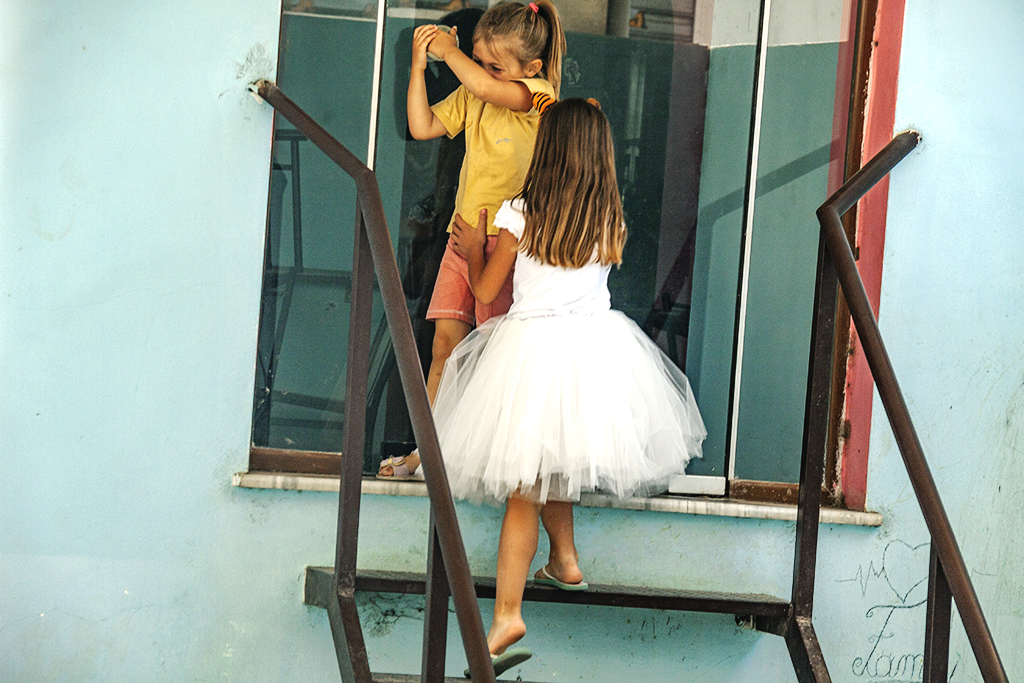
Two little girls playing on 6-28-21--Gramsh


.
.


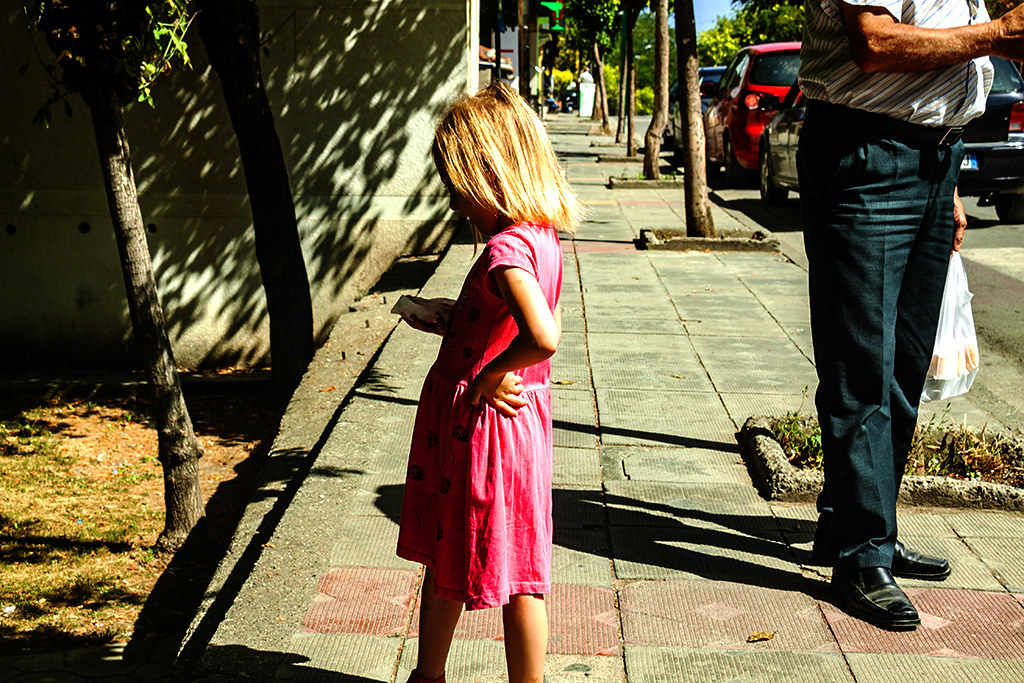
Girl and man on Hamit Dollani on 6-29-21--Gramsh


.
.


Donkey, man and goats on 6-28-21--Gramsh


.
.


The floor of my dreams van on 6-28-21--Gramsh


"My Dream Floor" in German. "the floor of my dreams" in Italian. Lots of used vehicles in Albania. When I first got here, I wrote that Tirana buses were new, but I should have written "newish." Once I started taking city buses, I noticed signs in German, French, Italian or Spanish, so many buses were bought used from all these countries. Albanian buses also seemed new because I had just spent months in Egypt and Lebanon, where there were many really ancient vehicles. (In Sidon, I ran into a passenger van that had been used in Vietnam!) In Albania, too, I would soon enough see very old buses and vans, especially outside Tirana.


.
.


Woman selling cherries on 6-29-21--Gramsh


.
.


Clothing store on 6-28-21--Gramsh


Most clothing stores in Albania sell used clothes, and in Gramsh, there are no stores selling new clothing.

Seconds after I took this photo, two girls walked up to me. One was about eight, the other maybe five. The 8-year-old very confidently said in clear English, "Where are you from?"

"Vietnam."

"Vietnam," she echoed me, looking very serious.

"Vietnam. It's close to China."

Satisfied, she said, "It's nice to meet you," and they both walked away.


.
.


Woman walking by store selling sandals and socks on 6-28-21--Gramsh


.
.


Lady bringing me my souvlaki on 6-28-21--Gramsh


.

Thursday, July 1, 2021

.


Old man walking by barber shop on July 10th Street on 6-29-21--Gramsh


.
.


Two woman with parasols on July 10th Street on 6-29-21--Gramsh


.
.


Two old farts at Caffe Ardiani on 6-28-21--Gramsh


At Ardiani Cafe, a macchiato coffee is 70 cents and a Korca Beer is $1.30. These two old farts are both thinking, "Did I do that? Why didn't I do that? It's not too late. Of course, it's too late," in an endless loop.


.
.


Old couple at Caffe Ardiani on 6-28-21--Gramsh


Ardiani Cafe. The 50-year-old owner spent three years in New Jersey, near Hoboken. His customers are mostly villagers coming to Gramsh to shop, visit the hospital or just look around.

"There's nothing to do in the villages," he said. The mini buses to the villages stop right outside his cafe.

As we talked, a girl of about 15 couldn't help but stare at me from outside the fence. She had on a boy's short sleeved dress shirt. With her was probably her grandma, in a black dress and white head scarf.

There are some foreigners in Gramsh, but no Orientals. I met a French guy who had been working at a nearby hydroelectric power plant. With his mullet and disco shirt, he didn't seem too French, but much of France doesn't look like what you see in the movies anyway.

Across the street from the cafe was a mosque, built just 25 years ago. "No one goes there," the owner said.

The morning I left Gramsh, I came by to say goodbye, but only his dad was there. We couldn't communicate. Luckily, one of the customers spoke Italian, so I said I just wanted to say ciao to the owner's son.

Leaving Gramsh is no simple matter. Most mini buses stop on the main street, but there is no schedule posted and no information booth. Again, my bit of Italian saved my ass. An old guy told me where to stand, then later, a fellow passenger instructed the driver to make sure I get to Korce.


.
.


Men watching Croatia vs Spain at Medusa Cafe on 6-28-21--Gramsh


Watching Croatia vs. Spain at the Medusa Cafe on 6/28/21. They were all cheering for Croatia. Spain won 5-3.


.