As published at OpEd News, Smirking Chimp, Unz Review, TruthSeeker, Intrepid Report and LewRockwell, 11/12/18:
Two years ago, I was having dinner in NYC with a group of Japanese writers. Next to me was Mieko Kawakami, who’s also known as a pop singer. Since her English was very limited, we conversed mostly through another person. Seeing that my beer glass was empty, Mieko filled it.
Earlier this year, I found myself in Tokyo with nearly the same group of Japanese, and next to me, again, was Mieko. Seeing that my bowl was empty, she used her chopsticks to replenish it with some fatty pork.
In Saigon a month ago, I was having dinner with a bunch of Taiwanese businessmen, whom I had just met. Next to me was a 36-year-old who had been in Vietnam for six years, was married to a Vietnamese and had two kids with her, so he spoke Vietnamese quite comfortably, even rapidly, though I must I admit, I only understood about half of it, such was his accent. Seeing that my bowl had some food scraps, he picked it up, cleaned it out with his chopsticks, then filled it with a couple of shrimps.
To be attentive to others at the dinner table is a trait inculcated in East Asians since childhood. It shows civilization, not obsequiousness. At an Oriental banquet, tables tend to be round, an egalitarian arrangement with no honored seats, and all the dishes are in the middle. Although you’re only supposed to pick, say, a piece of chicken that’s close to you, and not reach across a plate, you can choose a better morsel for anyone else, especially an older person, a guest or a social superior, such as your boss. To express concern, they can also drop food in your rice bowl.
Decades ago, I was at a Chinese restaurant in Northern Virginia with a close friend, Brian Robertson, and when our two dishes arrive, Brian instantly divided each in half, right down the middle, and scooped his shares onto his plate. Had I used my utensils to pick out food for Brian, he would have cringed and protested, I’m sure.
East is East, and West is West, and though the two do overlap, you will always know whether you’re in Intercourse or Phuoc Hai, and that’s good. Though relentlessly assaulted, the local endures, but it must be fiercely protected and nurtured.
Repeatedly, I have pointed out how boundaries are often blurred in Vietnam, but this also means that personal space is not as respected as in the West. In 1957, Gontran de Poncins published his excellent From a Chinese City, which documents his year of living in a residential hotel in Cho Lon, Saigon’s Chinatown. Other occupants were disturbed by De Poncins’ habit of keeping his door closed during the day, so they would just open it. Seeing that De Poncins was always alone, they asked if he needed a woman, and when he said no, they offered to bring him a boy. As De Poncins sketched, someone might snatch his notebook from him, to see what he was drawing.
Saigon in 2018 is much more Americanized, so there are gated communities, condos with security guards, restaurants behind plate glass windows, ubiquitous English schools and aggressive rap music being spat at you by street performers on Bui Vien Street. At a wedding, I noticed all the young people at my table were staring at their smart phones for nearly the entire evening. American styled swagger or aggression is also being aped, so on a truck in my neighborhood, I saw, in English, “CHOOSE LIFE / DON’T TOUCH MY CAR,” with the image of two hand guns being pointed at the viewer. In several Vietnamese cities, and even Singapore, there are Liêm barbershops, where all the hair cutters are all tatted up and dressed as cholos. Speaking to packed rooms of young Vietnamese, Liêm passionately teaches them on how to properly wear a bandana, flannel shirt or Ben Davis pants, etc.
Since I live five miles from downtown, however, the texture of my daily life is still very much Vietnamese, even if there’s a McDonald’s, Popeyes and KFC within a ten minute walk. Riding a beat up bicycle, a knife sharpener offered his service. Passing a funeral, I saw the pallbearers tilting the coffin three times, to make it bow to its old house, then three more times at the head of the alley, to say farewell to its neighborhood.
This morning, I had a 47 cent cup of coffee at a café in an alley. People streamed by, on foot or motorbikes. Within sight was the neighborhood Buddhist temple. Although hideous looking, it does have a shady and somewhat quiet courtyard, so sometimes I’d go and sit on one of its cement benches, near a bunch of wizened monks.
Vietnamese know their neighbors. The café’s owner is a taciturn middle-aged dude who keeps half a dozen lurid fish in a couple of tanks. His grown son is a heroin addict who’s been in and out of jail. The smirking young man has never had a job, only lots of tattoos.
On my right sat office workers in white shirts and black pants, and to my left was a man, called Mr. Mulberry, who had a stroke a decade ago, so now must inch around with a walker. Even before Mulberry got debilitated, his wife left him to marry a Vietnamese-Australian.
Mulberry has six brothers and two sisters. Two brothers are in Australia. The sisters were infamous in this neighborhood as “horses,” the Vietnamese term for “sluts,” because people could ride them.
Mulberry’s dad used to beat his mom, and complain that her skin wasn’t as smooth as his mistress’. Despite all this, they’re still together, and live with Mulberry and a daughter, a single mom, of course, in the house across the alley from my table.
Hearing anyone’s life story, I’m always filled with amazement and admiration, because I’m not sure I could have endured so many sucker punches from random strangers, God, my family and the weather.
At another neighborhood café a while back, I sat next to a man in his early 70’s who had raised ten kids. He has owned a company making truck trailers since before the Fall of Saigon.
“I made more than enough to take care of all my kids, then the state took over my company. They had to keep me on, however, because the company could not have functioned otherwise. I had all these supervisors and advisors who collected salaries, but did nothing. I survived all that. After Đổi Mới [Renovation], I got my company back.”
“Did you try to escape the country?” I asked.
“No, because I had ten kids! It would have been too complicated, and I didn’t want to send a couple of kids out by themselves. It would have been too risky.”
“So they’re all still here?”
“Yes, and they’re all doing well. One of my sons bought land and houses when they were still cheap, decades ago. He’s loaded. Another son works for the government as an electrical engineer. One of my daughters owns this café,” where we were sitting. “All the Socialist countries were dirt poor, while the Capitalist countries were rich. That’s why things had to change.”
After dinner with the Taiwanese businessmen, they dragged me to a karaoke session, so of course I had to go, and there, in a private room with pulsating blue, green and purple lights, each of us was assigned a hostess. Since I’m not gay, transitioning or rude, I graciously allowed myself to be fondled a bit by my “littlest sister,” which is Vietnamese slang for such a lady. I did milk Lan for her life story.
Though looking no more than 23, Lan was actually 35, and a divorcee raising a five-year-old son pretty much by herself, with her ex now a laborer in South Korea. Knowing her hostess career was quickly winding down, she had been saving, “I want to own a jewelry store, but I still don’t have enough cash, so I’m just going to open a little variety store.”
“Who takes care of your kid while you’re working?”
“My mom.”
“What’s his name?”
“Tuan.”
“Is Tuan a good kid?”
“Yeah,” she smiled.
“Smart?”
“Pretty smart.”
As I get older, my eyes often discharge this greenish pus. It’s disgusting, I know. With a moist towelette, Lan dabbed at the corners of my eyes. I didn’t purr, I swear.
“Some customers can be pretty gross, but we don’t have to serve any of them. If we walk out, though, we don’t get paid.”
It’s good to hear people’s stories, face to face. In Philadelphia, I knew almost none of my neighbors, so the only local community I had were the drinkers inside Friendly Lounge, yet even there, it was hard to talk, because the television was always on, even if no one was watching it, and the jukebox often interrupted.
Though not all Americans bowl, eat, drink and have sex alone, too many are divorced from their neighbors, neighborhood, the direct experience and even their own thought process, since it is regularly drowned out by canned garbage. Since the collapse of the American empire will be, among other things, a cultural and psychic deliverance for Americans themselves, all should wish for it.
One night in Philly, there was a blackout for maybe an hour, and inside McGlinchey’s, where I was sitting, the barmaid dug out some candles and lit them. Without electronic distractions, we became much more conscious of everyone else’s presence, clearly heard everything that was said, even if it was across the room, and was encouraged, or at least not prevented, from chattering at length. Finally, stories could flow. I remember being soothed, but also saddened, for why wasn’t this the norm?
A decade ago, I gave a reading at This Ain’t the Rosedale Library, a Toronto bookstore now out of business. It was fairly well attended, and afterwards, a bunch of us went to some Kensington Market bar to talk, but the canned music was so loud in there, conversations were impossible. We were reduced to shouting snippets at each other. I screamed to a woman next to me, “This is why poetry is dead!”
“What?!”
“Poetry is dead!”
“Yeah!”
“This is why!”
“Huh?”
“We can’t even fuckin’ talk!”
“I know!”
Lastly, an announcement: at 6PM on Sunday, November 18th, I’ll give a reading in Tokyo at Aoyama Book Center, 5-53-67 Jingumae, Shibuya-ku, Cosmos Aoyama Garden Floor (B2F). Mieko Kawakami was supposed to appear with me, but some nutcase has threatened, online, to come to this event to stab her, so the police has advised Mieko to not show up. It’s a great shame, but it’s also heartening to know that literature can still be that deadly serious somewhere.
.
Showing posts with label Toronto. Show all posts
Showing posts with label Toronto. Show all posts
Monday, November 12, 2018


Tuesday, June 6, 2017
The Great White North
As published at Unz Review, LewRockwell and Intrepid Report, 6/7/17:
Despairing Americans often threaten to move to Canada, but how many even know what it’s like now? Many liberals assume that our northern neighbor is more progressive, while those on the right might think that it’s, ah, whiter. Ask your average American to name ten Canadians, and it’s likely that nine will be white guys who can deftly handle a puck, with the tenth, the ultra-vanilla Justin Bieber.
According to Statistics Canada, 28% of Canada’s population will be foreign-born by 2031. In 2011, 4.53% of its residents were already Chinese, and on three visits to Toronto since, I’ve seen many more Han faces on the streets. Chinatown is pushing east into downtown, and west into Trinity Bellwoods, Little Portugal and Little Italy.
Outside Dragon City Mall in the heart of Toronto’s Chinatown, an old man played the erhu while another peddled rat traps from a cart. Within sight, Scotia Bank and National Bank had signs in Chinese.
With such an influx of immigrants and refugees, Toronto now touts itself as the most multicultural city on earth, even more so than London, New York or Paris. Its inhabitants, then, can sample not just a vast array of international dishes, but also hybrids such as sushi burritos at Rolltation or Dr. Pepper-flavored Jamaican pulled pork on a Belgian waffle, at Junked Food Co. In Kensington Market, there’s an eatery called Hungary Thai. Sticking to the basics, my friend Ian and I chowed on banh mi, then, for dessert, Colombian candied crickets, bought from a street kiosk.
Within the shadow of Notre Dame Cathedral in Montreal is New-Agey Boutique Lotus, and two doors down is Ming Tao Xuan, as astonishing a Chinese tea house as you’ll find outside Asia. With its many display cases filled with teapots, buddhas, sculpted animals, crystals, necklaces and bracelets, it’s also a museum. Tea choices range from the White Hair Silver Needle, Golden Beautiful Eyebrow, Black Tartary Buckwheat to Chun Jian Raw Pu’er, with everything served in clay tea pots on bamboo trays.
It’s been in business for decade. As Ian and I sipped from aromatic cups at a rosewood Ming table, the middle-aged proprietor stood by the counter and crooned along to a recorded ballad, chuckling every so often at its lyrics.
Outside the large picture window, a white, female beggar in a yellow windbreaker stood at the corner of Bressole and Saint Sulpice. Streaming by, foreign and domestic tourists mostly ignored her. Leaving Ming Tao Xuan, we could hear her singing “Que Sera, Sera.”
At Dunn’s Downtown Diner, we ate the confounding poutine to Bollywood music. As I struggled through my mess of French fries and curd cheese smothered in brown gravy, I lamented to Ian, “I can’t believe any French population could come up with this!”
Our waiter was a second-generation Portuguese-Canadian. “Yes, I can still speak Portuguese. Language is a big issue in Canada. Here in Quebec, sometimes you’ll hear two people talking in English and French, with each refusing to speak the other’s language!”
To babble a foreign tongue is to petition for admission into another family and heritage, a farcical failure in most cases, and that’s why most people don’t stray from their mama lingo. Even within a language, dialects and accents further divide. We are not one. Strolling through Kensington Market, I spotted the Hainan Association of Ontario. Even after half a century of internationalist indoctrination, Chinese are most trusting and loyal to people from their home region.
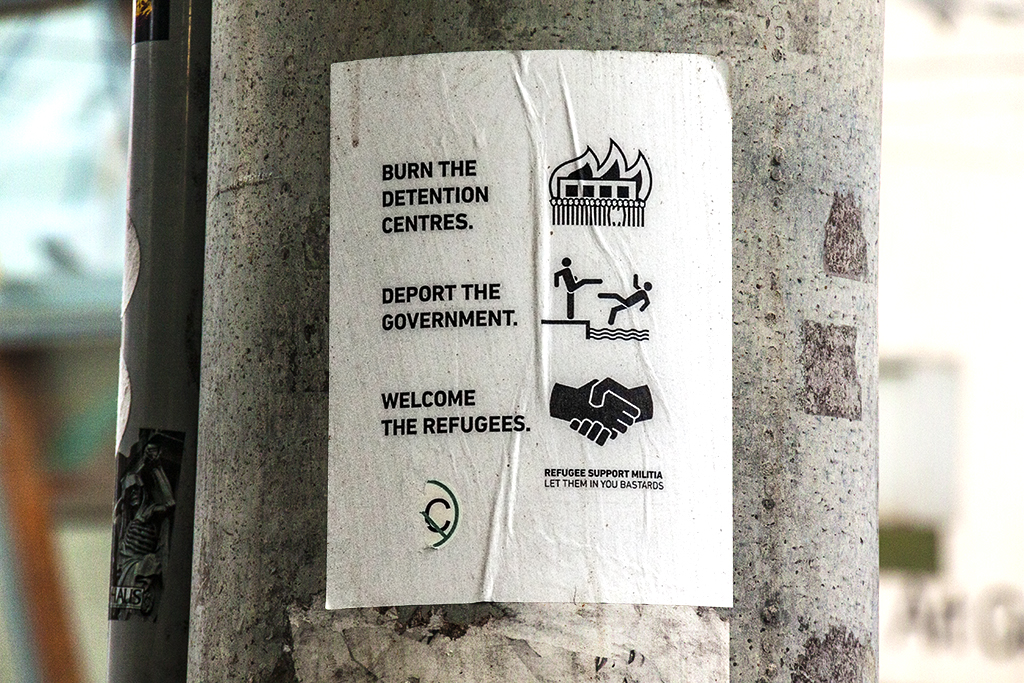
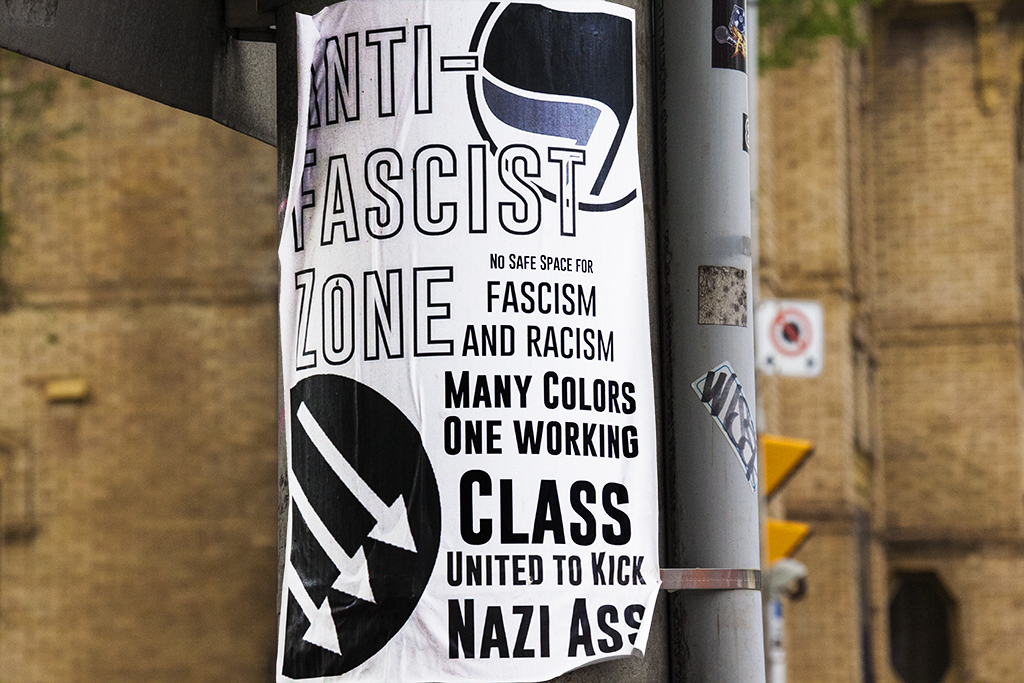
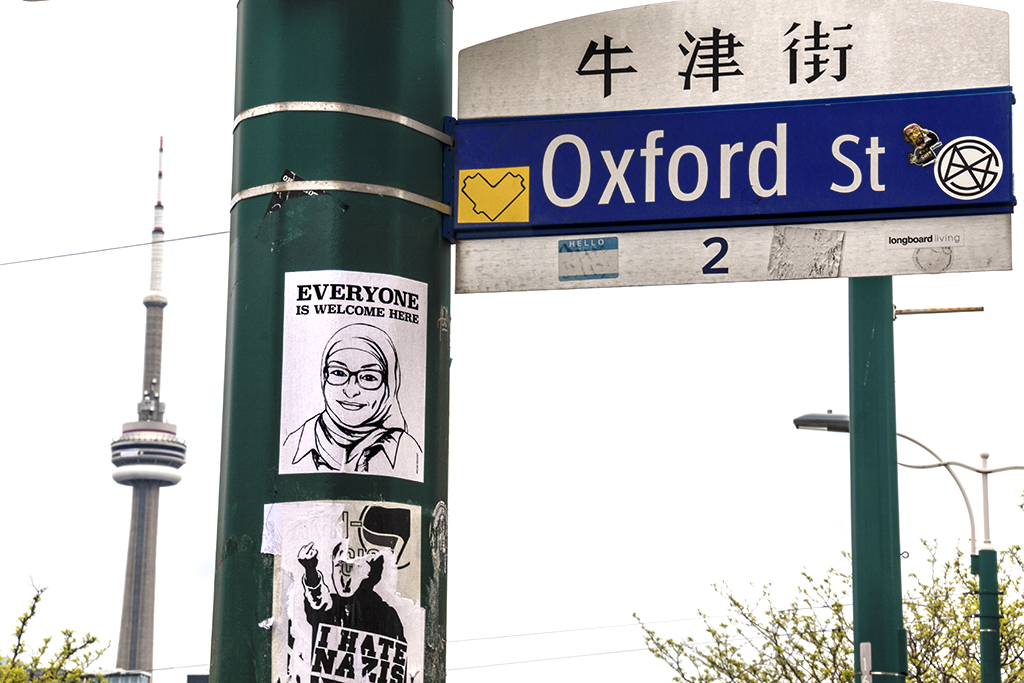
Nearer downtown, I caught a flyer that said, “BURN THE DETENTION CENTRES. DEPORT THE GOVERNMENT. WELCOME THE REFUGEES.” Similar flyers can be found in all majority-white countries, and notice how no protest is raised about not generating refugees in the first place.
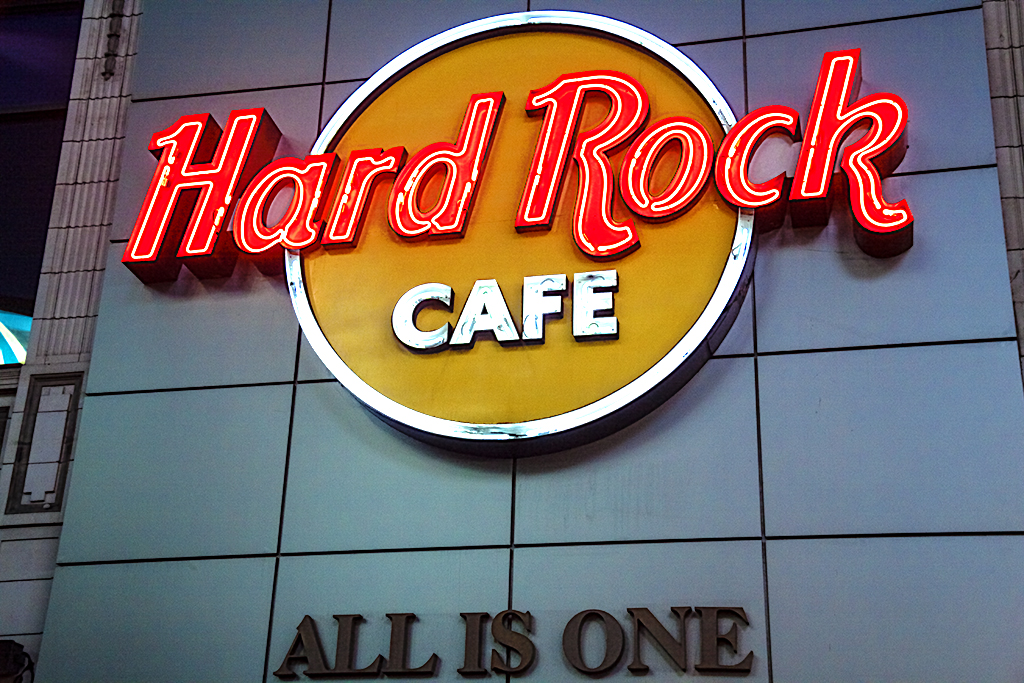
With no government, there are no borders to be defined, much less defended, but this is fine, see, since we’re all one, and this, mi amigo, is precisely the message being pushed relentlessly by the corporate, globalist elite to their progressive consumers. At Yonge-Dundas Square, the Hard Rock Cafe had this slogan on its facade, “ALL IS ONE.”
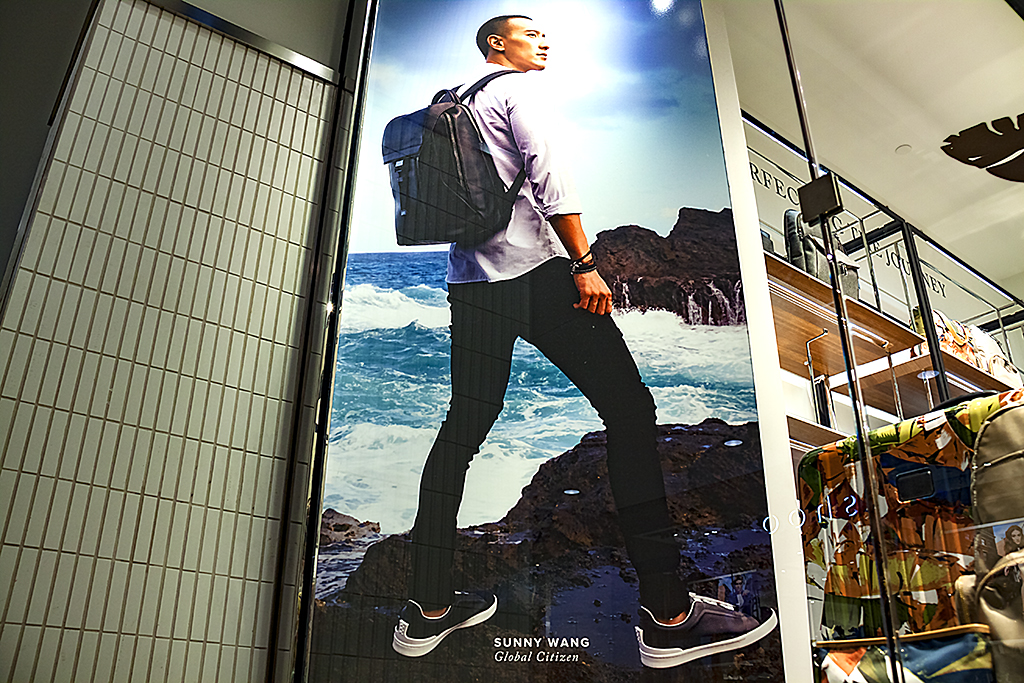
Inside the Eaton Center, an upscale luggage outfit displayed a large poster of “SUNNY WANG / Global Citizen.” On YouTube, there’s a video of Sunny flying on a chartered plane, swimming with sharks and even meditating on the ocean floor. Très cool. “As humans, we have a responsibility for this planet.” With a $350 backpack and $1,200 suitcase from Tumi, you too can be a responsible global citizen.
Sunny Wang reminds me of a Canadian editor at Dissident Voice, “DV Co-Editor Kim Petersen enjoys scuba diving, working out, and advancing the struggle for a world based on principles of peaceful and equitable sharing and respect for the environment and life … and Anton Berg marzipan. He studied at universities in occupied First Nations territory (‘British Columbia,’ ‘Canada’) and Norway.”
After giving articles to Dissident Voice for several years, I stopped when Petersen objected to my using “Indians” to describe the people of Wolf Point, Montana. Very politically correct, certain Canucks.
With its French language as relative barrier, Montreal attracts fewer immigrants than Toronto or Vancouver, but this city has also become much more mixed. Stumbling into Barfly in Le Plateau-Mont-Royal, Ian and I managed to chat with a few locals about a rapidly changing Canada.
On a warm, pleasant evening, we sat around a picnic table behind this charmingly grubby bar. John, in his early 50’s, said, “We live in a little bubble here, but honestly, no one I know, at all, is grumbling about immigrants.”
Maddy, 40-ish, elaborated, “It’s not an issue, because there’s so much space, and so much resource.”
John, “There was an actual issue for a brief spell, in the early 90’s. It had specifically to do with French schools, because the French schools had traditionally been Catholic and white, and what was happening in Montreal was schools winding up with, say, 40% immigrants. You had a lot of Spanish students who came in. That was reported on more than 20 years ago, but it’s over. Let me put it this way, ethnic gangs in schools are not a problem.”
Maddy, “There’s a very strong, kind of outdated Quebec national identity that has to do, very much, with having a European ancestry, speaking French and being Catholic. There’s a strong history of sovereignty, and it’s dying out now only because the time is changing. When you talk about national identity in North America, it doesn’t really make sense, as it did twenty years ago.
“In the 70’s, there was an ideological framework about immigrants called multiculturalism, by Trudeau the elder. Multiculturalism was supposed to set itself apart from the state’s melting pot concept, meaning you keep your culture when you come to Canada, and you keep and celebrate your differences. Yes, you try to learn the language and whatever, for economic reasons, but there’s no pressure, you know, to fit into a kind of common culture, so maybe that had an effect over the years, to change attitudes and tolerate differences. Maybe that’s why there are less racist crimes here.”
At this point, we were joined by Peter, a jazz pianist in his late 40’s. Peter related a racial incident, “I saw one guy who pulled his van in front of a car that had four women in it. They were wearing the hijab. He very slowly filled up his car with gasoline, so they couldn’t leave. When they politely honked their horn, he went up to a window and slammed his hand on their car, as if to say, “Fuck you, you don’t belong here, so I don’t even acknowledge you!” He was an older white man. I’ve also heard from black musician friends about the shit they have to endure. The driving while black exists here in Quebec as well.”
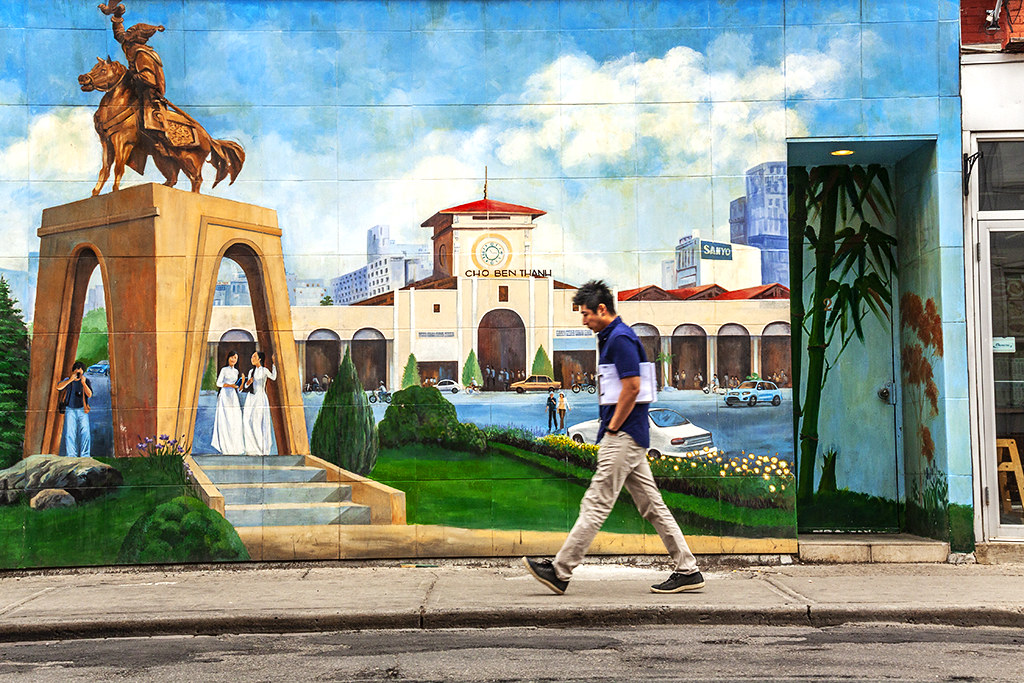
Having visited the US several times, Maddy and Peter think their country is in way better shape. Canadians are better informed, they told me, and with a social safety net, it’s very difficult to end up lying on concrete or asphalt. There’s nothing like Detroit, Camden, Baltimore or Gary in Canada. Welfare per month is 600 CAD, with no time limit, and healthcare is free. If you’re mentally ill, then it’s 900 bucks. Higher education is also much cheaper, even for foreigners. In Toronto’s Chinatown, I noticed a sign in Vietnamese and Chinese offering to enroll Vietnamese students in Canadian universities.
In 2016, John McCallum, Minister of Immigration, Refugees and Citizenship, declared that Canada wanted even more Chinese workers, students and tourists, “There’s a significant feeling that Canada does need more immigrants, partly because we have an aging population, and so we need more young blood to keep our economies going [...] If you ask me what is the best group of people in the world to become future Canadian citizens, I would say international students.” McCallum is now the ambassador to China.
In 2011, already 27.7% of Vancouver residents were Chinese. Since many of them are quite loaded, the city now has the highest real estate prices in the entire country, with a one-bedroom apartment averaging 1,400 USD. Perhaps to make amend for stealing land from its indigenous, Asiatic populations, Canada is purposely becoming more Asian. Half a million Chinese are granted visas, of all types, per year.
Since Maddy and Peter had no objection to increased immigration, I asked my new friends if they would mind, say, several million Americans fleeing north? Suddenly, they were stumped. The prospect is very real, I insisted. The greatest show boat on earth is taking on water, keeling and throwing out sparks. Au secours, Canada!
As I write this article, a Saudi Arabian newspaper requested an interview, and one of their questions asked about how living in different countries has informed my thinking. My answer, “Every society has evolved from an utterly unique set of beliefs and experiences. In the West, the idea that borders don’t really matter has infected many minds, especially those that are relatively untouched by experiences, books or travels, but this madness shall soon pass. Crossing many borders, I know that they are sacred. Much blood has been spilled over every inch.”
.
Despairing Americans often threaten to move to Canada, but how many even know what it’s like now? Many liberals assume that our northern neighbor is more progressive, while those on the right might think that it’s, ah, whiter. Ask your average American to name ten Canadians, and it’s likely that nine will be white guys who can deftly handle a puck, with the tenth, the ultra-vanilla Justin Bieber.
According to Statistics Canada, 28% of Canada’s population will be foreign-born by 2031. In 2011, 4.53% of its residents were already Chinese, and on three visits to Toronto since, I’ve seen many more Han faces on the streets. Chinatown is pushing east into downtown, and west into Trinity Bellwoods, Little Portugal and Little Italy.
Outside Dragon City Mall in the heart of Toronto’s Chinatown, an old man played the erhu while another peddled rat traps from a cart. Within sight, Scotia Bank and National Bank had signs in Chinese.
With such an influx of immigrants and refugees, Toronto now touts itself as the most multicultural city on earth, even more so than London, New York or Paris. Its inhabitants, then, can sample not just a vast array of international dishes, but also hybrids such as sushi burritos at Rolltation or Dr. Pepper-flavored Jamaican pulled pork on a Belgian waffle, at Junked Food Co. In Kensington Market, there’s an eatery called Hungary Thai. Sticking to the basics, my friend Ian and I chowed on banh mi, then, for dessert, Colombian candied crickets, bought from a street kiosk.
Within the shadow of Notre Dame Cathedral in Montreal is New-Agey Boutique Lotus, and two doors down is Ming Tao Xuan, as astonishing a Chinese tea house as you’ll find outside Asia. With its many display cases filled with teapots, buddhas, sculpted animals, crystals, necklaces and bracelets, it’s also a museum. Tea choices range from the White Hair Silver Needle, Golden Beautiful Eyebrow, Black Tartary Buckwheat to Chun Jian Raw Pu’er, with everything served in clay tea pots on bamboo trays.
It’s been in business for decade. As Ian and I sipped from aromatic cups at a rosewood Ming table, the middle-aged proprietor stood by the counter and crooned along to a recorded ballad, chuckling every so often at its lyrics.
Outside the large picture window, a white, female beggar in a yellow windbreaker stood at the corner of Bressole and Saint Sulpice. Streaming by, foreign and domestic tourists mostly ignored her. Leaving Ming Tao Xuan, we could hear her singing “Que Sera, Sera.”
At Dunn’s Downtown Diner, we ate the confounding poutine to Bollywood music. As I struggled through my mess of French fries and curd cheese smothered in brown gravy, I lamented to Ian, “I can’t believe any French population could come up with this!”
Our waiter was a second-generation Portuguese-Canadian. “Yes, I can still speak Portuguese. Language is a big issue in Canada. Here in Quebec, sometimes you’ll hear two people talking in English and French, with each refusing to speak the other’s language!”
To babble a foreign tongue is to petition for admission into another family and heritage, a farcical failure in most cases, and that’s why most people don’t stray from their mama lingo. Even within a language, dialects and accents further divide. We are not one. Strolling through Kensington Market, I spotted the Hainan Association of Ontario. Even after half a century of internationalist indoctrination, Chinese are most trusting and loyal to people from their home region.
Nearer downtown, I caught a flyer that said, “BURN THE DETENTION CENTRES. DEPORT THE GOVERNMENT. WELCOME THE REFUGEES.” Similar flyers can be found in all majority-white countries, and notice how no protest is raised about not generating refugees in the first place.
With no government, there are no borders to be defined, much less defended, but this is fine, see, since we’re all one, and this, mi amigo, is precisely the message being pushed relentlessly by the corporate, globalist elite to their progressive consumers. At Yonge-Dundas Square, the Hard Rock Cafe had this slogan on its facade, “ALL IS ONE.”
Inside the Eaton Center, an upscale luggage outfit displayed a large poster of “SUNNY WANG / Global Citizen.” On YouTube, there’s a video of Sunny flying on a chartered plane, swimming with sharks and even meditating on the ocean floor. Très cool. “As humans, we have a responsibility for this planet.” With a $350 backpack and $1,200 suitcase from Tumi, you too can be a responsible global citizen.
Sunny Wang reminds me of a Canadian editor at Dissident Voice, “DV Co-Editor Kim Petersen enjoys scuba diving, working out, and advancing the struggle for a world based on principles of peaceful and equitable sharing and respect for the environment and life … and Anton Berg marzipan. He studied at universities in occupied First Nations territory (‘British Columbia,’ ‘Canada’) and Norway.”
After giving articles to Dissident Voice for several years, I stopped when Petersen objected to my using “Indians” to describe the people of Wolf Point, Montana. Very politically correct, certain Canucks.
With its French language as relative barrier, Montreal attracts fewer immigrants than Toronto or Vancouver, but this city has also become much more mixed. Stumbling into Barfly in Le Plateau-Mont-Royal, Ian and I managed to chat with a few locals about a rapidly changing Canada.
On a warm, pleasant evening, we sat around a picnic table behind this charmingly grubby bar. John, in his early 50’s, said, “We live in a little bubble here, but honestly, no one I know, at all, is grumbling about immigrants.”
Maddy, 40-ish, elaborated, “It’s not an issue, because there’s so much space, and so much resource.”
John, “There was an actual issue for a brief spell, in the early 90’s. It had specifically to do with French schools, because the French schools had traditionally been Catholic and white, and what was happening in Montreal was schools winding up with, say, 40% immigrants. You had a lot of Spanish students who came in. That was reported on more than 20 years ago, but it’s over. Let me put it this way, ethnic gangs in schools are not a problem.”
Maddy, “There’s a very strong, kind of outdated Quebec national identity that has to do, very much, with having a European ancestry, speaking French and being Catholic. There’s a strong history of sovereignty, and it’s dying out now only because the time is changing. When you talk about national identity in North America, it doesn’t really make sense, as it did twenty years ago.
“In the 70’s, there was an ideological framework about immigrants called multiculturalism, by Trudeau the elder. Multiculturalism was supposed to set itself apart from the state’s melting pot concept, meaning you keep your culture when you come to Canada, and you keep and celebrate your differences. Yes, you try to learn the language and whatever, for economic reasons, but there’s no pressure, you know, to fit into a kind of common culture, so maybe that had an effect over the years, to change attitudes and tolerate differences. Maybe that’s why there are less racist crimes here.”
At this point, we were joined by Peter, a jazz pianist in his late 40’s. Peter related a racial incident, “I saw one guy who pulled his van in front of a car that had four women in it. They were wearing the hijab. He very slowly filled up his car with gasoline, so they couldn’t leave. When they politely honked their horn, he went up to a window and slammed his hand on their car, as if to say, “Fuck you, you don’t belong here, so I don’t even acknowledge you!” He was an older white man. I’ve also heard from black musician friends about the shit they have to endure. The driving while black exists here in Quebec as well.”
Having visited the US several times, Maddy and Peter think their country is in way better shape. Canadians are better informed, they told me, and with a social safety net, it’s very difficult to end up lying on concrete or asphalt. There’s nothing like Detroit, Camden, Baltimore or Gary in Canada. Welfare per month is 600 CAD, with no time limit, and healthcare is free. If you’re mentally ill, then it’s 900 bucks. Higher education is also much cheaper, even for foreigners. In Toronto’s Chinatown, I noticed a sign in Vietnamese and Chinese offering to enroll Vietnamese students in Canadian universities.
In 2016, John McCallum, Minister of Immigration, Refugees and Citizenship, declared that Canada wanted even more Chinese workers, students and tourists, “There’s a significant feeling that Canada does need more immigrants, partly because we have an aging population, and so we need more young blood to keep our economies going [...] If you ask me what is the best group of people in the world to become future Canadian citizens, I would say international students.” McCallum is now the ambassador to China.
In 2011, already 27.7% of Vancouver residents were Chinese. Since many of them are quite loaded, the city now has the highest real estate prices in the entire country, with a one-bedroom apartment averaging 1,400 USD. Perhaps to make amend for stealing land from its indigenous, Asiatic populations, Canada is purposely becoming more Asian. Half a million Chinese are granted visas, of all types, per year.
Since Maddy and Peter had no objection to increased immigration, I asked my new friends if they would mind, say, several million Americans fleeing north? Suddenly, they were stumped. The prospect is very real, I insisted. The greatest show boat on earth is taking on water, keeling and throwing out sparks. Au secours, Canada!
As I write this article, a Saudi Arabian newspaper requested an interview, and one of their questions asked about how living in different countries has informed my thinking. My answer, “Every society has evolved from an utterly unique set of beliefs and experiences. In the West, the idea that borders don’t really matter has infected many minds, especially those that are relatively untouched by experiences, books or travels, but this madness shall soon pass. Crossing many borders, I know that they are sacred. Much blood has been spilled over every inch.”
.
Sunday, June 4, 2017


Subscribe to:
Posts (Atom)