.
Donna (L.) all alone for 30 years at Lackawanna County Housing, Kennedy Boulevard, Taylor Borough, Pa.
To right is neighbor, Bea; she takes pity and persistently brings treats to Donna. Upon chatting, Donna smiled, said "take care of yourself during this awful virus."
.
If you have a PayPal account, please send your donation directly to linhdinh99@yahoo.com, to save me the fees. Thanks a lot!
Sample article at SubStack, "The Unliving."
Showing posts with label Taylor (PA). Show all posts
Sunday, May 3, 2020
Sunday, July 12, 2015
.
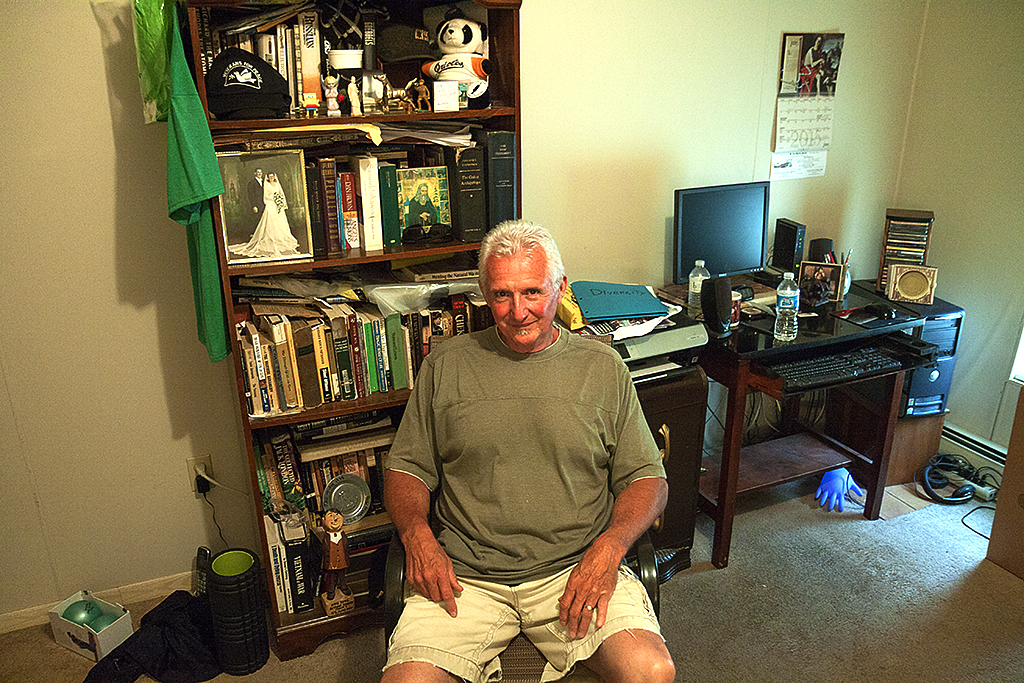
Chuck Orloski, chuckthezek@aol.com , at home in Taylor, PA.
In bookcase are Samuel Johnson, The Collected Jack London, Solzhenitsyn's The Gulag Archipelago, Joe Bageant's Deer Hunting with Jesus, Unamuno's Tragic Sense of Life, Dostoyevsky's The Possessed and Brothers Karamazov (Notes from Underground is on night table) and Czeslaw Milosz' New and Collected Poems, among others.
.
Chuck Orloski, chuckthezek@aol.com , at home in Taylor, PA.
In bookcase are Samuel Johnson, The Collected Jack London, Solzhenitsyn's The Gulag Archipelago, Joe Bageant's Deer Hunting with Jesus, Unamuno's Tragic Sense of Life, Dostoyevsky's The Possessed and Brothers Karamazov (Notes from Underground is on night table) and Czeslaw Milosz' New and Collected Poems, among others.
.
Saturday, July 11, 2015
Postcard from the End of America: Ashley, PA
As published at Smirking Chimp, OpEd News, Unz Review, CounterCurrents, Intrepid Report and Daily Dissident, 7/10/15:
It doesn’t get any better than this. Luxuriating in Dunkin’ Donuts, Chuck Orloski and I each have our own cup of coffee and, yes, our individual donut. Shrewd, I have ordered one without a hole since you get more donut for your bucks that way. Biting into a jelly filled, deep fried piece of dough, I too am fulfilled. Momentarily forgetting about his utility bills and the onrushing due date for next month’s rent, Chuck smiles goofily as he gazes into the half-filled parking lot. Across the street is a cemetery. Life is good.
Chuck’s younger son, 19-year-old Joe, has a new job at the Home Depot warehouse. Joe unloads merchandises, builds crates. Each working moment is pure exertion and the day is as long as several full-length marathons. Joe can deal with it. Soon, he will buy his first car, and it won’t be any used piece of crap either. Vrooming on sporty wheels, Joe will add a few inches to his six foot frame and feel all of his muscles, including those behind his eyeballs, harden.
I am staying at the Orloskis for three nights. This morning, Carol, Chuck’s wife, is making scrambled eggs with American cheese and canned potatoes. Chuck’s older son, Dan, likes to squirt ketchup on it. We also have English muffins. After my third cup of joe, I bark, “Isn’t it weird, Chuck, that this guy picked the oldest black church in the South to kill a bunch of people? I mean, it’s not just any old black chuch, it has to be the oldest motherfuckin’ black church in the South!”
“Yes, it is weird.”
From the kitchen window, I can see four Taylor Borough cops standing across the street. Their preys are hapless truck drivers who are steered onto this road by a bright sign, only to discover, via a smaller sign, that there’s a weight limit. Since it’s too late to turn around, those who are snared by this devious scheme must pay a $750 penalty, more than a week’s wage.
Carol cooks but doesn’t eat. I’ve never seen Carol eaten anything. She is 61 and gravely ill. Several times, Chuck has found her unconscious on the floor. The day before Carol’s birthday, she cheerfully said to me over the phone, “If I get up tomorrow, I’ll be 61!”
As a bus driver, Chuck meets many interesting people: violent kids who unleash their anger and sadism on those who can’t fight back, foreign students working for no pay at a Pocono resort just to glancingly experience America, bible thumpers who are bracing for the Great Whore of Revelation… If the pay wasn’t piss poor, Chuck would enjoy bus driving. At his previous job, Chuck had to clean up horrible messes of all kinds. When a man weighing well over 300 pounds died on a nursing home toilet, it was Chuck’s task to remove what the coroner couldn’t cart away. Undiscovered for three days, he had started to liquify. We don’t just turn into dirt, bones and a heaven or hellward notion after death, we also transfigured into unpotable water. Holding a bag of fecal matters and fleshy slush, Chuck was startled in the hallway by a cancer patient with no skin on his face. The zombie-like man wasn’t supposed to be there.
According to the Revival Baptist Church, the triumph and celebration of gay marriage is another sure sign the end is near, and Hillary Clinton might just be the Great Whore. Elizabeth Warren has no chance. (After probing and sniffing chicken entrails, however, I can cockily predict that Chris Christie will win the Presidency, do a Caitlyn Jenner and become the Mother of all Whores.) Driving for this fundamentalist church, Chuck met Jesus-fixated Jose, and he thinks I should too. We drive twenty minutes to Duryea, PA.
Jose has a spacious, detached home on a rural looking street. Custom built for only $135,000, it even has a nice basement. Along the Lackawana River just north of Wilkes-Barre, there is a string of little towns that have seen much better days. With the exception of Pittston’s, their tiny downtowns are quite dead. Then, coal miners and silk makers brought home the ham hocks to be transmogrified into golonka, studinetz or stinco di maiale arrosto. Now, folks twirl pizza dough, sling beer or sell each other made-in-China stuff in strip or mega malls. In 1910, Duryea had 7,487 inhabitants. Now, not even 5,000.
In Jose’s vestibule, there’s a large clock and a rustic, wooden sign, “This House BELIEVES.” Chuck and I follow our host into the kitchen. On the central counter, there’s a blender, and on a wall by the sliding doors leading to a beautiful deck, there’s a small radio tuned to a Christian sermon. “I like this preacher,” Jose quietly says.
In a crew cut, Jose is a smallish yet very solidly built man, an alert welterweight with good punching power. His voice and demeanor are gentle yet insistent, for he has one message to deliver at all times. On his left hand, there’s a tiny, inky “X” at the apex of the web between thumb and index finger. Perhaps more tattoos have been removed?
Working as a hospital security guard, Jose injured his spine while trying to hold down a psychiatric patient, so he’s in constant pain. Hoping to feel better, Jose makes his own juice mix and drinks many glasses a day. “At first, I didn’t think anything of it. Honestly, I had had bruised ribs and broken, you know, multiple surgeries. There were fights, lots of fights in there. It was a really physical job. I’m in a lot of pain, but I just have to deal with it. It’s a part of life. God has a purpose for everything.”
Jose on moving to Duryea, “I love it, man, it’s peaceful, and it’s affordable, you know. I could never afford a house like this in New York City. I’d always wanted to get my wife a house, and now I’ve done it.”
Astronomical rents in NYC have pushed many Hispanics into Eastern Pennsylvania, so there are many Puerto Ricans and Dominicans in places like Allentown and Bethlehem. A century ago, Mexicans were recruited from Texas to work in Pennsylvania steel mills. “Yo me voy pa’ Pensilvania / Por no andar en la vagancia,” goes a corrido. “Yo, I’m going to the Keystone State / To be a freakin’ bum no more.” Most of the Mexicans you see in the region are recent arrivals, however. They join other Hispanics in South Scranton and South Wilkes-Barre, etc. In 2006, Hazelton enacted laws that penalized landlords for renting to illegal immigrants, and business owners for hiring them, but a year later, a federal court struck these laws down.
On July 14th, 2008, a 25-year-old illegal immigrant from Mexico, Luis Ramirez, was killed by four white teens in Shenandoah. Acquitted of murder in Schuykill County, two of the defendants were convicted of hate crimes in federal court, with each sentenced to nine years. They could have received life. Derrick Donchak had been the starting quarterback of the town’s high school football team. Three local cops were also charged with obstruction of justice, but only two were convicted of lesser crimes. Living in the area for six years, Ramirez left behind his fiance, Crystal Dillman, and their two young children.
Fifty-six-years-old, Jose was born in Brooklyn. When he was seven, his mom deserted the family, and a few months later, his father tried to commit suicide by drinking, in front of him, Coke mixed with rat poison. Growing up in 18 foster homes, Jose got started on alcohol at nine-years-old, then drugs at eleven. He got to know several jails. At 18, Jose married a woman he had known since he was eight and she was nine. They’re still together. In his early 30’s, Jose became a born again Christian. After his daughter married a man in Duryea, Jose followed her and now lives within sight of her house. With his church the center of his life, Jose knocks on doors and visits homes. As an adult, Jose found and visited his mom in Florida. He doesn’t hate her.
Jose’s account of his harrowing life is fascinating, but his theology is not much more than, “You must accept Jesus as your personal savior,” and to do this, it’s best that you join his church and contribute money, for God will reimburse you manifold. After making a large pledge, Jose unexpectedly received a huge check in the mail for his back pay. “God works in mysterious ways!”
Being an Orthodox Catholic, Chuck is certainly damned, and I’m even more so, since I have attended masses only thrice in 35 years. Once, it was for my father’s funeral, and the other two times, I was with family and couldn’t wiggle my way out. Though Jose has offered to make us cheeseburgers and hotdogs, it is time to leave. Before we drive off, Jose suggests that we pray, so here we all are, all of us, all clumped together, all standing, you too, on this appallingly murderous and goofy planet. Amen.
The most Catholic region in all of Vietnam is Bui Chu, my father’s home, and you’d be surprised at the number of beautiful churches that were built there roughly a century ago. At my father’s funeral in San Jose, California, the priest was his cousin, and the passage read was from Ecclesiastes, “To every thing there is a season, and a time to every purpose under the heaven: A time to be born, and a time to die; a time to plant, and a time to pluck up that which is planted.” I’d have preferred, “The heart of the wise is in the house of mourning; but the heart of fools is in the house of mirth.”
I go where Chuck takes me, and our next visit is with Father Vincent Dang, a Vietnamese priest in Ashley, a town of 2,751 people just South of Wilkes-Barre. I am tired. I’ve heard so many stories of misery in the last two days, two weeks, two decades, all my life, but so have most of you. I’m not complaining or bragging. I’m just exhausted, man. Whenever I reach my mental or psychological limits, my body heats up, especially my head and stomach, and I can feel it coming on right about now.
I don’t know anything about this priest, and neither does Chuck. Chuck left a phone message, Father Dang called back, so here we are in Ashley, an obviously poor but somewhat lively town, with folks walking on sidewalks. The clapboard houses are mostly modest but well-kept, with their tiny porches and yards neat. Though a few businesses appear long dead, I haven’t spotted any graffiti or litter. The largest store here is Family Dollar. Ashley’s population peaked in 1930 at 7,093. Now, it’s roughly 2,750. Ashley’s most famous native son is Russell Johnson, best known as “the professor” in Gilligan’s Island. He also acted in the TV series The Twilight Zone and Outer Limits, and the movies It Came from Outer Space, This Island Earth, Attack of the Crab Monsters and The Space Children. There it is! The spire of St. Leo’s Holy Rosary Church. We hone in.
We walk towards the back, ring the doorbell and a man of about 45 opens the door. (He’s actually 53.) Grinning, I say in Vietnamese, “I’m sorry to bug you, Father, but my crazy friend, Chuck, insisted that we come to see you. I hope we’re not bugging you?”
“No, no, come in.”
In Vietnamese, you can’t just use neutral “I” and “you,” but pronouns expressing familial relationships. Since I address the priest as “father,” I have to call myself “son,” but him, being polite, actually calls me “older brother.” So I’m both his older brother and son, while he’s my younger brother and father. It’s like that scene in Chinatown where Jack Nicholson slaps Faye Dunaway like 600 times while she sobs, “She’s my sister! She’s my daugher! She’s my sister and my daughter!” Vietnamese is like that.
The priest gives Chuck and me small bottles of water, instead of Yuengling, unfortunately, then he and I make small talk in Vietnamese. We’re sitting in a high ceilinged and uncluttered receiving room. Suddenly, Chuck blurts, “Father, I need to make a confession. I haven’t gone to confession in two years. If you don’t mind, Father, I’d like to make a confession to you a little later.”
“Yes, we can do that.”
“Why don’t you do it right now, Chuck?” I jump in. “Don’t wait.”
“If Father Dang doesn’t mind?” Chuck eyes the priest.
“No, we can go into my office right there.”
Alone, I wander into the next room where there’s a statue of the Virgin Mary. Standing there staring at her, my head and stomach heat up and my eyes fill. Go ahead and laugh at me, but every so often I simply crack from the overwhelming sadness of it all, from how much has been taken away from all of us, from how we have been alienated from everything, our earth, our towns, ourselves.
Coming out, Chuck looks a bit shaken himself. My face obviously damp, I wrap my arms around my older brother, my father, my son, my long lost twin, “Get back in there, man! You have so many more sins!”
“I can’t remember the Act of Contrition, Linh. I’m sorry, Father Dang. I’ll say it later.”
Chuck goes to sit outside, and I soon take my leave of the priest, for an obviously distressed woman has just walked in. Stooped, she waits in his office for guidance and comfort.
Born in 1962, Father Dang escaped from Vietnam by boat in 1986 and, after a year in a Malaysian refugee camp, arrived in Scranton at age 25. Ordained in 1995, he was the parish priest for five years at Sugar Notch, two miles from Ashley. In 2000, both towns were 99% non-Hispanic white. Now, it’s 97% for Sugar Notch and 94% for Ashley. The decision to transfer Father Dang caused an uproar. The Citizens Voice of July 14th, 2009 has a story, “Sugar Notch parishioners plead to keep ‘Father Vinny.’” “Some can’t eat. Some can’t sleep. Many have cried. One woman is praying the rosary over and over until her prayer, and the plea of the parishioners, is answered—let Father Vinny stay.” They wrote to the Diocese, “Under Father Dang’s leadership, we have become a cohesive, vibrant, accepting, self-sacrificing community.”
Though no longer Catholic, my mind has been shaped by Catholic concepts and habits. From the confession, I’ve learnt to examine myself quite ruthlessly, though not nearly as neurotically as before. I know that evil is in every man, and can flare out at just about any moment. From Swedenborg, I’ve also learnt that there are as many heavens and hells as individuals, and they are often misidentified, with hell confused for heaven. Heaven or hell, then, is more often a state of mind than a geography, and that’s why one can leap, quite instantly, from heaven into hell, though never the other way around. To climb out of hell is certainly a bitch, grasshopper.
Leaving Father Dang, Chuck remembers there’s a Lebanese bakery nearby, and so we spend a few minutes looking for it. Chuck wants to buy a special loaf of bread. Seeing a black man in a Yankees cap, Chuck leans out and asks for directions, then adds, “I’m an Orioles fan!”
“I feel sorry for you!” The guy laughs.
“They never win anything!” I pile on. Well, it’s been a while. It turns out the store is closed, so we move on. After a few blocks, I say, “Chuck, man, you’re broke. You shouldn’t have wanted to buy it in the first place. Carol would give you shit!”
“Yeah, you’re right.”
“When I’m broke, man, I hang on to every buck. I don’t waste anything.”
“Yeah, I know. I was the only child. I’m spoiled.”
“Remember yesterday when you showed me how Navajo Indians drink aftershave by pouring it on a piece of bread over a cup?”
“Yeah.”
“That’s a waste of a piece of bread! You might need it later!”
“You’re right.”
“At my house, I don’t throw anything away, man. I save the stupid packets of MSG from the instant noodles. I save ketchup packets from McDonald’s. With a little bit of water, you have a bowl of soup! I don’t throw shit away.”
“You know, I’ve never been careful with money, Linh. I was an only child. When I was a kid, I stole money from my parents to take girls out. I feel terrible now.”
“Well, don’t worry about that now. Worry about next month. You’re broke!”
To save money, Chuck would often ride a Suzuki motorbike instead of his KIA truck. Sometimes, he only has two bucks to put into any gas tank. For the last six years, Chuck has had to resort to his parish church’s pantry and, more recently, St. Francis Soup Kitchen, where he also volunteers. At St. Vincent de Paul in downtown Wilkes-Barre, around 300 people eat a free lunch each day, and most of them are not homeless. For many Americans, going to a soup kitchen is already a daily routine, but imagine how overwhelmed these places will be when this ponzi farce that’s held together by joky accounting and dopey lies really falls apart. A recent headline, “US Economy Nearing Full Employment.”
I go where Chuck takes me, and right now, it’s up some mountain in a fog, “Shit, Linh, I have no idea where we are.”
“You don’t recognize anything?”
“No, I don’t even know which direction we’re heading.”
With my head and stomach like blast furnaces, I might just internally combust in Chuck’s car, but it won’t be a big deal, really, since he’s well used to cleaning up bodily remains. The road twists and the fog thickens.
“We’re fucked, Chuck.”
“We are fucked.”
After several random turns, we finally descend into sunlight. We need to get home to take Dan, Chuck’s older son, out. Twenty-two-years-old, Dan has just graduated from college with $40,000 in debt and no serious job prospect. Majoring in psycholody, he’s a cashier at CVS, the drug store. Dan is also down because his girlfriend dumped him, then quickly got married. Quiet and reflective, Dan is an admirer of the Tao Te Ching and Orwell’s Animal Farm. I’ve gotten him to read Notes from Underground, Orwell’s “How The Poor Die” and Hemingway’s trailblazing yet often ignored gem, “The Sea Change.” It’s about a woman who ditches her boyfriend to be with another woman.
On my last visit, Dan said to me quite matter-of-factly, “You know what girls are into now? Black guys and Hispanic guys.”
Dan and I are sitting in Julia’s. Chuck has gone outside. No boozer, Dan rarely goes to a bar, so Chuck is very happy to see his son socializing. A bright, airy place, Julia’s is a local institution, with a hotel above and restaurant out back. It’s the first in Taylor to serve Mexican food, and that was several decades ago.
This day began with news of the South Carolina church shooting, then we visited Jose and Father Dang. “It’s a Jesus day,” I told Chuck. Chuck graduated from the University of Scranton, a Jesuit school, and he even thought of becoming a priest. Contemplating fluttering skirts, Chuck wisely decided against the chasuble, however. I don’t blame him.
Returning, Chuck announces with a glint in his eyes, “I just won the lottery.”
With a flat voice, Dan asks, “How much, Dad?”
“$660.”
Turning to me, Dan states, “We would have been in deep trouble for this month.”
Nearly each day, Chuck buys a $1 lottery ticket. Sometimes, he buys more. The most he will spend each month is $60, and the number he picks is nearly always 614, after his mother’s birthday of June 14th, or Flag Day.
Across this sinking nation, how many are buoyed by lottery dreams, casino hopes, stock fantasies, increasingly desperate prayers or, as Chuck is convinced in this one instance, miraculous grace? With legal means diminished and magical odds unlikely, many are turning to shadier or bloodier tactics. This month taken care of, there is still the next.
Attacked by Goldman Sachs monsters, spaced out children on earth island have reached outer limits of twilight zone.
.
It doesn’t get any better than this. Luxuriating in Dunkin’ Donuts, Chuck Orloski and I each have our own cup of coffee and, yes, our individual donut. Shrewd, I have ordered one without a hole since you get more donut for your bucks that way. Biting into a jelly filled, deep fried piece of dough, I too am fulfilled. Momentarily forgetting about his utility bills and the onrushing due date for next month’s rent, Chuck smiles goofily as he gazes into the half-filled parking lot. Across the street is a cemetery. Life is good.
Chuck’s younger son, 19-year-old Joe, has a new job at the Home Depot warehouse. Joe unloads merchandises, builds crates. Each working moment is pure exertion and the day is as long as several full-length marathons. Joe can deal with it. Soon, he will buy his first car, and it won’t be any used piece of crap either. Vrooming on sporty wheels, Joe will add a few inches to his six foot frame and feel all of his muscles, including those behind his eyeballs, harden.
I am staying at the Orloskis for three nights. This morning, Carol, Chuck’s wife, is making scrambled eggs with American cheese and canned potatoes. Chuck’s older son, Dan, likes to squirt ketchup on it. We also have English muffins. After my third cup of joe, I bark, “Isn’t it weird, Chuck, that this guy picked the oldest black church in the South to kill a bunch of people? I mean, it’s not just any old black chuch, it has to be the oldest motherfuckin’ black church in the South!”
“Yes, it is weird.”
From the kitchen window, I can see four Taylor Borough cops standing across the street. Their preys are hapless truck drivers who are steered onto this road by a bright sign, only to discover, via a smaller sign, that there’s a weight limit. Since it’s too late to turn around, those who are snared by this devious scheme must pay a $750 penalty, more than a week’s wage.
Carol cooks but doesn’t eat. I’ve never seen Carol eaten anything. She is 61 and gravely ill. Several times, Chuck has found her unconscious on the floor. The day before Carol’s birthday, she cheerfully said to me over the phone, “If I get up tomorrow, I’ll be 61!”
As a bus driver, Chuck meets many interesting people: violent kids who unleash their anger and sadism on those who can’t fight back, foreign students working for no pay at a Pocono resort just to glancingly experience America, bible thumpers who are bracing for the Great Whore of Revelation… If the pay wasn’t piss poor, Chuck would enjoy bus driving. At his previous job, Chuck had to clean up horrible messes of all kinds. When a man weighing well over 300 pounds died on a nursing home toilet, it was Chuck’s task to remove what the coroner couldn’t cart away. Undiscovered for three days, he had started to liquify. We don’t just turn into dirt, bones and a heaven or hellward notion after death, we also transfigured into unpotable water. Holding a bag of fecal matters and fleshy slush, Chuck was startled in the hallway by a cancer patient with no skin on his face. The zombie-like man wasn’t supposed to be there.
According to the Revival Baptist Church, the triumph and celebration of gay marriage is another sure sign the end is near, and Hillary Clinton might just be the Great Whore. Elizabeth Warren has no chance. (After probing and sniffing chicken entrails, however, I can cockily predict that Chris Christie will win the Presidency, do a Caitlyn Jenner and become the Mother of all Whores.) Driving for this fundamentalist church, Chuck met Jesus-fixated Jose, and he thinks I should too. We drive twenty minutes to Duryea, PA.
Jose has a spacious, detached home on a rural looking street. Custom built for only $135,000, it even has a nice basement. Along the Lackawana River just north of Wilkes-Barre, there is a string of little towns that have seen much better days. With the exception of Pittston’s, their tiny downtowns are quite dead. Then, coal miners and silk makers brought home the ham hocks to be transmogrified into golonka, studinetz or stinco di maiale arrosto. Now, folks twirl pizza dough, sling beer or sell each other made-in-China stuff in strip or mega malls. In 1910, Duryea had 7,487 inhabitants. Now, not even 5,000.
In Jose’s vestibule, there’s a large clock and a rustic, wooden sign, “This House BELIEVES.” Chuck and I follow our host into the kitchen. On the central counter, there’s a blender, and on a wall by the sliding doors leading to a beautiful deck, there’s a small radio tuned to a Christian sermon. “I like this preacher,” Jose quietly says.
In a crew cut, Jose is a smallish yet very solidly built man, an alert welterweight with good punching power. His voice and demeanor are gentle yet insistent, for he has one message to deliver at all times. On his left hand, there’s a tiny, inky “X” at the apex of the web between thumb and index finger. Perhaps more tattoos have been removed?
Working as a hospital security guard, Jose injured his spine while trying to hold down a psychiatric patient, so he’s in constant pain. Hoping to feel better, Jose makes his own juice mix and drinks many glasses a day. “At first, I didn’t think anything of it. Honestly, I had had bruised ribs and broken, you know, multiple surgeries. There were fights, lots of fights in there. It was a really physical job. I’m in a lot of pain, but I just have to deal with it. It’s a part of life. God has a purpose for everything.”
Jose on moving to Duryea, “I love it, man, it’s peaceful, and it’s affordable, you know. I could never afford a house like this in New York City. I’d always wanted to get my wife a house, and now I’ve done it.”
Astronomical rents in NYC have pushed many Hispanics into Eastern Pennsylvania, so there are many Puerto Ricans and Dominicans in places like Allentown and Bethlehem. A century ago, Mexicans were recruited from Texas to work in Pennsylvania steel mills. “Yo me voy pa’ Pensilvania / Por no andar en la vagancia,” goes a corrido. “Yo, I’m going to the Keystone State / To be a freakin’ bum no more.” Most of the Mexicans you see in the region are recent arrivals, however. They join other Hispanics in South Scranton and South Wilkes-Barre, etc. In 2006, Hazelton enacted laws that penalized landlords for renting to illegal immigrants, and business owners for hiring them, but a year later, a federal court struck these laws down.
On July 14th, 2008, a 25-year-old illegal immigrant from Mexico, Luis Ramirez, was killed by four white teens in Shenandoah. Acquitted of murder in Schuykill County, two of the defendants were convicted of hate crimes in federal court, with each sentenced to nine years. They could have received life. Derrick Donchak had been the starting quarterback of the town’s high school football team. Three local cops were also charged with obstruction of justice, but only two were convicted of lesser crimes. Living in the area for six years, Ramirez left behind his fiance, Crystal Dillman, and their two young children.
Fifty-six-years-old, Jose was born in Brooklyn. When he was seven, his mom deserted the family, and a few months later, his father tried to commit suicide by drinking, in front of him, Coke mixed with rat poison. Growing up in 18 foster homes, Jose got started on alcohol at nine-years-old, then drugs at eleven. He got to know several jails. At 18, Jose married a woman he had known since he was eight and she was nine. They’re still together. In his early 30’s, Jose became a born again Christian. After his daughter married a man in Duryea, Jose followed her and now lives within sight of her house. With his church the center of his life, Jose knocks on doors and visits homes. As an adult, Jose found and visited his mom in Florida. He doesn’t hate her.
Jose’s account of his harrowing life is fascinating, but his theology is not much more than, “You must accept Jesus as your personal savior,” and to do this, it’s best that you join his church and contribute money, for God will reimburse you manifold. After making a large pledge, Jose unexpectedly received a huge check in the mail for his back pay. “God works in mysterious ways!”
Being an Orthodox Catholic, Chuck is certainly damned, and I’m even more so, since I have attended masses only thrice in 35 years. Once, it was for my father’s funeral, and the other two times, I was with family and couldn’t wiggle my way out. Though Jose has offered to make us cheeseburgers and hotdogs, it is time to leave. Before we drive off, Jose suggests that we pray, so here we all are, all of us, all clumped together, all standing, you too, on this appallingly murderous and goofy planet. Amen.
The most Catholic region in all of Vietnam is Bui Chu, my father’s home, and you’d be surprised at the number of beautiful churches that were built there roughly a century ago. At my father’s funeral in San Jose, California, the priest was his cousin, and the passage read was from Ecclesiastes, “To every thing there is a season, and a time to every purpose under the heaven: A time to be born, and a time to die; a time to plant, and a time to pluck up that which is planted.” I’d have preferred, “The heart of the wise is in the house of mourning; but the heart of fools is in the house of mirth.”
I go where Chuck takes me, and our next visit is with Father Vincent Dang, a Vietnamese priest in Ashley, a town of 2,751 people just South of Wilkes-Barre. I am tired. I’ve heard so many stories of misery in the last two days, two weeks, two decades, all my life, but so have most of you. I’m not complaining or bragging. I’m just exhausted, man. Whenever I reach my mental or psychological limits, my body heats up, especially my head and stomach, and I can feel it coming on right about now.
I don’t know anything about this priest, and neither does Chuck. Chuck left a phone message, Father Dang called back, so here we are in Ashley, an obviously poor but somewhat lively town, with folks walking on sidewalks. The clapboard houses are mostly modest but well-kept, with their tiny porches and yards neat. Though a few businesses appear long dead, I haven’t spotted any graffiti or litter. The largest store here is Family Dollar. Ashley’s population peaked in 1930 at 7,093. Now, it’s roughly 2,750. Ashley’s most famous native son is Russell Johnson, best known as “the professor” in Gilligan’s Island. He also acted in the TV series The Twilight Zone and Outer Limits, and the movies It Came from Outer Space, This Island Earth, Attack of the Crab Monsters and The Space Children. There it is! The spire of St. Leo’s Holy Rosary Church. We hone in.
We walk towards the back, ring the doorbell and a man of about 45 opens the door. (He’s actually 53.) Grinning, I say in Vietnamese, “I’m sorry to bug you, Father, but my crazy friend, Chuck, insisted that we come to see you. I hope we’re not bugging you?”
“No, no, come in.”
In Vietnamese, you can’t just use neutral “I” and “you,” but pronouns expressing familial relationships. Since I address the priest as “father,” I have to call myself “son,” but him, being polite, actually calls me “older brother.” So I’m both his older brother and son, while he’s my younger brother and father. It’s like that scene in Chinatown where Jack Nicholson slaps Faye Dunaway like 600 times while she sobs, “She’s my sister! She’s my daugher! She’s my sister and my daughter!” Vietnamese is like that.
The priest gives Chuck and me small bottles of water, instead of Yuengling, unfortunately, then he and I make small talk in Vietnamese. We’re sitting in a high ceilinged and uncluttered receiving room. Suddenly, Chuck blurts, “Father, I need to make a confession. I haven’t gone to confession in two years. If you don’t mind, Father, I’d like to make a confession to you a little later.”
“Yes, we can do that.”
“Why don’t you do it right now, Chuck?” I jump in. “Don’t wait.”
“If Father Dang doesn’t mind?” Chuck eyes the priest.
“No, we can go into my office right there.”
Alone, I wander into the next room where there’s a statue of the Virgin Mary. Standing there staring at her, my head and stomach heat up and my eyes fill. Go ahead and laugh at me, but every so often I simply crack from the overwhelming sadness of it all, from how much has been taken away from all of us, from how we have been alienated from everything, our earth, our towns, ourselves.
Coming out, Chuck looks a bit shaken himself. My face obviously damp, I wrap my arms around my older brother, my father, my son, my long lost twin, “Get back in there, man! You have so many more sins!”
“I can’t remember the Act of Contrition, Linh. I’m sorry, Father Dang. I’ll say it later.”
Chuck goes to sit outside, and I soon take my leave of the priest, for an obviously distressed woman has just walked in. Stooped, she waits in his office for guidance and comfort.
Born in 1962, Father Dang escaped from Vietnam by boat in 1986 and, after a year in a Malaysian refugee camp, arrived in Scranton at age 25. Ordained in 1995, he was the parish priest for five years at Sugar Notch, two miles from Ashley. In 2000, both towns were 99% non-Hispanic white. Now, it’s 97% for Sugar Notch and 94% for Ashley. The decision to transfer Father Dang caused an uproar. The Citizens Voice of July 14th, 2009 has a story, “Sugar Notch parishioners plead to keep ‘Father Vinny.’” “Some can’t eat. Some can’t sleep. Many have cried. One woman is praying the rosary over and over until her prayer, and the plea of the parishioners, is answered—let Father Vinny stay.” They wrote to the Diocese, “Under Father Dang’s leadership, we have become a cohesive, vibrant, accepting, self-sacrificing community.”
Though no longer Catholic, my mind has been shaped by Catholic concepts and habits. From the confession, I’ve learnt to examine myself quite ruthlessly, though not nearly as neurotically as before. I know that evil is in every man, and can flare out at just about any moment. From Swedenborg, I’ve also learnt that there are as many heavens and hells as individuals, and they are often misidentified, with hell confused for heaven. Heaven or hell, then, is more often a state of mind than a geography, and that’s why one can leap, quite instantly, from heaven into hell, though never the other way around. To climb out of hell is certainly a bitch, grasshopper.
Leaving Father Dang, Chuck remembers there’s a Lebanese bakery nearby, and so we spend a few minutes looking for it. Chuck wants to buy a special loaf of bread. Seeing a black man in a Yankees cap, Chuck leans out and asks for directions, then adds, “I’m an Orioles fan!”
“I feel sorry for you!” The guy laughs.
“They never win anything!” I pile on. Well, it’s been a while. It turns out the store is closed, so we move on. After a few blocks, I say, “Chuck, man, you’re broke. You shouldn’t have wanted to buy it in the first place. Carol would give you shit!”
“Yeah, you’re right.”
“When I’m broke, man, I hang on to every buck. I don’t waste anything.”
“Yeah, I know. I was the only child. I’m spoiled.”
“Remember yesterday when you showed me how Navajo Indians drink aftershave by pouring it on a piece of bread over a cup?”
“Yeah.”
“That’s a waste of a piece of bread! You might need it later!”
“You’re right.”
“At my house, I don’t throw anything away, man. I save the stupid packets of MSG from the instant noodles. I save ketchup packets from McDonald’s. With a little bit of water, you have a bowl of soup! I don’t throw shit away.”
“You know, I’ve never been careful with money, Linh. I was an only child. When I was a kid, I stole money from my parents to take girls out. I feel terrible now.”
“Well, don’t worry about that now. Worry about next month. You’re broke!”
To save money, Chuck would often ride a Suzuki motorbike instead of his KIA truck. Sometimes, he only has two bucks to put into any gas tank. For the last six years, Chuck has had to resort to his parish church’s pantry and, more recently, St. Francis Soup Kitchen, where he also volunteers. At St. Vincent de Paul in downtown Wilkes-Barre, around 300 people eat a free lunch each day, and most of them are not homeless. For many Americans, going to a soup kitchen is already a daily routine, but imagine how overwhelmed these places will be when this ponzi farce that’s held together by joky accounting and dopey lies really falls apart. A recent headline, “US Economy Nearing Full Employment.”
I go where Chuck takes me, and right now, it’s up some mountain in a fog, “Shit, Linh, I have no idea where we are.”
“You don’t recognize anything?”
“No, I don’t even know which direction we’re heading.”
With my head and stomach like blast furnaces, I might just internally combust in Chuck’s car, but it won’t be a big deal, really, since he’s well used to cleaning up bodily remains. The road twists and the fog thickens.
“We’re fucked, Chuck.”
“We are fucked.”
After several random turns, we finally descend into sunlight. We need to get home to take Dan, Chuck’s older son, out. Twenty-two-years-old, Dan has just graduated from college with $40,000 in debt and no serious job prospect. Majoring in psycholody, he’s a cashier at CVS, the drug store. Dan is also down because his girlfriend dumped him, then quickly got married. Quiet and reflective, Dan is an admirer of the Tao Te Ching and Orwell’s Animal Farm. I’ve gotten him to read Notes from Underground, Orwell’s “How The Poor Die” and Hemingway’s trailblazing yet often ignored gem, “The Sea Change.” It’s about a woman who ditches her boyfriend to be with another woman.
On my last visit, Dan said to me quite matter-of-factly, “You know what girls are into now? Black guys and Hispanic guys.”
Dan and I are sitting in Julia’s. Chuck has gone outside. No boozer, Dan rarely goes to a bar, so Chuck is very happy to see his son socializing. A bright, airy place, Julia’s is a local institution, with a hotel above and restaurant out back. It’s the first in Taylor to serve Mexican food, and that was several decades ago.
This day began with news of the South Carolina church shooting, then we visited Jose and Father Dang. “It’s a Jesus day,” I told Chuck. Chuck graduated from the University of Scranton, a Jesuit school, and he even thought of becoming a priest. Contemplating fluttering skirts, Chuck wisely decided against the chasuble, however. I don’t blame him.
Returning, Chuck announces with a glint in his eyes, “I just won the lottery.”
With a flat voice, Dan asks, “How much, Dad?”
“$660.”
Turning to me, Dan states, “We would have been in deep trouble for this month.”
Nearly each day, Chuck buys a $1 lottery ticket. Sometimes, he buys more. The most he will spend each month is $60, and the number he picks is nearly always 614, after his mother’s birthday of June 14th, or Flag Day.
Across this sinking nation, how many are buoyed by lottery dreams, casino hopes, stock fantasies, increasingly desperate prayers or, as Chuck is convinced in this one instance, miraculous grace? With legal means diminished and magical odds unlikely, many are turning to shadier or bloodier tactics. This month taken care of, there is still the next.
Attacked by Goldman Sachs monsters, spaced out children on earth island have reached outer limits of twilight zone.
.
Monday, June 29, 2015
.
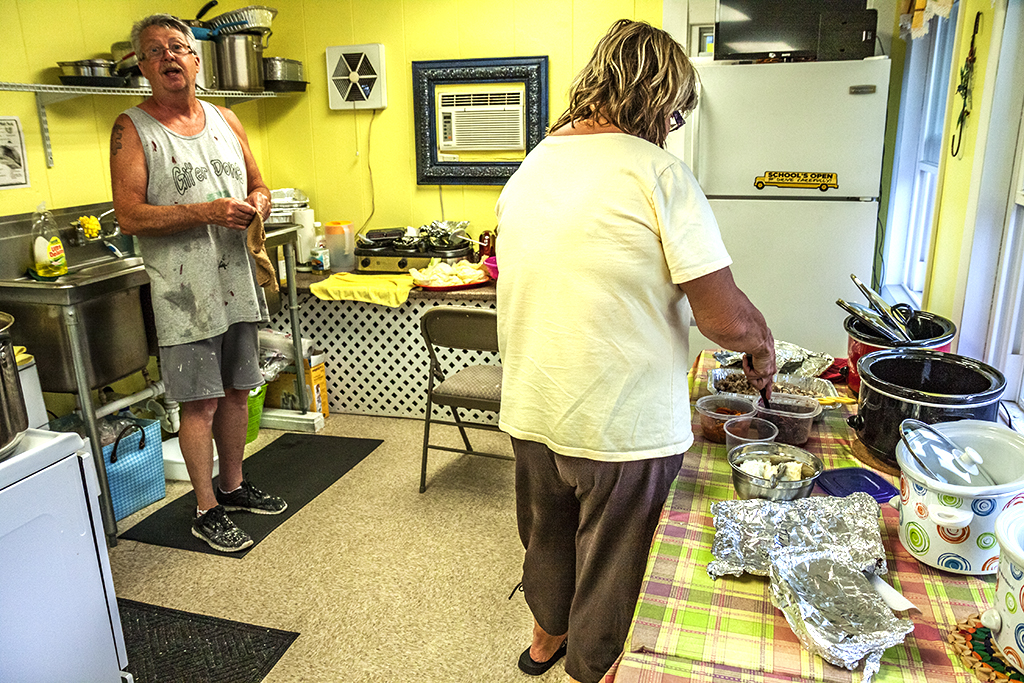
Down Home Cookin' Joan. Shoebox sized restaurant on Main Street has no counter, seating, bathroom or even drinks, but the tiny menu of comfort food dinners is excellent. For $7 per, Chuck and I had a meal of turkey with gravy and cranberry sauce over a piece of bread, mashed potato and carrot. We ate it sitting on a bench in front of a store down the street.
After three years in business, they had to shut down for three when a texting driver drove into their restaurant and destroyed it. Just reopened, all of their old customers are coming back, they said. He's a housepainter--notice the paint splatters on his shorts and shoes--and she also has another job, but I forgot to ask what it was.
They told me about their local bar in Old Forge, said a Bud is only $1.50 and that they were going there the next night. Chuck and I did go, but with Daniel, Chuck's son. When Dan saw a bunch of old farts sitting elbow to elbow in the darkened joint, he freaked out, however, so we went somewhere else.
.
Down Home Cookin' Joan. Shoebox sized restaurant on Main Street has no counter, seating, bathroom or even drinks, but the tiny menu of comfort food dinners is excellent. For $7 per, Chuck and I had a meal of turkey with gravy and cranberry sauce over a piece of bread, mashed potato and carrot. We ate it sitting on a bench in front of a store down the street.
After three years in business, they had to shut down for three when a texting driver drove into their restaurant and destroyed it. Just reopened, all of their old customers are coming back, they said. He's a housepainter--notice the paint splatters on his shorts and shoes--and she also has another job, but I forgot to ask what it was.
They told me about their local bar in Old Forge, said a Bud is only $1.50 and that they were going there the next night. Chuck and I did go, but with Daniel, Chuck's son. When Dan saw a bunch of old farts sitting elbow to elbow in the darkened joint, he freaked out, however, so we went somewhere else.
.
Tuesday, June 23, 2015
.
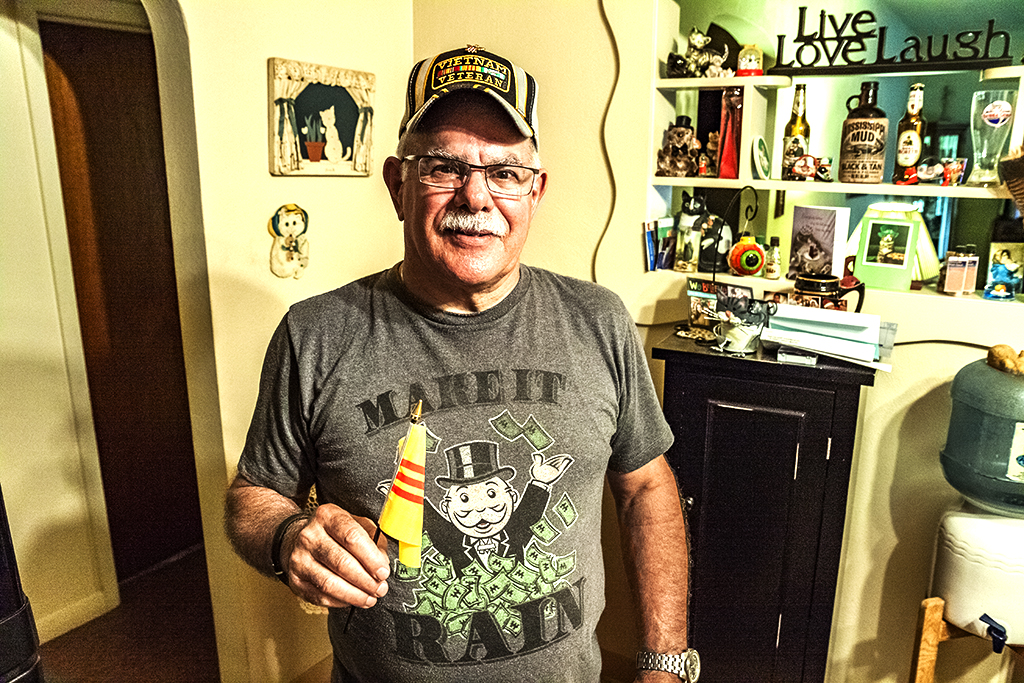
Sixty-five-years-old, Bob Bruno spent a year in Vietnam as an air force mechanic. Based in Nha Trang, he never fired a weapon, nor was he ever shot at. In fact, he never even saw anyone hurt. "The base was outside of town, and I never even saw the town. A few times, we went to the beach. The beach was divided into three sections, one for us, the Americans, one for the Australians, and one for the South Vietnamese soldiers." Bob spoke fondly of trading rum to the Australians for their lobsters, and of a Hawaiian buddy who brought back heavily seasoned dried fish, "It was sort of like beef jerky."
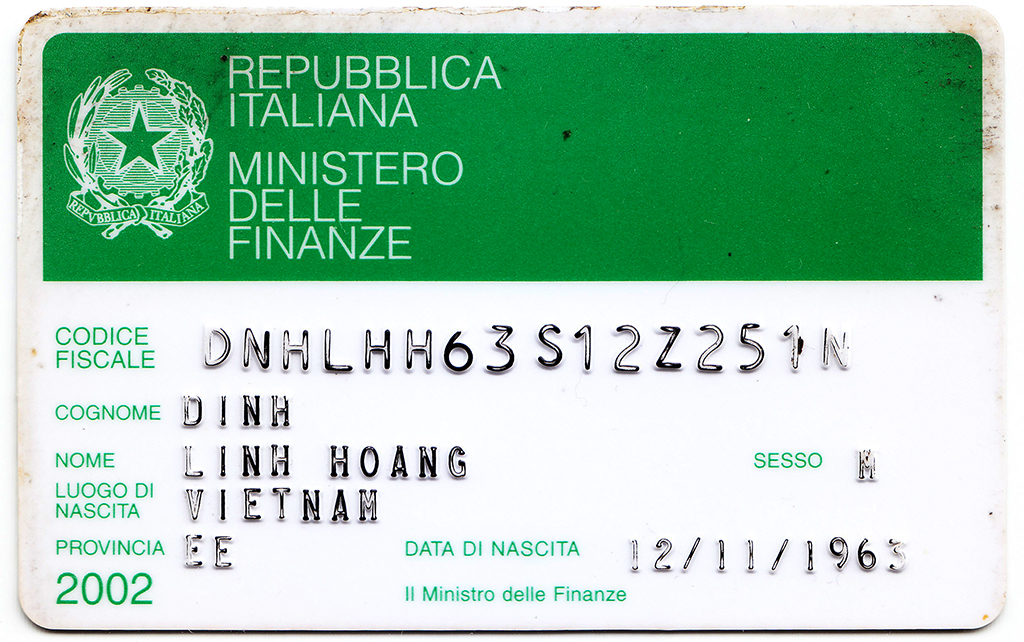
Bob is 100% Italian. His grandparents came here from Calabria and Sicily. His wife is Czech, German and Italian. Before leaving Bob, I showed him my Italian ID card, which greatly surprised and pleased him. "Look at this," he yelled as he showed it to his wife. Cathryn was watching TV in the next room.
"I spent two years in Italy, Bob."
The Brunos have never been to their ancestral country.
.
Sixty-five-years-old, Bob Bruno spent a year in Vietnam as an air force mechanic. Based in Nha Trang, he never fired a weapon, nor was he ever shot at. In fact, he never even saw anyone hurt. "The base was outside of town, and I never even saw the town. A few times, we went to the beach. The beach was divided into three sections, one for us, the Americans, one for the Australians, and one for the South Vietnamese soldiers." Bob spoke fondly of trading rum to the Australians for their lobsters, and of a Hawaiian buddy who brought back heavily seasoned dried fish, "It was sort of like beef jerky."
Bob is 100% Italian. His grandparents came here from Calabria and Sicily. His wife is Czech, German and Italian. Before leaving Bob, I showed him my Italian ID card, which greatly surprised and pleased him. "Look at this," he yelled as he showed it to his wife. Cathryn was watching TV in the next room.
"I spent two years in Italy, Bob."
The Brunos have never been to their ancestral country.
.
Sunday, June 21, 2015
.
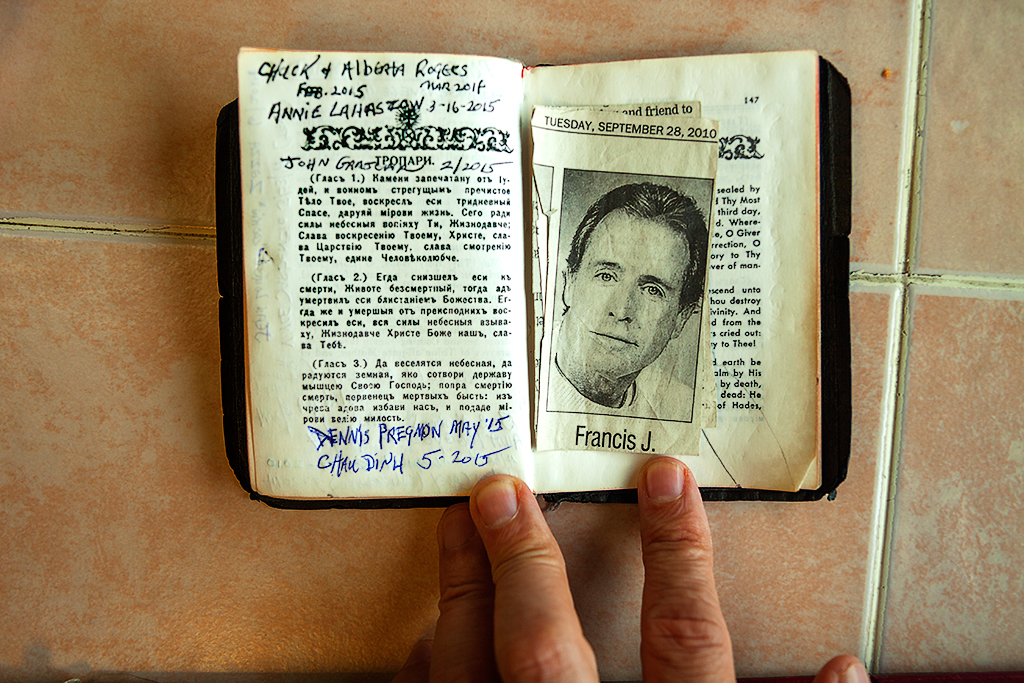
A section of Chuck Orloski's Russian Orthodox prayer book is devoted to the deceased, so there's my father's name, Chau Dinh, as the latest entry. Sixty-three-year-old Chuck kept talking about not having much time left himself, of being "in the 9th inning of life."
Chuck, "The book was a gift from the father of my dear childhood friend Mark Lezinsky. Mark died after walking (at work) a hazardous materials contaminated site, and when toxic chemicals seeped into his boots, entered into blood stream, having legs amputated to stop poison spread, and he died.... early 1990s."
.
A section of Chuck Orloski's Russian Orthodox prayer book is devoted to the deceased, so there's my father's name, Chau Dinh, as the latest entry. Sixty-three-year-old Chuck kept talking about not having much time left himself, of being "in the 9th inning of life."
Chuck, "The book was a gift from the father of my dear childhood friend Mark Lezinsky. Mark died after walking (at work) a hazardous materials contaminated site, and when toxic chemicals seeped into his boots, entered into blood stream, having legs amputated to stop poison spread, and he died.... early 1990s."
.
.
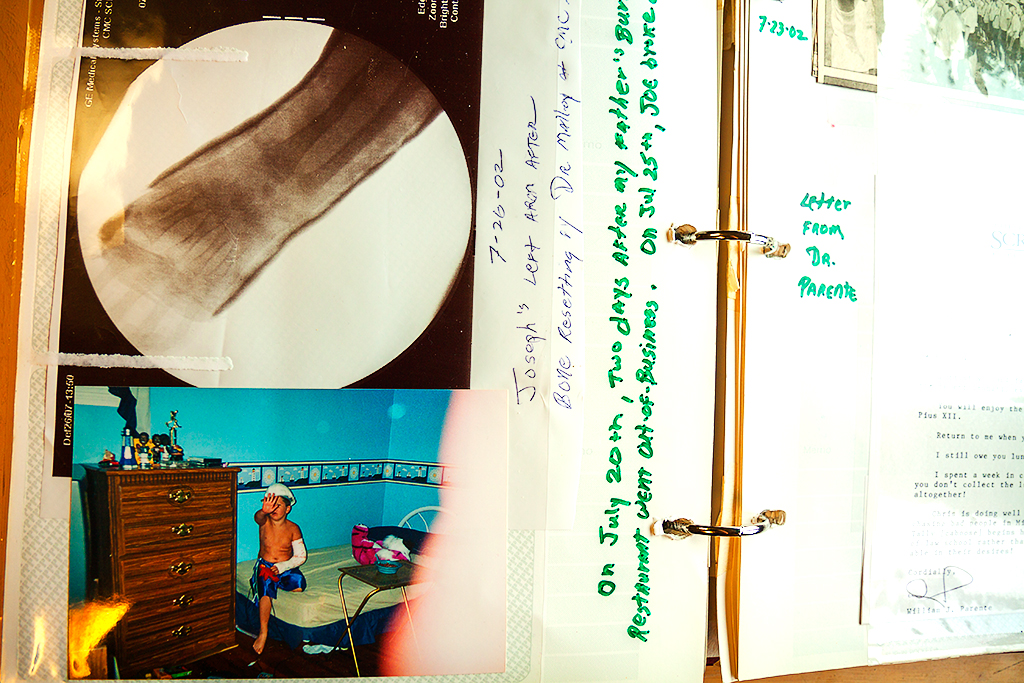
One of Charles Orloski's scrapbooks. That's Joe, his younger son, in 2002. Roller skating, Joe broke his arm. After graduating from Riverside High in 2014, Joe worked in a supermarket and video rental store, then just seven weeks ago, landed a job at a Home Depot warehouse. Unloading boxes and making crates, Joe earns $12.50 an hour, an excellent wage in these parts. Though it's grueling work, Joe is handling it well and looks forward to buying his first car in a couple months. Joe's girlfriend's dad is a state trooper, and he's thinking of becoming one also.
On the day I left, I noticed Joe was sitting in the living room watching reruns of The Office, the famous sit-com located in Scranton.
.
One of Charles Orloski's scrapbooks. That's Joe, his younger son, in 2002. Roller skating, Joe broke his arm. After graduating from Riverside High in 2014, Joe worked in a supermarket and video rental store, then just seven weeks ago, landed a job at a Home Depot warehouse. Unloading boxes and making crates, Joe earns $12.50 an hour, an excellent wage in these parts. Though it's grueling work, Joe is handling it well and looks forward to buying his first car in a couple months. Joe's girlfriend's dad is a state trooper, and he's thinking of becoming one also.
On the day I left, I noticed Joe was sitting in the living room watching reruns of The Office, the famous sit-com located in Scranton.
.
.
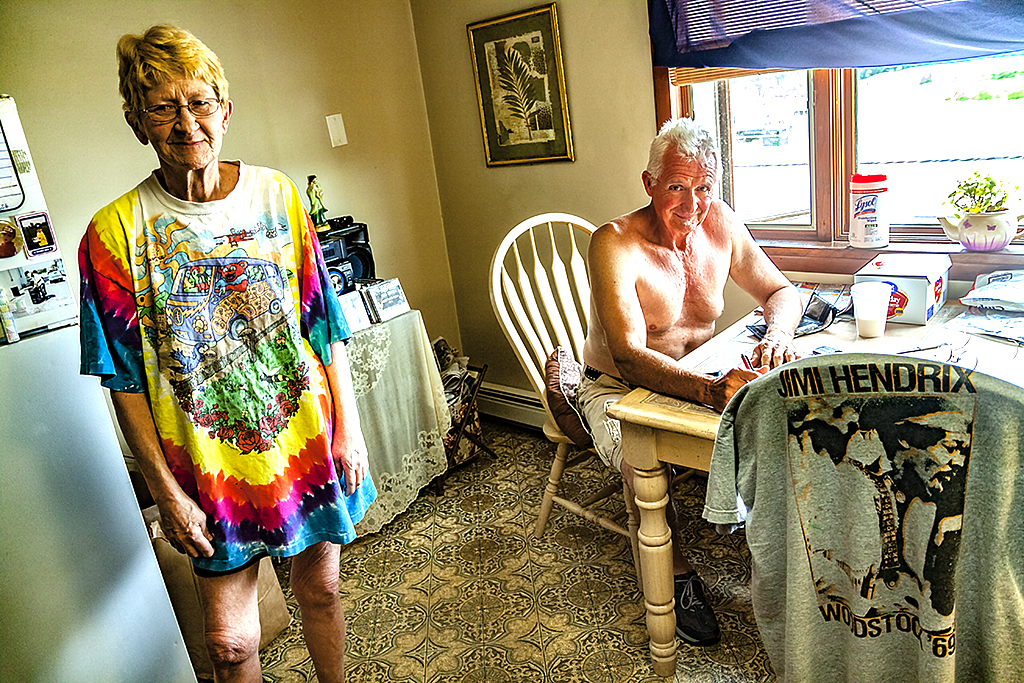
Carol and Charles Orloski. A Charles Orloski poem from 2008:
Then Why Can’t I Paint You?
As material circumstances
of Jake’s life began to improve,
America became an enchanting place,
and Jake had made it.
He toiled for twenty years as a
machine operator at Popple’s Quarry,
had a juicy 401-K,
hit the Pennsylvania scratch-off lottery
for half a million,
built a log cabin house,
owned a hundred acres, small pond,
and a little grove where he fed
apples and corn to the deer.
Jake knew where his next meal
was coming from.
He used to hunt to work-off stress
Joined Mr. Moe’s Total Fitness Club
and took yoga classes at
the Himalayan Institute.
His wife, Regina, got into
country-western dancing
and his eighteen year old son played
guitar at Cooper’s Seafood Restaurant
and sang for tourists in T-shirts.
“Things are as they should be,”
Jake beamed.
On Friday night,
Jake called all his friends
to brag about the “amazing”
birthday gift from Regina –
a $400 motion sensitive “Trail Camera,”
purchased at Gander Mountain.
Jake wanted to know basic stuff:
How to insert batteries?
How to secure the camera
to a Weeping Willow tree?
Jake’s goal? “To have all the animals
in my Kingdom on C.D.”
Exposed to freedom too soon,
“Trail Cameras” tend to lose their
conservative surveillance roots,
develop great insolence, and begin
to shoot without ethical regard.
Sunday afternoon:
Jake sank into his black leather
Easy-Lift recliner, lit a pipe,
sipped ice-tea, listened to Kenny G,
and downloaded the precious
digital images on to his lap top.
1st Frame ... a white-tail buck, pine tree
stump, diagonal sun rays.
2nd Frame ... blurry. Turkey and gray
squirrel.
3rd Frame ... high resolution. Jake’s brother
Eddie fucking Regina on recently
painted picnic table. Upturned
cotton sun dress. Khaki Docker
shorts on sod grass.
“Animals fucking,” he seethed.
He began to shake, turned the camera
toward the recliner, sat, combed his hair,
and placed a Glock on a plate filled
with cold bacon and scrambled eggs.
The shot – heard outside in the wild –
frightened away a robin looking
side-to-side for a worm.
Jake didn’t want it that way,
Regina didn’t know the words to say,
and Eddie burned the pictures.
.
Carol and Charles Orloski. A Charles Orloski poem from 2008:
Then Why Can’t I Paint You?
As material circumstances
of Jake’s life began to improve,
America became an enchanting place,
and Jake had made it.
He toiled for twenty years as a
machine operator at Popple’s Quarry,
had a juicy 401-K,
hit the Pennsylvania scratch-off lottery
for half a million,
built a log cabin house,
owned a hundred acres, small pond,
and a little grove where he fed
apples and corn to the deer.
Jake knew where his next meal
was coming from.
He used to hunt to work-off stress
Joined Mr. Moe’s Total Fitness Club
and took yoga classes at
the Himalayan Institute.
His wife, Regina, got into
country-western dancing
and his eighteen year old son played
guitar at Cooper’s Seafood Restaurant
and sang for tourists in T-shirts.
“Things are as they should be,”
Jake beamed.
On Friday night,
Jake called all his friends
to brag about the “amazing”
birthday gift from Regina –
a $400 motion sensitive “Trail Camera,”
purchased at Gander Mountain.
Jake wanted to know basic stuff:
How to insert batteries?
How to secure the camera
to a Weeping Willow tree?
Jake’s goal? “To have all the animals
in my Kingdom on C.D.”
Exposed to freedom too soon,
“Trail Cameras” tend to lose their
conservative surveillance roots,
develop great insolence, and begin
to shoot without ethical regard.
Sunday afternoon:
Jake sank into his black leather
Easy-Lift recliner, lit a pipe,
sipped ice-tea, listened to Kenny G,
and downloaded the precious
digital images on to his lap top.
1st Frame ... a white-tail buck, pine tree
stump, diagonal sun rays.
2nd Frame ... blurry. Turkey and gray
squirrel.
3rd Frame ... high resolution. Jake’s brother
Eddie fucking Regina on recently
painted picnic table. Upturned
cotton sun dress. Khaki Docker
shorts on sod grass.
“Animals fucking,” he seethed.
He began to shake, turned the camera
toward the recliner, sat, combed his hair,
and placed a Glock on a plate filled
with cold bacon and scrambled eggs.
The shot – heard outside in the wild –
frightened away a robin looking
side-to-side for a worm.
Jake didn’t want it that way,
Regina didn’t know the words to say,
and Eddie burned the pictures.
.
Thursday, June 4, 2015
Chuck Orloski reports from Taylor, PA:
.
Something bad, not murder robbery, rape, happened here early this morning in my hometown that I want to talk about. As you well know, on daily basis, strange dealings (rackets) are made made by U.S. cities and towns to generate revenue, sustain government. "Nothing new under Sun."
In Taylor Borough twice, you sat at our kitchen table, and likely gazed northeast into panoramic view of a parking lot, coal culm banks, baseball field, a playground, and Saint Ann's Basilica atop hill, Remember when I showed you how the Taylor Police Department stage check points across Union Street and wait for tractor trailers to approach, and pull them over for weight limit checks? Well, this morning, looking out kitchen window across Union Street, I witnessed such police action succeeded in collaring an overweight "18-wheeler" and its driver.
At around 9:30 A.M., the Taylor cops were gone, and it was about time to start my extra school bus run. Had some time so I crossed street and approached the driver who worked below his trailer, checked for defective electric wires and hook-ups. Getting close up, the driver emerged from beneath trailer, a tall man, maybe 6'5", wore safety glasses, his hands and clothes stained by grease. Introduced myself, and I offered sympathy for his dilemma; he stood straight, sighed, and with Hispanic accent, said, "I am good Mister, but the police just gave me a $750.00 fine!"
"That's horrible, Sir. What did you do to deserve such hefty fine?"
"Well, I dropped a load at the Kane Warehouse, and traveled Keyser Avenue south until I saw a road sign that signaled, "Interstate 81, Keep Left."
"O yes, I know exactly the sign you speak of."
"Well I turned left on Union, drove only 1/4 mile, and noticed a small black & white sign which read, 'Limit 10-Tons.' "
"Yes, I know that road sign too, it's small, black and white, maybe 2'x3.' "
"Yes, yes Sir, you are correct, and I took chance, kept going until I could find a good spot to turn my truck around, obey the law."
Unfortunately, the best place the driver could turn his tractor trailer around is the spot where Taylor Police Department had staked out. Upon arrival, they placed his unit upon portable scale, and found the vehicle illegally overweight for passage, and the trailer lights were not working. Having noticed accent, I asked the man his name.
"My name is Paulo Paredo, I am 54, and I come from Brazil. My wife and three children now live in Elizabeth, N.J., and this $750.00 fine will hurt."
"How long you been driving tractor trailer, Class A license, Paulo?"
" Sir, only 6-months. This penalty hurts me... not long ago I weighed 400-pounds, and finding and doing work was very difficult for me. But now I am only a little over 300-pounds on scale!"
"400-pounds? You should have walked-on at N.Y. Jets training camp, asked Rex Ryan for try out!"
"Ha, ha, you're funny man, Mister. What's your name?"
"My name is Carlos Orloski. I am a Polish American, and I wish the Taylor cops would have given you a break, Paulo."
"No, that was not God's Will. I pleaded with them to forgive mine error, allow me to turn around and carefully go back the way I came. Polite, understanding, the police did not go for that idea at all, they say it's unreasonable."
"Jesus! I feel very bad for you. I could never make it as cop, in fact I barely make it as a school bus driver! Uh, how about taking a little break, go across street, and I'll treat you to a sandwich and something cold to drink."
"My Sir, how generous of you to invite me into your home. But I can not, my company has dispatched a mechanic here in order to repair my trailer light system. I must not leave."
I reached for Paulo's the large hand to shake, and he withdrew, indicating "it's too greasy." Anyway, knowing the hand was that of a worker, calloused and dirty, I insisted on a hand shake, and Paulo gave thanks to Lord Jesus Christ. I asked the Giant if he might be a Catholic.
"No, I am not anymore. But I believe this crazy and expensive incident was God's Will. Maybe had I kept going straight on Keyser Avenue, I get in accident... hurt me and others. Who knows, Mister Carlos..., Destiny, eh?"
Prior to my departure, Paulo made an ecumenical point and emphasized that he really liked the new Pope Francis. He bluntly asserted, "Francis is shaking-up Vatican corruption, he wears only a humble wooden cross, and I fear he's going to be assassinated."
"You know the Pope plans to visit Philadelphia come September? Maybe you will cross river and see him?"
"Ha, ha! I would hope so, but I do not get much time off at my busy company, Hall's Intermodal."
"Did you say Hell's Intermodal, Paulo?"
"You're funny man, Carlos. I say HALLS, not Hells!!"
"Had you time and money, would you cross the border to see Francis speak in Philly?"
"Uh, possibly. But one thing for sure is I would tell Pope's motorcade driver to avoid passing through Union Street, Taylor, avoid getting over weight tickets! Ha-ha."
We laughed and I shook the Giant's hand one more time. A Swift tractor-trailer passed by parking lot, and I looked at the American flags attached to every telephone pole on Union Street, since Memorial Day. Dismayed, Paulo watched another tractor trailer pass by, and said, "looks like some drivers take big chances here, eh?"
"Their companies probably have special permits, and consequently, they don't sweat police check points."
"Ah, maybe my luck turns one day, and I drive for company who purchases such permits!"
"One never knows, Paulo. Maybe someday I will live in a place where local police would give drivers like you a break."
"God works in mysterious ways, Carlos, and every one knows the old saying, 'what goes around comes around.' "
Paulo returned beneath the trailer bottom to fidget with electrical hook-ups some more. I walked toward school bus #24, pondered his catchy phrase, "what goes around comes around" -- wished it were true. O Linh, I feel very bad for what Taylor Borough did to Paulo. If the latter old saying turns out to be at least 50-50 correct, the real robbers and outlaws of this country stand a chance to enter an unforeseen check point, and topple under weight of their decadent excess.
.
Something bad, not murder robbery, rape, happened here early this morning in my hometown that I want to talk about. As you well know, on daily basis, strange dealings (rackets) are made made by U.S. cities and towns to generate revenue, sustain government. "Nothing new under Sun."
In Taylor Borough twice, you sat at our kitchen table, and likely gazed northeast into panoramic view of a parking lot, coal culm banks, baseball field, a playground, and Saint Ann's Basilica atop hill, Remember when I showed you how the Taylor Police Department stage check points across Union Street and wait for tractor trailers to approach, and pull them over for weight limit checks? Well, this morning, looking out kitchen window across Union Street, I witnessed such police action succeeded in collaring an overweight "18-wheeler" and its driver.
At around 9:30 A.M., the Taylor cops were gone, and it was about time to start my extra school bus run. Had some time so I crossed street and approached the driver who worked below his trailer, checked for defective electric wires and hook-ups. Getting close up, the driver emerged from beneath trailer, a tall man, maybe 6'5", wore safety glasses, his hands and clothes stained by grease. Introduced myself, and I offered sympathy for his dilemma; he stood straight, sighed, and with Hispanic accent, said, "I am good Mister, but the police just gave me a $750.00 fine!"
"That's horrible, Sir. What did you do to deserve such hefty fine?"
"Well, I dropped a load at the Kane Warehouse, and traveled Keyser Avenue south until I saw a road sign that signaled, "Interstate 81, Keep Left."
"O yes, I know exactly the sign you speak of."
"Well I turned left on Union, drove only 1/4 mile, and noticed a small black & white sign which read, 'Limit 10-Tons.' "
"Yes, I know that road sign too, it's small, black and white, maybe 2'x3.' "
"Yes, yes Sir, you are correct, and I took chance, kept going until I could find a good spot to turn my truck around, obey the law."
Unfortunately, the best place the driver could turn his tractor trailer around is the spot where Taylor Police Department had staked out. Upon arrival, they placed his unit upon portable scale, and found the vehicle illegally overweight for passage, and the trailer lights were not working. Having noticed accent, I asked the man his name.
"My name is Paulo Paredo, I am 54, and I come from Brazil. My wife and three children now live in Elizabeth, N.J., and this $750.00 fine will hurt."
"How long you been driving tractor trailer, Class A license, Paulo?"
" Sir, only 6-months. This penalty hurts me... not long ago I weighed 400-pounds, and finding and doing work was very difficult for me. But now I am only a little over 300-pounds on scale!"
"400-pounds? You should have walked-on at N.Y. Jets training camp, asked Rex Ryan for try out!"
"Ha, ha, you're funny man, Mister. What's your name?"
"My name is Carlos Orloski. I am a Polish American, and I wish the Taylor cops would have given you a break, Paulo."
"No, that was not God's Will. I pleaded with them to forgive mine error, allow me to turn around and carefully go back the way I came. Polite, understanding, the police did not go for that idea at all, they say it's unreasonable."
"Jesus! I feel very bad for you. I could never make it as cop, in fact I barely make it as a school bus driver! Uh, how about taking a little break, go across street, and I'll treat you to a sandwich and something cold to drink."
"My Sir, how generous of you to invite me into your home. But I can not, my company has dispatched a mechanic here in order to repair my trailer light system. I must not leave."
I reached for Paulo's the large hand to shake, and he withdrew, indicating "it's too greasy." Anyway, knowing the hand was that of a worker, calloused and dirty, I insisted on a hand shake, and Paulo gave thanks to Lord Jesus Christ. I asked the Giant if he might be a Catholic.
"No, I am not anymore. But I believe this crazy and expensive incident was God's Will. Maybe had I kept going straight on Keyser Avenue, I get in accident... hurt me and others. Who knows, Mister Carlos..., Destiny, eh?"
Prior to my departure, Paulo made an ecumenical point and emphasized that he really liked the new Pope Francis. He bluntly asserted, "Francis is shaking-up Vatican corruption, he wears only a humble wooden cross, and I fear he's going to be assassinated."
"You know the Pope plans to visit Philadelphia come September? Maybe you will cross river and see him?"
"Ha, ha! I would hope so, but I do not get much time off at my busy company, Hall's Intermodal."
"Did you say Hell's Intermodal, Paulo?"
"You're funny man, Carlos. I say HALLS, not Hells!!"
"Had you time and money, would you cross the border to see Francis speak in Philly?"
"Uh, possibly. But one thing for sure is I would tell Pope's motorcade driver to avoid passing through Union Street, Taylor, avoid getting over weight tickets! Ha-ha."
We laughed and I shook the Giant's hand one more time. A Swift tractor-trailer passed by parking lot, and I looked at the American flags attached to every telephone pole on Union Street, since Memorial Day. Dismayed, Paulo watched another tractor trailer pass by, and said, "looks like some drivers take big chances here, eh?"
"Their companies probably have special permits, and consequently, they don't sweat police check points."
"Ah, maybe my luck turns one day, and I drive for company who purchases such permits!"
"One never knows, Paulo. Maybe someday I will live in a place where local police would give drivers like you a break."
"God works in mysterious ways, Carlos, and every one knows the old saying, 'what goes around comes around.' "
Paulo returned beneath the trailer bottom to fidget with electrical hook-ups some more. I walked toward school bus #24, pondered his catchy phrase, "what goes around comes around" -- wished it were true. O Linh, I feel very bad for what Taylor Borough did to Paulo. If the latter old saying turns out to be at least 50-50 correct, the real robbers and outlaws of this country stand a chance to enter an unforeseen check point, and topple under weight of their decadent excess.
.
Tuesday, March 17, 2015
Chuck Orloski just emailed me:
.
“Linh, This past November, a friend of mine, Leo Maxville, 25, a Eucharistic Minister at St. Ann's, got his school bus driving license, and was assigned a route which someone prior to him hated and QUIT. A little background? Some students are so misbehaved, the particular schools Districts are ROUTINELY required to assign an ‘aide’ to ride bus everyday and help the driver maintain order, safety.
Yesterday afternoon, Leo entered the driver's room, sat and looked very discouraged. I asked him, ‘What's up, Leo?’ He handed me his completed (standard) form used by driver to make official complaint against student misbehavior. I looked at Leo's form and he checked every possible section of listed violations committed by ‘Reegan’ (7th grade, maybe 12-years old) during the morning bus pickup. Including ‘Mischief, hitting, tripping, profane language, damage to bus, Etcetera.’ Following is what happened to Leo who is also St. Ann's Youth Ministry Director.
The ‘perp,’ Reegan, typically sits in rear of the bus as do many both behaved & mischievous kids. However, a fellow student saw Reegan take an ink pen, poke a hole into the school bus seat, ripped it a few inches, and ink let loose all over the seat. (Note: Reegan's mother is white, father black, they live in Scranton's notorious Valley View Terrace Apartments)
A fellow student witnessed Reegan stabbing the seat and reported him to the female (late 20s) aide who sat in bus middle. Immediately after reporting what happened, the ‘whistle blower’ student was punched in the face by Reegan, an act which sent the aide running to bus rear, and making attempt to quiet things down. The aide sat with Reegan, and she motioned to Leo Maxville to continue on his route, until suddenly, Reegan started to PUNCH the hell out of the aide! She cried out and Leo once again stopped the bus, parked, and went to her aid. Upon Leo's arrival, Reegan, outnumbered, retreated to another seat. With red face & bloody nose, the aide furiously exclaimed, ‘I've had it, Reegan... I'm going to contact the Principal!’
Leo told me that the Principal simply told the aide, ‘O well, do what we're supposed to do... call Scranton Police!’ The aide called the cops and within a few moments, a Scranton cop arrived on scene and entered Leo's bus. By law, allegedly, the cop could not run Reegan downtown, reason because he's only in 7th grade. I am told that, in order to haul a mischievous and in this case VIOLENT kid downtown, the student must be in 8th grade! Holy shit, Linh? Needless to say, Leo was pretty rattled with this insane experience, and I offered to fill-in for him, switch bus runs for a while. Leo replied, ‘That's real nice of you, Chuck, but I heard your kids are not angels either, and besides, your run takes almost an hour & half to complete.’ Frankly, I want to do Leo's route just to experience the madness for a few days.
Finally, Linh and I'm sorry to take-up too much of your time, but here's some detail on Reegan's parents: White mother, corpulent, always a butt hanging from lips, she always has her hair shaved like Telly Savalas. Last Friday, she came to meet Reegan at bus stop and she wore a Dolly Parton style wig! Leo Maxville described Reegan's father, Beaux, as a ‘real wing-ding.’ He's a big guy, 30s maybe, and when he's at bus stop, Beaux tries to ‘hit on’ the aide who is, according to Leo, ‘nothing that would turn a guy's head.’ Typically, as Reegan disembarks bus, his father routinely tells Leo, ‘Ahs give you A'ficial pahmission to treat 'ma boy like you need be when he does actin' up, sir.’
Upon return, maybe you can meet Leo Maxville and listen to other school bus driving travesties.”
.
“Linh, This past November, a friend of mine, Leo Maxville, 25, a Eucharistic Minister at St. Ann's, got his school bus driving license, and was assigned a route which someone prior to him hated and QUIT. A little background? Some students are so misbehaved, the particular schools Districts are ROUTINELY required to assign an ‘aide’ to ride bus everyday and help the driver maintain order, safety.
Yesterday afternoon, Leo entered the driver's room, sat and looked very discouraged. I asked him, ‘What's up, Leo?’ He handed me his completed (standard) form used by driver to make official complaint against student misbehavior. I looked at Leo's form and he checked every possible section of listed violations committed by ‘Reegan’ (7th grade, maybe 12-years old) during the morning bus pickup. Including ‘Mischief, hitting, tripping, profane language, damage to bus, Etcetera.’ Following is what happened to Leo who is also St. Ann's Youth Ministry Director.
The ‘perp,’ Reegan, typically sits in rear of the bus as do many both behaved & mischievous kids. However, a fellow student saw Reegan take an ink pen, poke a hole into the school bus seat, ripped it a few inches, and ink let loose all over the seat. (Note: Reegan's mother is white, father black, they live in Scranton's notorious Valley View Terrace Apartments)
A fellow student witnessed Reegan stabbing the seat and reported him to the female (late 20s) aide who sat in bus middle. Immediately after reporting what happened, the ‘whistle blower’ student was punched in the face by Reegan, an act which sent the aide running to bus rear, and making attempt to quiet things down. The aide sat with Reegan, and she motioned to Leo Maxville to continue on his route, until suddenly, Reegan started to PUNCH the hell out of the aide! She cried out and Leo once again stopped the bus, parked, and went to her aid. Upon Leo's arrival, Reegan, outnumbered, retreated to another seat. With red face & bloody nose, the aide furiously exclaimed, ‘I've had it, Reegan... I'm going to contact the Principal!’
Leo told me that the Principal simply told the aide, ‘O well, do what we're supposed to do... call Scranton Police!’ The aide called the cops and within a few moments, a Scranton cop arrived on scene and entered Leo's bus. By law, allegedly, the cop could not run Reegan downtown, reason because he's only in 7th grade. I am told that, in order to haul a mischievous and in this case VIOLENT kid downtown, the student must be in 8th grade! Holy shit, Linh? Needless to say, Leo was pretty rattled with this insane experience, and I offered to fill-in for him, switch bus runs for a while. Leo replied, ‘That's real nice of you, Chuck, but I heard your kids are not angels either, and besides, your run takes almost an hour & half to complete.’ Frankly, I want to do Leo's route just to experience the madness for a few days.
Finally, Linh and I'm sorry to take-up too much of your time, but here's some detail on Reegan's parents: White mother, corpulent, always a butt hanging from lips, she always has her hair shaved like Telly Savalas. Last Friday, she came to meet Reegan at bus stop and she wore a Dolly Parton style wig! Leo Maxville described Reegan's father, Beaux, as a ‘real wing-ding.’ He's a big guy, 30s maybe, and when he's at bus stop, Beaux tries to ‘hit on’ the aide who is, according to Leo, ‘nothing that would turn a guy's head.’ Typically, as Reegan disembarks bus, his father routinely tells Leo, ‘Ahs give you A'ficial pahmission to treat 'ma boy like you need be when he does actin' up, sir.’
Upon return, maybe you can meet Leo Maxville and listen to other school bus driving travesties.”
.
Monday, December 1, 2014
Postcard from the End of America: Taylor, PA
As published at CounterCurrents, Information Clearing House and Intrepid Report, 12/1/14:
The sixteen-year-old’s consciousness was percussive with recorded music, as usual, when the train slammed into him, and it’s not clear, even now, if it was suicide or merely absentmindedness that killed this boy. (To have your inner life constantly stunted or suffocated is already a form of death, but had he lived, this incipient man may eventually outgrow his three-chord addiction.) Home in Taylor, PA, Chuck Orloski was already in bed when he received the call to drive four hours to that ghastly site where it was his job to clean up the unholy mess. Like a mortifying penitent in an impossibly long church, Chuck knelt on lumpy or jagged track ballast and inched along for half a mile to pick up five perfectly aligned teeth still embedded in gums, a spleen and so many other bloody bits as his supervisor stood over him with a flash light. It took eight hours to scrounge all that could be salvaged from this exploded human form. Ah, but the pay was half-decent! Or $23.75 an hour, to be exact.
On another occasion, Chuck and his co-workers removed blood-splattered boxes of frozen, crinkle cut French fries that had tumbled out of a tractor trailer lying on its side, mangled, at the bottom of a leafy embankment. There is so much fluid inside each of us. It was football season and Penn State won that weekend, if memory serves. The dead driver was a 70-year-old man who had lived in his cab. Wifeless, he covered his personal space with naked crotch shots of various ladies. What others hazily consign to mental albums, he made concrete and permanent, or at least much more so than his flesh. Staring nostalgically at a Kodak labial flare, did the pay-by-the-half-hour Don Juan even recall the smoky, drunken or drugged smile that came with it? Nodding off at the wheel, perhaps he was dreaming of a truck stop angel.
A constant phrase among Chuck and his co-workers was, “Eat some shit!” This rallying cry steeled them as they dealt with yet another toxic or bloody horror. “Eat some shit!” they’d grumble at each other as they tried to remove a chemical spill from the freeway or the lovely suicide’s splattered brains from a motel bed, floor and wall. Heading to a hellish scene, Chuck often clutched his rosary. Knowing it wasn’t easy to find another job that paid $23.75 an hour, Chuck toughed it out and tried his best to ignore the abusive and, at times, psychotically menacing behavior from two of his bosses, but what else could he do? Like employees everywhere, Chuck just ate shit and grinned. In March, however, they fired him anyway. Chuck emailed me, “The termination is actually a ‘mercy killing’ of sort. Two decades of 24/7 emergency responses have gotten the best of my mental health, and the ruthless branch manager took every shot he could at me. At age 62, in life’s 9th inning, I can start collecting Social Security and maybe unemployment money for a while—must learn how the freaking system works.”
A month later, Chuck reported, “I am looking at PA Employment office training to become a ‘Certified Nursing Aide.’ The State will pay the full-cost for this, capped @ $5,000. Colleges charge on average $30,000 to become an Licensed Practical Nurse, and at age 62, it makes little sense to take a college loan for this endeavor. I’d really like to do something to help people & make some money, and IDEALLY of course, avoid management tyrants. If this nursing deal does not pan out, I plan to get a bus driver endorsement on my Class B Commercial Driver License. Anything but re-entering life as a 24/7 emergency spill responder. F#@uck that.”
Alas, Chuck became a school bus driver, but this happy ending is blighted by the fact that his pay is just over a quarter of what it used to be, and when there’s a snow day, like tomorrow, Chuck doesn’t get paid at all. Such jobs used to be unionized and well-compensated, but in today’s economy, a man must leap at any bone that’s flung his way. Meanwhile, Chuck’s wife, Carol, is still stricken by rheumatoid arthritis, lupus and carpal tunnel syndrome. For four decades, Carol was a waitress.
With jobs so scarce, workers have even less leverage against asshole bosses or managers, and starting one’s own business is hardly a solution, considering how many of them have been wiped out by huge corporations. On Main Streets across America, countless mom and pops are left vacant or replaced by chain stores.
A year and a half ago, I went to see the Orloskis, stayed at their house and wrote about it. Chuck told me much about Scranton and Taylor, recounted his grandfather’s life as a coal miner and even took me to see his mother-in-law, Florence, who had spent half a century as a seamstress. I talked to Chuck’s older son, Daniel, who wished CVS, the chain drug store on Main Street, would give him more hours. Chuck’s other child, Joseph, was lost to the television.
Last week, I visited the Orloskis again, and since I got in before Chuck was finished with his driving, I left downtown Scranton and headed South. The Scranton area is populated mostly by Irish, Polish and Italians, with an influx in recent years of Mexicans, Puerto Ricans and Dominicans. It is still overwhelmingly white, and though very poor, much safer than others of similar size. In 2012, there was no murder in Scranton proper, population 76,000, and just one each for 2013 and 2014.
With so much barbarity in the nightly news, our capacity to be outraged has been diminished to an alarming degree, and one has to wonder at what point, exactly, will we cease to be civilized or even socialized? Two recent crimes shook the Scranton area. In June of 2013, a Taylor woman and her two daughters were charged with starving her retarded son to death. Though 31-years-old, he weighted only 69 pounds and had open sores all over his body, with bones showing in places. Interviewed by the police, the 59-year-old seemed unaware of her likely jail stint, for she asked if she’d still receive her dead son’s Social Security checks of $1,042 a month. To those closest to him, Robert Gensiask was little more than a fetid cash machine. Locals were also astonished by the huge size of the three women.
In May of 2014, a 16-year-old, Aazis Richardson, called for a cab at 3AM, then shot the driver, Vincent Darbenzio, twice in the back of the head “because he didn’t listen” to Richardson’s driving instruction.
“Is that a reason to kill someone?” a reporter asked.
“To me it is,” the soulless-eyed, sullen young man coolly blurted.
“Do you have anything to say to the victim’s family?”
“Fuck them.”
In Scranton, the “We Buy Gold” shops are everywhere, so it’s obvious its population is going broke, and on the wire fences of electrical substations, there are all these signs showing handcuffs, and:
“Our metal in your hands?
Their metal around your wrists
REWARD
PPL Electric Utilities is offering a reward of up to $1,000 for information that leads to the arrest and conviction of anyone responsible for stealing copper wire, or other materials, from any of its facilities.
Stealing wire from electrical facilities and equipment is dangerous!
Severe injuries or death could result.”
Needing quick cash, Americans are stripping the greatest nation on earth’s infrastructure. A 2013 headline from CNBC: “Copper theft ‘like an epidemic’ sweeping US.”
Most of the houses in Scranton are still well-kept, however, and there is no trash or graffiti to speak of. It was extremely cold that day and with the topography somewhat hilly, I soon got tired of traipsing around, so I asked a man sitting in a parked car to point me to the nearest bar. He suggested Bacwals, which I misheard as Back Wall, and this evoked, somehow, the famous Goya execution scene…
I opened the door, saw only old men, heard no music, yeah, then discovered that each pint of Yuengling would only set me back two bucks. Thank you, Lord! Though Ben Franklin never declared, “Beer is proof that God loves us and wants us to be happy,” it’s still an insight worthy of Poor Richard. Settled, I dialed Chuck to tell him where I was, but Carol answered, so I talked to her for a bit. Since my last visit, the Orloskis had given up their cell phones.
Old timers who had known each other forever, they talked about how much things used to cost, how you could get a beer and hotdog for only 25 cents at a long dead bar, and how at another joint, three beers were also a quarter, as were two boiled eggs, “Though I only bought one at a time for 15 cents. I still don’t know why. Maybe I’m stupid.”
A gent with a lingering Irish brogue came in, “How come it’s so hot in here?”
“It ain’t hot,” the short, white-haired bartender responded. “The heat’s not even on.”
“It’s your testosterone,” said a man in a baritone drawl. “It’s your hormone.”
“Testosterone?! I lost that a long time ago!”
“How about your brain?”
“That too. I ain’t got nothing left.”
“You’ve gained a lot of weight, that’s for sure.”
“You know what it is? It’s my hernia.”
“I have a hernia too, but I don’t look like you.”
“I have five hernias!”
“Five! You go to the hospital all the time. Why don’t you have them removed?”
“They can’t be taken out. I just take these pills for the pain, that’s all.”
“Drink more of that!”
“I do.”
“Eat right.”
“I’m seventy-years-old. I don’t give a shit what I eat.”
“Go to a good doctor. Go to Doctor Frankenstein!”
“Hey, I wouldn’t want him to turn me into you!”
A man came in wearing an ushanka, which prompted Baritone Drawl to exclaim, “Holy Jesus!”
“No, it’s only me!”
Brogue, “That’s just his hair.”
Eventually, I talked to Brogue and found out that he was in the Navy during the Vietnam War and has two grandchildren who’re half-Chinese. When our conversation strayed into politics, he declared, “We shouldn’t have two parties in this country, because they cancel each other out and nothing gets done! I think we should only have one party.”
When Brogue complained about Obama’s immigration diktat, I pointed out that the executive office shouldn’t be able to start wars either, but he disagreed, “The President is the Commander-in-Chief, so he can start wars.” Then, “What really gets me are the freeloaders. There is a segment of the population who think they’re still living on the plantation. They want the government to do everything for them!”
Like a cruise vacation or the gulag, slavery is also an all-inclusive package, I suppose, but though crudely put, Brogue’s assessment of black dependency doesn’t differ essentially from the analysis of Thomas Sowell, a black conservative. Seeking to explain the much higher level of achievements among West Indians as compared to American-born blacks, Sowell pointed out a key difference in their histories, “Unlike slaves in the United States, who were issued food rations and were often fed from the common kitchen, West Indian slaves were assigned land and time to raise their own food. They sold surplus food in the market to buy amenities for themselves. In short, West Indian Negroes had centuries of experience in taking care of themselves, even under slavery, as well as experience with buying and selling […] They had the kind of incentives and experience common in a market economy but denied American slaves for two centuries.”
With this in mind, what does that say about the state of all Americans as more become dependent on government and private charities just to eat from day to day? Even many of those with jobs can’t get by without food stamps, church pantries or soup kitchens, and with self-employment harder to achieve than ever, we’re also being corralled into a new kind of plantation. A system that prevents you from fishing will throw you a fish bone. Economically castrated, we’re also losing our basic rights. Down into slavery!
Speaking of free food, the owner of Bacwals came in and gave everyone a peanut-sprinkled and chocolate-dipped ice cream cone, and a patron also brought a large box of bagels, “My brother works in a bakery. They’d have just thrown them away. They’re still excellent, though. Take as many as you want!” He even had paper bags to put them in.
The man to my right, Larry, filled me in on his life, “I’ve always had two jobs, but I lost them both five years ago.”
“What did you do?”
“I fixed dentist equipments and was a delivery man. My wife also had two jobs. She worked in a cafeteria and a nursing home.”
“Did she lose her jobs too?”
“She quit one. After working in the cafeteria for 25 years, she was only paid $9.25 an hour, and her boss was an asshole. Now, I’m a school crossing guard. I only work an hour a day. My wife does the same. Together, we make $40 a day.”
“Wow, man, that’s nothing!”
“It’s enough to pay for the groceries and taxes. They’ve gone way up!”
“You don’t pay rent?”
“No, I own my own home. I got a good deal, though. It’s my grandma’s, and we were already living in it when she died. In her will, she left it to my dad, me and my brothers, so I paid them $25,000. Even before that, though, I paid rent. I had to get married at 18 because I got my girlfriend pregnant. She was a year older than me.”
“She was the older woman!”
“Yeah, she took advantage of me! But it’s worked out. We’re still together, and I’m 59.”
“You look good!”
“I’m going to the doctor tomorrow. I haven’t seen one in eight years.”
“I haven’t seen one in a lot longer than that. Is anything wrong with you?”
“I don’t know. I’ll find out tomorrow.”
“You come here everyday?”
“Most days.”
“How about your wife?”
“No, she doesn’t drink at all.”
“She’s never been to this place?”
“Never, and I wouldn’t want her to see it. I mean, just look at it!”
“It’s not so bad. One thing, though, I’ve been here for about three hours and haven’t seen a single woman. At least your wife doesn’t have to worry about you hitting on women!”
“And the women who do come in here, you wouldn’t want to hit on anyway, believe me!”
Finally, Chuck came in, “You know, I’ve been a hermit and haven’t been out in weeks!” After a beer and a quick game of pool with one Dana, whom Chuck met at the juke box, we left for Taylor. In her “HOOPS FOR TROOPS” T-shirt, Dana appeared as schlocky as the rest of us, but she was in fact a lawyer. She also volunteered, quite unprompted, that she had been the live-in lover of Jason Miller, the Pulitzer-winning playwright of “That Championship Season,” by far the most famous literary work about Scranton.
“It’s weird, ain’t it, Chuck, that she just told us that?”
“And he was a lot older too.”
Trim, youthfully dressed, with his Eagles cap, round glasses, salt and pepper soul patch and often smiling, Chuck exuded a serenity that belied the considerable amount of stress he’d gone through the last several years, what with losing his job and Carol’s deteriorating health, among many other worries. Three weeks earlier, he had written to me, “I try to be a gentleman but fail. My mind, body and spirit have gone though dramatic changes since 1952, and I still do not understand what brought me to be a school bus driver and maker-of-response to your email.” Like many others, like me, Chuck’s surface equanimity and good humor rest on a quivering bedrock of bewilderment, frustration, sadness, dread and not a small bit of anger.
Fifty of his 62 years, Chuck Orloski has spent in the Scranton area, where he was born, so he has seen a vast cast of characters evolve. As we drove or walked around over two days, Chuck kept running into old faces. In a bank parking lot, Chuck waved at a funeral director, then said to me, “I should ask him for driving work over Christmas. I must have an income for those two weeks I have off.” Then, “You know, when my dad died, we didn’t have enough money for the funeral, so we had to pay him back a little at a time.”
Chuck stopped his car to say hello to a confused looking man, “Hey, Sal!”
After I was introduced, the unsmiling man asked, “Taking pictures?”
“Yeah, just for fun!”
“Nothing wrong with that.”
Chuck jumped in, “Hey Sal, can I buy you a coffee?”
“Sure,” and so Chuck handed him a buck.
Driving away, Chuck explained, “Sal is a little slow. People help him out. He used to hang out all day at this diner, Sluckie’s, but it has shut down.”
“It was weird to see him just standing there like that,” and it was bitterly cold that afternoon, in the low 20’s.
“He has nowhere to go!”
There is almost no foot traffic on Taylor’s Main Street and no tavern left in this entire borough of 6,200 souls. One evening, we popped into an Italian restaurant and bar in neighboring Old Forge and found ourselves the only customers. “It’s the day before payday,” the bartender explained. “This place used to be jumping,” Chuck told me. “I could have become its manager had I married the owner’s daughter. He liked me a lot. I was dating her.”
Ever since Carol got too sick to work five years ago, the Orloskis have had to resort to the food pantry at Saint Ann’s, their parish church. In an email, Chuck elaborated, “My company’s family health insurance also skyrocketed to $14,000 a year. Ever the stoic, Carol used to make light, insisted, ‘We’d be O.K. financially were it not for the need to EAT.’ The cost of food also skyrocketed.” For the last five months, Chuck has also been a volunteer, at least two days a week, at St. Francis of Assisi Soup Kitchen. It’s a bright, cheery place that serves over 200 people each day at lunch, plus dinner three nights a week. Most of the folks who eat there aren’t homeless, just poor, and during my visit, I saw people of all ages, including small kids. Entire families would come in, as well the odd street walker in her skimpy outfit. No one is turned away. Many would show up half an hour beforehand and wait just inside the door. That day, lunch was pierogies, cheese pizza, fruit salad and bread, with everything freshly made.
When Chuck greeted an old lady he had given a jacket to, she told him its texture chafed her skin, and on top of that, it had to be dry cleaned, so he promised to find her another one. Chuck is always giving stuff away, and this time, as the last, I had to restrain him from stuffing my backpack with all sorts of gifts, but since he was so relentlessly giving, I went home with a Phillies baseball cap, Phillies knit cap and a book.
I was hoping to see Jack, whom I had talked to during my last visit, but he wasn’t around. Busted with two thousand kilograms of pot, yes, two tons of ganja!, Jack was locked up for 22 years, but now he had a paid job at St. Francis of Assisi. Both Chuck and I marvel at Jack’s absence of bitterness. When I howled at “two tons,” Jack cracked up too.
On the day I left, there was the Santa Parade in downtown Scranton. I’m very fond of homespun, small time parades where crude floats roll by, kids perform basic dance steps that even I can pull off, sort of, and one civic group or another in casual clothes simply march and wave. I also like the goofiness that’s also often on display, and in Scranton, it was three ducks in a cage being pushed by a waddling woman, sombrero-wearing donkeys, humans transformed into walking Christmas presents, an inflated Statue of Liberty that struggled to stay upright, teen girls in “I LOVE MY JOB” sweat shirts and a puffy and glowering Ronald McDonald who was clearly in the last stage of a psychotic breakdown.
Chuck’s younger son, Joseph, was one of four young people carrying a banner for the Pennsylvania State Police. Since I saw him in 2013, Joseph has matured into a solid young man with two part time jobs, at a supermarket and video game store, and he has a plan for the future. Dating the daughter of a state trooper, Joseph also wants to be one, although it will take five years of studying. Meanwhile, his brother Dan is majoring in psychology at Keystone College, where he lives on campus, though each weekend he comes home to work at CVS, a job he has had for over two years. Dan wants to eventually get a Master’s in head shrinking, which worries Chuck, naturally, but if that’s the young man’s passion, who’s to stop him? With this economy being strangled and disemboweled, just about every profession is endangered, so there’s no surefire career choice. The bottom line is we have too many people going to college, and doing so will also weigh down your future if it entails crippling loans. Still, there are many social benefits to attempting a higher education, for it’s good for any young person to be liberated from parents and home. Removed from one’s upbringing and its stifling thought patterns, one can sample new ideas, hair colors, spiked cocktails, what’s left of free love and personalized or unprecedented sexual orientations, for example, and with the right instructors, one can also learn how to write in loopy, looping and ungrammatical sentences.
Although Dan has received financial aids, including a grant from the Office of Vocational Rehabilitation due to his cerebral palsy, he will still owe $40,000 by the time he graduates in May of 2015. Dan’s among the millions of poor Americans who are led to believe a college education at a second or third tier school, at whatever cost, will still lead, inexorably, to a brighter future. Although they are merely businesses that must compete with each other for customers, colleges pose as life mentors and nurturers to their students, and in this disguise, steer millions of wide-eyed marks towards the rapaciously criminal banks. Marketing has become an American college’s first order of business, not education.
This year, Keystone charges $21,750 in tuition and fees. In comparison, UPenn docked $9,600 for the same in 1984, so for the current cost of a Keystone education, one could attend an Ivy League school for two years, with enough bouncing coins left over for many cases of beer and bong hits. UPenn’s tuition and fees are now $47,668. Of course, wages haven’t increased five folds in 30 years. The obscene overpricing of a diluted education is yet another sign that we’re failing future generations. To stuff the pockets of a few smirking old farts and their precious scions, countless young people are maimed.
The Orloski household now has three working adults, but only one car, and the buses barely run in Taylor, so on many days, it’s a Chinese fire drill just to get everyone to where they need to be on time. Chuck also has an old motorcycle, but it’s not practical to use in Winter.
Behind Joseph at the Santa Parade was an old military truck carrying Tiffany Dickson, widow of Bryon K. Dickson II, a state trooper recently killed by Eric Frein. During the 48 days when hundreds of cops searched for the murderer, they managed to accost a man who somewhat resembles Eric Frein dozens of times. “I lost count after 20,” James Tully told ABC News. Frein is 6’3” with a pudgy face, and Tully 5’9” with a narrow face, but they’re both very pale, and that’s close enough for the law enforcement confusion.
One day, Tully was stopped seven times altogether. Exasperated, he took to wearing a reflective vest plus lanyard with his driver’s license and work ID. One has to wonder, though, what kind of police intelligence and coordination can fail to figure out that the same poor schmuck they stop, day after day, on the same road, is not the cop killer, survivalist they were looking for? During Tully’s most harrowing encounter, a screaming, camouflage dressed man pointed a rifle at him as he ordered Tully to lie on the ground, face down, with his arms spread out. Kneeling on Tully’s back, the presumed cop yanked Tully’s IDs from his neck. “Good thing it had a break away clasp or he would have choked me,” Tully said to the Pocono Record, “From the minute I saw him with that gun I thought, let me survive this.”
His ordeal far from over, Tully added, “I’m worried about what is going to happen with the next one. Is he going to shoot first and ask questions later?” With our cops known to pump a dozen bullets into a suspect within seconds of spotting him, then, with guns still trained, handcuff the bloody corpse, it’s not too paranoid a fear. With such police tactics at home, it’s no wonder why we’re so popular as liberators worldwide! To show even more unequivocably that he was not the fugitive, Tully should have decked himself in feathers and sequins, like a mummer, then strutted down the side of the road strumming a banjo. Actually, that’s a terrible idea, for the authorities could cite said instrument as the rationale for splattering him. “Dressed in colorful camouflage to blend with the autumnal foliage, suspect pointed an object with barrel and stock, just like any assault rifle, at our peace officers. Ignoring our telepathic instructions, suspect then charged forward while screaming ‘O, dem golden slippers!’”
The reason why Tully was always walking around and ready to be pounced on by cops was because he had no car. Each day, he spent four hours trekking to and from work. Living in a badly laid out country that’s unraveling economically, many Americans are already familiar with Tully’s one-manpower, sweating and huffing, uphill or through the rain, sleet, hurricane or snow, leg it out commute, and this rank will only balloon. Tully’s story does have a happy ending, however, for a neighbor organized an online fundraising that netted him $23,025.15. A local church also raised $985. With contributions from well over a thousand people, Tully is now driving, with money left over for insurance and gas.
Walking for many blocks along the parade route, Chuck would ask the cotton candy, hotdog or toy vendors how business was going, and they all said it was terrible, no one was buying anything, and it’s true we only saw one kid getting his face sticky with cotton candy and another blowing into a plastic horn. Nobody was buying nada!
For two decades now, it’s traditional to head into the Steamtown Mall after the parade, so that’s what we did. Just outside, we saw a shabbily dressed old guy fish a cigarette butt from a standing ashtray. “How are you doing today?” Chuck said, for he greets everybody, but the dude didn’t respond. Walking inside, we found the mall to be nearly empty, with over two-thirds of its retail spaces vacant. In the remaining stores, still brightly lit, employees stood staring out at nothing.
“This was the centerpiece of Scranton’s urban renewal,” Chuck explained. “This place used to be packed. Let’s go find Santee Claus.” (Yes, that’s how Chuck pronounces “Santa.”)
If this was the downtown mall after a big parade, just outside, I can only imagine what it looks like at midday during the week. A naked Miley Cyrus could twerk her ass off and no one would notice. Just five years ago, hundreds of teenaged girls swarmed into Steamtown to scream lovingly at a baby-faced Justin Bieber.
Hey, here comes Santee Claus! With no kids lining up to see him, the rotund fellow in the rather mangy outfit was wandering around this still sparkling, well maintained yet comatose temple of shopping. Cerulean banners with graphic snow flakes streamed from the cathedral-high ceiling. In the abandoned stores’ windows, cheerful tableaux had been set up to shoo away the gloom. In one, disco-dancing John Travolta, Mr. Spock, Kermit the Frog and a cruise ship pin-up tried to perk us up. In another, there were Captain America, Indiana Jones and Ecto-1, the ghostbusting car. Meandering through the American ruins, we shall be comforted by shards and peeling evocations of American pop icons. Classic rock songs will be our dirges. “Ooh baby, it’s a wild world!” Across this Potemkin nation, faux frontage has become a thriving business, for we’re still the world leader in illusions, after all, though our top hat, red cape and white gloves have become seriously threadbare. Soon enough, we’ll be booed off the stage, if not arrested, put on trial then lined up in front of a firing squad.
Looking bored, Santee only grinned when bumping into a rare window shopper. I greeted him, “How are you doing, Sir?”
“Call me Santa,” he whispered, winked, smiled.
Santee has worked at this mall every Christmas, ever since it opened in 1993. Business started to dip in 2000, but things didn’t get awful until five years ago, “It’s bankrupt. The banks own it now. In the past, the rent was so high here, it was unbelievable. For a kiosk like this,” he pointed, “you had to pay eight to ten grand for the Christmas season, for three months, and you had to pay it up front.”
“When was this, Santee?” Chuck asked.
“Nineteen-ninety-six, seven… This place is so boring, teenagers don’t even come. Sometimes they throw coins at me from the second level!”
“Why?!”
“Because they’re teenagers. The last three weeks before Christmas, it will get a little busy, mostly because of me.”
“But how come the kids aren’t here now?” I asked. “We thought you’d be mobbed!”
“People are afraid to come inside. There used to be a lot of homeless, you know, and crimes.”
“Inside here?”
“Yes, and down in the basement. There was a rape down there.”
“Rape?!” Chuck blurted. “How come we didn’t hear about it?”
“They had to keep it quiet.”
The dying mall has attracted some odd tenants, such as a satellite branch of the public library and an office of the State Attorney General’s Child Predator Unit. As malls die across the country, we’ll see many creative repurposing. Already, there are churches and casinos inside half-dead malls, so why not massage parlors, detox centers, transient hotels, haunted houses, prisons, petting zoos or putt-putt golf courses (covering the entire mall)? Leaving Santee, Chuck and I wandered into the food court, where only 3 of 12 restaurant slots were still occupied. On the back wall of this forlorn and silent space was a mural put up by Boscov, the mall’s main tenant. Titled “B part of your community,” it reads:
“KINDNESS COUNTS / PLANT A TREE / MAKE A DONATION / HELP A NEIGHBOR / VISIT THE ELDERLY / HOPE / ADOPT A PET / DRIVE A HYBRID / PICK UP TRASH / VOLUNTEER / CONSERVE ENERGY / RECYCLE / JOIN SOMETHING / PAINT A MURAL / HUG SOMEONE / SMILE / DRINK FILTERED WATER / GIVE YOUR TIME / USE SOLAR ENERGY / FEED THE HUNGRY / ORGANIZE A FUNDRAISER / CREATE AWARENESS / FIX A PLAYGROUND / START A CLUB / BABYSIT”
These empty recommendations are about as effective as “Just Say No,” I’m afraid. As the CIA pushed drugs, the First Lady chirped, “Just say no!” And since everything in the culture, car, iPad, iPhone, television, internet, FaceBook, Twitter and shopping mall, etc., is designed to remove you from your immediate surroundings, it will take more than cutesy suggestions on walls to rebuild communities. Also, the worse the neighborhoods or contexts, the more hopeful and positive the slogans. Starved of solutions, we shall eat slogans.
Chuck and I approached a man sitting by himself. Fifty-years-old, Bob looked nearly a decade older. A Scranton native, he had gone to Las Vegas to work as a cook at the MGM Hotel. Making $20 an hour, Bob was doing fine until disaster struck, “I had a stroke and a heart attack. I lost my memory for a while. It’s coming back…”
“Did you have health insurance?” I asked.
“No, I turned it down.”
“How long did you work for MGM?”
“Two years. I was working in the Rainforest Café. Huge place, lots of people.”
“Did you save money while you were there?”
“No! I gambled and I partied.”
“Oh, shit!”
“God bless you,” Chuck added.
All this time, Bob was listening to the Penn State-Illinois game on a tiny transistor radio. As Illinois prepared to kick the winning field goal, we stopped to listen. Game lost, I continued, “Do you have an income, Bob?”
“No, I’m applying for Social Security but it will take a while though. I will probably have to get a lawyer.”
Though Bob has family in the area, he’s sleeping in a shelter and takes his meals at St. Francis and the Rescue Mission, “You stay for the service then they feed you.”
“What if you don’t stay for the service?” I asked.
“Then they don’t feed you,” Bob laughed. “They have good food there, too, they feed you good.”
“What if you fall asleep during the service? Will they notice?”
“I don’t think they care about that, but they do give you coffee as soon as you come in.”
Attached by a footbridge to the Steamtown Mall is an impressive railroad museum that’s just as moribund, unfortunately, thanks to poor management. The locomotives on display are relics from a time when Scranton was a major mining and industrial center. The magnificent wealth of the US, at its peak, came largely from its ability to extract hydrocarbons from its own (and many other people’s) soil. As these finite resources are depleted, the country’s fortunes must decline, and it doesn’t help that much of our manufacturing base has been exported, leaving cities like Scranton husks of what they used to be. If you don’t make shit, you ain’t gonna have shit to buy nothing, excuse my Scrantonese. Driving through a particularly desolate part of town, Chuck summed it up, “There is nothing but shit jobs! College graduates are fighting each other over shit jobs!”
I’ll end with an account from Carol. Before I came up, Chuck said Carol’s condition had deteriorated, so I feared seeing her emaciated or even bedridden, but Carol was her usual feisty self. One afternoon, as Chuck was out on his bus run, I sat at the Orloskis’ kitchen table as Carol cooked. “Carol,” I began, “you told me a story last year about a stomach wound the size of a grapefruit. Who was that?”
“Ah, Chuck’s father! He was in a car accident, and he had a wound in his stomach the size of a grapefruit.”
“I remember you telling me about how miraculously it healed?”
“Yes, it was this large wound that you could look into. I could see the inside of his stomach.”
“And it was your job to take care of it?”
“Yes, they gave me a solution to apply each day, and as I cleaned the wound, I could see it healing itself from the inside out. The skin grew back from the inside out!”
“That’s incredible!”
“Yes, it was, and the skin and everything grew back out, little by little, until he was almost normal again. His stomach smoothed itself out. Now, how did it know to do that?!”
No serious wound can heal, however, if you don’t tend to it, but according to our rulers and their media magicians, there is not even a nick on these Disunited States of Dying Malls. Daily, we’re told that unemployment is down, inflation is actually too low, the recovery is picking speed and, soon enough, we’ll be energy-independent. With life so good, it’s unclear why food stamp usage is at a record high and more and more adults are forced to live with their parents? As we stagger into 2015, however, watch for this rosy pornography to freeze, then black out finally, for our supernaturally levitating stock market will certainly rediscover gravity, and our relentless provocation and demonization of Russia will climax in either a suicidal war or end, more mercifully, with us a humbled and shunned nation. Already, many of our peripheral allies are decoupling from our “leadership.” If only Americans themselves could do the same.
.
The sixteen-year-old’s consciousness was percussive with recorded music, as usual, when the train slammed into him, and it’s not clear, even now, if it was suicide or merely absentmindedness that killed this boy. (To have your inner life constantly stunted or suffocated is already a form of death, but had he lived, this incipient man may eventually outgrow his three-chord addiction.) Home in Taylor, PA, Chuck Orloski was already in bed when he received the call to drive four hours to that ghastly site where it was his job to clean up the unholy mess. Like a mortifying penitent in an impossibly long church, Chuck knelt on lumpy or jagged track ballast and inched along for half a mile to pick up five perfectly aligned teeth still embedded in gums, a spleen and so many other bloody bits as his supervisor stood over him with a flash light. It took eight hours to scrounge all that could be salvaged from this exploded human form. Ah, but the pay was half-decent! Or $23.75 an hour, to be exact.
On another occasion, Chuck and his co-workers removed blood-splattered boxes of frozen, crinkle cut French fries that had tumbled out of a tractor trailer lying on its side, mangled, at the bottom of a leafy embankment. There is so much fluid inside each of us. It was football season and Penn State won that weekend, if memory serves. The dead driver was a 70-year-old man who had lived in his cab. Wifeless, he covered his personal space with naked crotch shots of various ladies. What others hazily consign to mental albums, he made concrete and permanent, or at least much more so than his flesh. Staring nostalgically at a Kodak labial flare, did the pay-by-the-half-hour Don Juan even recall the smoky, drunken or drugged smile that came with it? Nodding off at the wheel, perhaps he was dreaming of a truck stop angel.
A constant phrase among Chuck and his co-workers was, “Eat some shit!” This rallying cry steeled them as they dealt with yet another toxic or bloody horror. “Eat some shit!” they’d grumble at each other as they tried to remove a chemical spill from the freeway or the lovely suicide’s splattered brains from a motel bed, floor and wall. Heading to a hellish scene, Chuck often clutched his rosary. Knowing it wasn’t easy to find another job that paid $23.75 an hour, Chuck toughed it out and tried his best to ignore the abusive and, at times, psychotically menacing behavior from two of his bosses, but what else could he do? Like employees everywhere, Chuck just ate shit and grinned. In March, however, they fired him anyway. Chuck emailed me, “The termination is actually a ‘mercy killing’ of sort. Two decades of 24/7 emergency responses have gotten the best of my mental health, and the ruthless branch manager took every shot he could at me. At age 62, in life’s 9th inning, I can start collecting Social Security and maybe unemployment money for a while—must learn how the freaking system works.”
A month later, Chuck reported, “I am looking at PA Employment office training to become a ‘Certified Nursing Aide.’ The State will pay the full-cost for this, capped @ $5,000. Colleges charge on average $30,000 to become an Licensed Practical Nurse, and at age 62, it makes little sense to take a college loan for this endeavor. I’d really like to do something to help people & make some money, and IDEALLY of course, avoid management tyrants. If this nursing deal does not pan out, I plan to get a bus driver endorsement on my Class B Commercial Driver License. Anything but re-entering life as a 24/7 emergency spill responder. F#@uck that.”
Alas, Chuck became a school bus driver, but this happy ending is blighted by the fact that his pay is just over a quarter of what it used to be, and when there’s a snow day, like tomorrow, Chuck doesn’t get paid at all. Such jobs used to be unionized and well-compensated, but in today’s economy, a man must leap at any bone that’s flung his way. Meanwhile, Chuck’s wife, Carol, is still stricken by rheumatoid arthritis, lupus and carpal tunnel syndrome. For four decades, Carol was a waitress.
With jobs so scarce, workers have even less leverage against asshole bosses or managers, and starting one’s own business is hardly a solution, considering how many of them have been wiped out by huge corporations. On Main Streets across America, countless mom and pops are left vacant or replaced by chain stores.
A year and a half ago, I went to see the Orloskis, stayed at their house and wrote about it. Chuck told me much about Scranton and Taylor, recounted his grandfather’s life as a coal miner and even took me to see his mother-in-law, Florence, who had spent half a century as a seamstress. I talked to Chuck’s older son, Daniel, who wished CVS, the chain drug store on Main Street, would give him more hours. Chuck’s other child, Joseph, was lost to the television.
Last week, I visited the Orloskis again, and since I got in before Chuck was finished with his driving, I left downtown Scranton and headed South. The Scranton area is populated mostly by Irish, Polish and Italians, with an influx in recent years of Mexicans, Puerto Ricans and Dominicans. It is still overwhelmingly white, and though very poor, much safer than others of similar size. In 2012, there was no murder in Scranton proper, population 76,000, and just one each for 2013 and 2014.
With so much barbarity in the nightly news, our capacity to be outraged has been diminished to an alarming degree, and one has to wonder at what point, exactly, will we cease to be civilized or even socialized? Two recent crimes shook the Scranton area. In June of 2013, a Taylor woman and her two daughters were charged with starving her retarded son to death. Though 31-years-old, he weighted only 69 pounds and had open sores all over his body, with bones showing in places. Interviewed by the police, the 59-year-old seemed unaware of her likely jail stint, for she asked if she’d still receive her dead son’s Social Security checks of $1,042 a month. To those closest to him, Robert Gensiask was little more than a fetid cash machine. Locals were also astonished by the huge size of the three women.
In May of 2014, a 16-year-old, Aazis Richardson, called for a cab at 3AM, then shot the driver, Vincent Darbenzio, twice in the back of the head “because he didn’t listen” to Richardson’s driving instruction.
“Is that a reason to kill someone?” a reporter asked.
“To me it is,” the soulless-eyed, sullen young man coolly blurted.
“Do you have anything to say to the victim’s family?”
“Fuck them.”
In Scranton, the “We Buy Gold” shops are everywhere, so it’s obvious its population is going broke, and on the wire fences of electrical substations, there are all these signs showing handcuffs, and:
“Our metal in your hands?
Their metal around your wrists
REWARD
PPL Electric Utilities is offering a reward of up to $1,000 for information that leads to the arrest and conviction of anyone responsible for stealing copper wire, or other materials, from any of its facilities.
Stealing wire from electrical facilities and equipment is dangerous!
Severe injuries or death could result.”
Needing quick cash, Americans are stripping the greatest nation on earth’s infrastructure. A 2013 headline from CNBC: “Copper theft ‘like an epidemic’ sweeping US.”
Most of the houses in Scranton are still well-kept, however, and there is no trash or graffiti to speak of. It was extremely cold that day and with the topography somewhat hilly, I soon got tired of traipsing around, so I asked a man sitting in a parked car to point me to the nearest bar. He suggested Bacwals, which I misheard as Back Wall, and this evoked, somehow, the famous Goya execution scene…
I opened the door, saw only old men, heard no music, yeah, then discovered that each pint of Yuengling would only set me back two bucks. Thank you, Lord! Though Ben Franklin never declared, “Beer is proof that God loves us and wants us to be happy,” it’s still an insight worthy of Poor Richard. Settled, I dialed Chuck to tell him where I was, but Carol answered, so I talked to her for a bit. Since my last visit, the Orloskis had given up their cell phones.
Old timers who had known each other forever, they talked about how much things used to cost, how you could get a beer and hotdog for only 25 cents at a long dead bar, and how at another joint, three beers were also a quarter, as were two boiled eggs, “Though I only bought one at a time for 15 cents. I still don’t know why. Maybe I’m stupid.”
A gent with a lingering Irish brogue came in, “How come it’s so hot in here?”
“It ain’t hot,” the short, white-haired bartender responded. “The heat’s not even on.”
“It’s your testosterone,” said a man in a baritone drawl. “It’s your hormone.”
“Testosterone?! I lost that a long time ago!”
“How about your brain?”
“That too. I ain’t got nothing left.”
“You’ve gained a lot of weight, that’s for sure.”
“You know what it is? It’s my hernia.”
“I have a hernia too, but I don’t look like you.”
“I have five hernias!”
“Five! You go to the hospital all the time. Why don’t you have them removed?”
“They can’t be taken out. I just take these pills for the pain, that’s all.”
“Drink more of that!”
“I do.”
“Eat right.”
“I’m seventy-years-old. I don’t give a shit what I eat.”
“Go to a good doctor. Go to Doctor Frankenstein!”
“Hey, I wouldn’t want him to turn me into you!”
A man came in wearing an ushanka, which prompted Baritone Drawl to exclaim, “Holy Jesus!”
“No, it’s only me!”
Brogue, “That’s just his hair.”
Eventually, I talked to Brogue and found out that he was in the Navy during the Vietnam War and has two grandchildren who’re half-Chinese. When our conversation strayed into politics, he declared, “We shouldn’t have two parties in this country, because they cancel each other out and nothing gets done! I think we should only have one party.”
When Brogue complained about Obama’s immigration diktat, I pointed out that the executive office shouldn’t be able to start wars either, but he disagreed, “The President is the Commander-in-Chief, so he can start wars.” Then, “What really gets me are the freeloaders. There is a segment of the population who think they’re still living on the plantation. They want the government to do everything for them!”
Like a cruise vacation or the gulag, slavery is also an all-inclusive package, I suppose, but though crudely put, Brogue’s assessment of black dependency doesn’t differ essentially from the analysis of Thomas Sowell, a black conservative. Seeking to explain the much higher level of achievements among West Indians as compared to American-born blacks, Sowell pointed out a key difference in their histories, “Unlike slaves in the United States, who were issued food rations and were often fed from the common kitchen, West Indian slaves were assigned land and time to raise their own food. They sold surplus food in the market to buy amenities for themselves. In short, West Indian Negroes had centuries of experience in taking care of themselves, even under slavery, as well as experience with buying and selling […] They had the kind of incentives and experience common in a market economy but denied American slaves for two centuries.”
With this in mind, what does that say about the state of all Americans as more become dependent on government and private charities just to eat from day to day? Even many of those with jobs can’t get by without food stamps, church pantries or soup kitchens, and with self-employment harder to achieve than ever, we’re also being corralled into a new kind of plantation. A system that prevents you from fishing will throw you a fish bone. Economically castrated, we’re also losing our basic rights. Down into slavery!
Speaking of free food, the owner of Bacwals came in and gave everyone a peanut-sprinkled and chocolate-dipped ice cream cone, and a patron also brought a large box of bagels, “My brother works in a bakery. They’d have just thrown them away. They’re still excellent, though. Take as many as you want!” He even had paper bags to put them in.
The man to my right, Larry, filled me in on his life, “I’ve always had two jobs, but I lost them both five years ago.”
“What did you do?”
“I fixed dentist equipments and was a delivery man. My wife also had two jobs. She worked in a cafeteria and a nursing home.”
“Did she lose her jobs too?”
“She quit one. After working in the cafeteria for 25 years, she was only paid $9.25 an hour, and her boss was an asshole. Now, I’m a school crossing guard. I only work an hour a day. My wife does the same. Together, we make $40 a day.”
“Wow, man, that’s nothing!”
“It’s enough to pay for the groceries and taxes. They’ve gone way up!”
“You don’t pay rent?”
“No, I own my own home. I got a good deal, though. It’s my grandma’s, and we were already living in it when she died. In her will, she left it to my dad, me and my brothers, so I paid them $25,000. Even before that, though, I paid rent. I had to get married at 18 because I got my girlfriend pregnant. She was a year older than me.”
“She was the older woman!”
“Yeah, she took advantage of me! But it’s worked out. We’re still together, and I’m 59.”
“You look good!”
“I’m going to the doctor tomorrow. I haven’t seen one in eight years.”
“I haven’t seen one in a lot longer than that. Is anything wrong with you?”
“I don’t know. I’ll find out tomorrow.”
“You come here everyday?”
“Most days.”
“How about your wife?”
“No, she doesn’t drink at all.”
“She’s never been to this place?”
“Never, and I wouldn’t want her to see it. I mean, just look at it!”
“It’s not so bad. One thing, though, I’ve been here for about three hours and haven’t seen a single woman. At least your wife doesn’t have to worry about you hitting on women!”
“And the women who do come in here, you wouldn’t want to hit on anyway, believe me!”
Finally, Chuck came in, “You know, I’ve been a hermit and haven’t been out in weeks!” After a beer and a quick game of pool with one Dana, whom Chuck met at the juke box, we left for Taylor. In her “HOOPS FOR TROOPS” T-shirt, Dana appeared as schlocky as the rest of us, but she was in fact a lawyer. She also volunteered, quite unprompted, that she had been the live-in lover of Jason Miller, the Pulitzer-winning playwright of “That Championship Season,” by far the most famous literary work about Scranton.
“It’s weird, ain’t it, Chuck, that she just told us that?”
“And he was a lot older too.”
Trim, youthfully dressed, with his Eagles cap, round glasses, salt and pepper soul patch and often smiling, Chuck exuded a serenity that belied the considerable amount of stress he’d gone through the last several years, what with losing his job and Carol’s deteriorating health, among many other worries. Three weeks earlier, he had written to me, “I try to be a gentleman but fail. My mind, body and spirit have gone though dramatic changes since 1952, and I still do not understand what brought me to be a school bus driver and maker-of-response to your email.” Like many others, like me, Chuck’s surface equanimity and good humor rest on a quivering bedrock of bewilderment, frustration, sadness, dread and not a small bit of anger.
Fifty of his 62 years, Chuck Orloski has spent in the Scranton area, where he was born, so he has seen a vast cast of characters evolve. As we drove or walked around over two days, Chuck kept running into old faces. In a bank parking lot, Chuck waved at a funeral director, then said to me, “I should ask him for driving work over Christmas. I must have an income for those two weeks I have off.” Then, “You know, when my dad died, we didn’t have enough money for the funeral, so we had to pay him back a little at a time.”
Chuck stopped his car to say hello to a confused looking man, “Hey, Sal!”
After I was introduced, the unsmiling man asked, “Taking pictures?”
“Yeah, just for fun!”
“Nothing wrong with that.”
Chuck jumped in, “Hey Sal, can I buy you a coffee?”
“Sure,” and so Chuck handed him a buck.
Driving away, Chuck explained, “Sal is a little slow. People help him out. He used to hang out all day at this diner, Sluckie’s, but it has shut down.”
“It was weird to see him just standing there like that,” and it was bitterly cold that afternoon, in the low 20’s.
“He has nowhere to go!”
There is almost no foot traffic on Taylor’s Main Street and no tavern left in this entire borough of 6,200 souls. One evening, we popped into an Italian restaurant and bar in neighboring Old Forge and found ourselves the only customers. “It’s the day before payday,” the bartender explained. “This place used to be jumping,” Chuck told me. “I could have become its manager had I married the owner’s daughter. He liked me a lot. I was dating her.”
Ever since Carol got too sick to work five years ago, the Orloskis have had to resort to the food pantry at Saint Ann’s, their parish church. In an email, Chuck elaborated, “My company’s family health insurance also skyrocketed to $14,000 a year. Ever the stoic, Carol used to make light, insisted, ‘We’d be O.K. financially were it not for the need to EAT.’ The cost of food also skyrocketed.” For the last five months, Chuck has also been a volunteer, at least two days a week, at St. Francis of Assisi Soup Kitchen. It’s a bright, cheery place that serves over 200 people each day at lunch, plus dinner three nights a week. Most of the folks who eat there aren’t homeless, just poor, and during my visit, I saw people of all ages, including small kids. Entire families would come in, as well the odd street walker in her skimpy outfit. No one is turned away. Many would show up half an hour beforehand and wait just inside the door. That day, lunch was pierogies, cheese pizza, fruit salad and bread, with everything freshly made.
When Chuck greeted an old lady he had given a jacket to, she told him its texture chafed her skin, and on top of that, it had to be dry cleaned, so he promised to find her another one. Chuck is always giving stuff away, and this time, as the last, I had to restrain him from stuffing my backpack with all sorts of gifts, but since he was so relentlessly giving, I went home with a Phillies baseball cap, Phillies knit cap and a book.
I was hoping to see Jack, whom I had talked to during my last visit, but he wasn’t around. Busted with two thousand kilograms of pot, yes, two tons of ganja!, Jack was locked up for 22 years, but now he had a paid job at St. Francis of Assisi. Both Chuck and I marvel at Jack’s absence of bitterness. When I howled at “two tons,” Jack cracked up too.
On the day I left, there was the Santa Parade in downtown Scranton. I’m very fond of homespun, small time parades where crude floats roll by, kids perform basic dance steps that even I can pull off, sort of, and one civic group or another in casual clothes simply march and wave. I also like the goofiness that’s also often on display, and in Scranton, it was three ducks in a cage being pushed by a waddling woman, sombrero-wearing donkeys, humans transformed into walking Christmas presents, an inflated Statue of Liberty that struggled to stay upright, teen girls in “I LOVE MY JOB” sweat shirts and a puffy and glowering Ronald McDonald who was clearly in the last stage of a psychotic breakdown.
Chuck’s younger son, Joseph, was one of four young people carrying a banner for the Pennsylvania State Police. Since I saw him in 2013, Joseph has matured into a solid young man with two part time jobs, at a supermarket and video game store, and he has a plan for the future. Dating the daughter of a state trooper, Joseph also wants to be one, although it will take five years of studying. Meanwhile, his brother Dan is majoring in psychology at Keystone College, where he lives on campus, though each weekend he comes home to work at CVS, a job he has had for over two years. Dan wants to eventually get a Master’s in head shrinking, which worries Chuck, naturally, but if that’s the young man’s passion, who’s to stop him? With this economy being strangled and disemboweled, just about every profession is endangered, so there’s no surefire career choice. The bottom line is we have too many people going to college, and doing so will also weigh down your future if it entails crippling loans. Still, there are many social benefits to attempting a higher education, for it’s good for any young person to be liberated from parents and home. Removed from one’s upbringing and its stifling thought patterns, one can sample new ideas, hair colors, spiked cocktails, what’s left of free love and personalized or unprecedented sexual orientations, for example, and with the right instructors, one can also learn how to write in loopy, looping and ungrammatical sentences.
Although Dan has received financial aids, including a grant from the Office of Vocational Rehabilitation due to his cerebral palsy, he will still owe $40,000 by the time he graduates in May of 2015. Dan’s among the millions of poor Americans who are led to believe a college education at a second or third tier school, at whatever cost, will still lead, inexorably, to a brighter future. Although they are merely businesses that must compete with each other for customers, colleges pose as life mentors and nurturers to their students, and in this disguise, steer millions of wide-eyed marks towards the rapaciously criminal banks. Marketing has become an American college’s first order of business, not education.
This year, Keystone charges $21,750 in tuition and fees. In comparison, UPenn docked $9,600 for the same in 1984, so for the current cost of a Keystone education, one could attend an Ivy League school for two years, with enough bouncing coins left over for many cases of beer and bong hits. UPenn’s tuition and fees are now $47,668. Of course, wages haven’t increased five folds in 30 years. The obscene overpricing of a diluted education is yet another sign that we’re failing future generations. To stuff the pockets of a few smirking old farts and their precious scions, countless young people are maimed.
The Orloski household now has three working adults, but only one car, and the buses barely run in Taylor, so on many days, it’s a Chinese fire drill just to get everyone to where they need to be on time. Chuck also has an old motorcycle, but it’s not practical to use in Winter.
Behind Joseph at the Santa Parade was an old military truck carrying Tiffany Dickson, widow of Bryon K. Dickson II, a state trooper recently killed by Eric Frein. During the 48 days when hundreds of cops searched for the murderer, they managed to accost a man who somewhat resembles Eric Frein dozens of times. “I lost count after 20,” James Tully told ABC News. Frein is 6’3” with a pudgy face, and Tully 5’9” with a narrow face, but they’re both very pale, and that’s close enough for the law enforcement confusion.
One day, Tully was stopped seven times altogether. Exasperated, he took to wearing a reflective vest plus lanyard with his driver’s license and work ID. One has to wonder, though, what kind of police intelligence and coordination can fail to figure out that the same poor schmuck they stop, day after day, on the same road, is not the cop killer, survivalist they were looking for? During Tully’s most harrowing encounter, a screaming, camouflage dressed man pointed a rifle at him as he ordered Tully to lie on the ground, face down, with his arms spread out. Kneeling on Tully’s back, the presumed cop yanked Tully’s IDs from his neck. “Good thing it had a break away clasp or he would have choked me,” Tully said to the Pocono Record, “From the minute I saw him with that gun I thought, let me survive this.”
His ordeal far from over, Tully added, “I’m worried about what is going to happen with the next one. Is he going to shoot first and ask questions later?” With our cops known to pump a dozen bullets into a suspect within seconds of spotting him, then, with guns still trained, handcuff the bloody corpse, it’s not too paranoid a fear. With such police tactics at home, it’s no wonder why we’re so popular as liberators worldwide! To show even more unequivocably that he was not the fugitive, Tully should have decked himself in feathers and sequins, like a mummer, then strutted down the side of the road strumming a banjo. Actually, that’s a terrible idea, for the authorities could cite said instrument as the rationale for splattering him. “Dressed in colorful camouflage to blend with the autumnal foliage, suspect pointed an object with barrel and stock, just like any assault rifle, at our peace officers. Ignoring our telepathic instructions, suspect then charged forward while screaming ‘O, dem golden slippers!’”
The reason why Tully was always walking around and ready to be pounced on by cops was because he had no car. Each day, he spent four hours trekking to and from work. Living in a badly laid out country that’s unraveling economically, many Americans are already familiar with Tully’s one-manpower, sweating and huffing, uphill or through the rain, sleet, hurricane or snow, leg it out commute, and this rank will only balloon. Tully’s story does have a happy ending, however, for a neighbor organized an online fundraising that netted him $23,025.15. A local church also raised $985. With contributions from well over a thousand people, Tully is now driving, with money left over for insurance and gas.
Walking for many blocks along the parade route, Chuck would ask the cotton candy, hotdog or toy vendors how business was going, and they all said it was terrible, no one was buying anything, and it’s true we only saw one kid getting his face sticky with cotton candy and another blowing into a plastic horn. Nobody was buying nada!
For two decades now, it’s traditional to head into the Steamtown Mall after the parade, so that’s what we did. Just outside, we saw a shabbily dressed old guy fish a cigarette butt from a standing ashtray. “How are you doing today?” Chuck said, for he greets everybody, but the dude didn’t respond. Walking inside, we found the mall to be nearly empty, with over two-thirds of its retail spaces vacant. In the remaining stores, still brightly lit, employees stood staring out at nothing.
“This was the centerpiece of Scranton’s urban renewal,” Chuck explained. “This place used to be packed. Let’s go find Santee Claus.” (Yes, that’s how Chuck pronounces “Santa.”)
If this was the downtown mall after a big parade, just outside, I can only imagine what it looks like at midday during the week. A naked Miley Cyrus could twerk her ass off and no one would notice. Just five years ago, hundreds of teenaged girls swarmed into Steamtown to scream lovingly at a baby-faced Justin Bieber.
Hey, here comes Santee Claus! With no kids lining up to see him, the rotund fellow in the rather mangy outfit was wandering around this still sparkling, well maintained yet comatose temple of shopping. Cerulean banners with graphic snow flakes streamed from the cathedral-high ceiling. In the abandoned stores’ windows, cheerful tableaux had been set up to shoo away the gloom. In one, disco-dancing John Travolta, Mr. Spock, Kermit the Frog and a cruise ship pin-up tried to perk us up. In another, there were Captain America, Indiana Jones and Ecto-1, the ghostbusting car. Meandering through the American ruins, we shall be comforted by shards and peeling evocations of American pop icons. Classic rock songs will be our dirges. “Ooh baby, it’s a wild world!” Across this Potemkin nation, faux frontage has become a thriving business, for we’re still the world leader in illusions, after all, though our top hat, red cape and white gloves have become seriously threadbare. Soon enough, we’ll be booed off the stage, if not arrested, put on trial then lined up in front of a firing squad.
Looking bored, Santee only grinned when bumping into a rare window shopper. I greeted him, “How are you doing, Sir?”
“Call me Santa,” he whispered, winked, smiled.
Santee has worked at this mall every Christmas, ever since it opened in 1993. Business started to dip in 2000, but things didn’t get awful until five years ago, “It’s bankrupt. The banks own it now. In the past, the rent was so high here, it was unbelievable. For a kiosk like this,” he pointed, “you had to pay eight to ten grand for the Christmas season, for three months, and you had to pay it up front.”
“When was this, Santee?” Chuck asked.
“Nineteen-ninety-six, seven… This place is so boring, teenagers don’t even come. Sometimes they throw coins at me from the second level!”
“Why?!”
“Because they’re teenagers. The last three weeks before Christmas, it will get a little busy, mostly because of me.”
“But how come the kids aren’t here now?” I asked. “We thought you’d be mobbed!”
“People are afraid to come inside. There used to be a lot of homeless, you know, and crimes.”
“Inside here?”
“Yes, and down in the basement. There was a rape down there.”
“Rape?!” Chuck blurted. “How come we didn’t hear about it?”
“They had to keep it quiet.”
The dying mall has attracted some odd tenants, such as a satellite branch of the public library and an office of the State Attorney General’s Child Predator Unit. As malls die across the country, we’ll see many creative repurposing. Already, there are churches and casinos inside half-dead malls, so why not massage parlors, detox centers, transient hotels, haunted houses, prisons, petting zoos or putt-putt golf courses (covering the entire mall)? Leaving Santee, Chuck and I wandered into the food court, where only 3 of 12 restaurant slots were still occupied. On the back wall of this forlorn and silent space was a mural put up by Boscov, the mall’s main tenant. Titled “B part of your community,” it reads:
“KINDNESS COUNTS / PLANT A TREE / MAKE A DONATION / HELP A NEIGHBOR / VISIT THE ELDERLY / HOPE / ADOPT A PET / DRIVE A HYBRID / PICK UP TRASH / VOLUNTEER / CONSERVE ENERGY / RECYCLE / JOIN SOMETHING / PAINT A MURAL / HUG SOMEONE / SMILE / DRINK FILTERED WATER / GIVE YOUR TIME / USE SOLAR ENERGY / FEED THE HUNGRY / ORGANIZE A FUNDRAISER / CREATE AWARENESS / FIX A PLAYGROUND / START A CLUB / BABYSIT”
These empty recommendations are about as effective as “Just Say No,” I’m afraid. As the CIA pushed drugs, the First Lady chirped, “Just say no!” And since everything in the culture, car, iPad, iPhone, television, internet, FaceBook, Twitter and shopping mall, etc., is designed to remove you from your immediate surroundings, it will take more than cutesy suggestions on walls to rebuild communities. Also, the worse the neighborhoods or contexts, the more hopeful and positive the slogans. Starved of solutions, we shall eat slogans.
Chuck and I approached a man sitting by himself. Fifty-years-old, Bob looked nearly a decade older. A Scranton native, he had gone to Las Vegas to work as a cook at the MGM Hotel. Making $20 an hour, Bob was doing fine until disaster struck, “I had a stroke and a heart attack. I lost my memory for a while. It’s coming back…”
“Did you have health insurance?” I asked.
“No, I turned it down.”
“How long did you work for MGM?”
“Two years. I was working in the Rainforest Café. Huge place, lots of people.”
“Did you save money while you were there?”
“No! I gambled and I partied.”
“Oh, shit!”
“God bless you,” Chuck added.
All this time, Bob was listening to the Penn State-Illinois game on a tiny transistor radio. As Illinois prepared to kick the winning field goal, we stopped to listen. Game lost, I continued, “Do you have an income, Bob?”
“No, I’m applying for Social Security but it will take a while though. I will probably have to get a lawyer.”
Though Bob has family in the area, he’s sleeping in a shelter and takes his meals at St. Francis and the Rescue Mission, “You stay for the service then they feed you.”
“What if you don’t stay for the service?” I asked.
“Then they don’t feed you,” Bob laughed. “They have good food there, too, they feed you good.”
“What if you fall asleep during the service? Will they notice?”
“I don’t think they care about that, but they do give you coffee as soon as you come in.”
Attached by a footbridge to the Steamtown Mall is an impressive railroad museum that’s just as moribund, unfortunately, thanks to poor management. The locomotives on display are relics from a time when Scranton was a major mining and industrial center. The magnificent wealth of the US, at its peak, came largely from its ability to extract hydrocarbons from its own (and many other people’s) soil. As these finite resources are depleted, the country’s fortunes must decline, and it doesn’t help that much of our manufacturing base has been exported, leaving cities like Scranton husks of what they used to be. If you don’t make shit, you ain’t gonna have shit to buy nothing, excuse my Scrantonese. Driving through a particularly desolate part of town, Chuck summed it up, “There is nothing but shit jobs! College graduates are fighting each other over shit jobs!”
I’ll end with an account from Carol. Before I came up, Chuck said Carol’s condition had deteriorated, so I feared seeing her emaciated or even bedridden, but Carol was her usual feisty self. One afternoon, as Chuck was out on his bus run, I sat at the Orloskis’ kitchen table as Carol cooked. “Carol,” I began, “you told me a story last year about a stomach wound the size of a grapefruit. Who was that?”
“Ah, Chuck’s father! He was in a car accident, and he had a wound in his stomach the size of a grapefruit.”
“I remember you telling me about how miraculously it healed?”
“Yes, it was this large wound that you could look into. I could see the inside of his stomach.”
“And it was your job to take care of it?”
“Yes, they gave me a solution to apply each day, and as I cleaned the wound, I could see it healing itself from the inside out. The skin grew back from the inside out!”
“That’s incredible!”
“Yes, it was, and the skin and everything grew back out, little by little, until he was almost normal again. His stomach smoothed itself out. Now, how did it know to do that?!”
No serious wound can heal, however, if you don’t tend to it, but according to our rulers and their media magicians, there is not even a nick on these Disunited States of Dying Malls. Daily, we’re told that unemployment is down, inflation is actually too low, the recovery is picking speed and, soon enough, we’ll be energy-independent. With life so good, it’s unclear why food stamp usage is at a record high and more and more adults are forced to live with their parents? As we stagger into 2015, however, watch for this rosy pornography to freeze, then black out finally, for our supernaturally levitating stock market will certainly rediscover gravity, and our relentless provocation and demonization of Russia will climax in either a suicidal war or end, more mercifully, with us a humbled and shunned nation. Already, many of our peripheral allies are decoupling from our “leadership.” If only Americans themselves could do the same.
.
Friday, May 17, 2013
Postcard from the End of America: Scranton
As published at OpEd News, Dissident Voice, CounterPunch, Information Clearing House, CounterCurrents, Noticias de Abajo and Intrepid Report, 5/16/13:
In most European cities and towns, the church is at the center, with a square in front of it. In Texas towns, it’s the courthouse. In New York, it’s Times Square, where you can be dazzled by bombastic signs from the world’s largest corporations. In Washington, the Mall affords long vistas of the Capitol, Washington Monument and Lincoln Memorial. You are meant to be awed and feel elated, so proud you might send the President or Pentagon a bounced check. In many American downtowns, banks occupy the tallest buildings, and downtown stadiums are also named after banks. Perpetual debt has become our civic and personal identities, and even in our down time, we can chillax by basking in the glow emanating from Citi Field, Bank of America Stadium, Barclay’s Center, PNC Park, Wells Fargo Center, Citizens Bank Park, Lincoln Financial Field, Chase Field, BankAtlantic Center, Comerica Park or M&T Bank Stadium, etc. Thank God for the banksters, for they have brought within reach, for each of us, an overpriced college education, an upside down house, a mesmerizing, brainwashing machine in each room and a messed up country. Federal Reserve notes dribble from their asses, which we can scoop up, with interest, of course, if our credit score hasn’t been scorched. I mean, what else does a citizen need?
The Lackawanna County Courthouse commands the center of Scranton, PA. From the monuments on its large, handsome square, a visitor can make some reasonable guesses about the makeup and character of this city. There are prominent statues of Christopher Columbus and Thaddeus Kosciuszko, and a monument to Casimir Pulaski, so it’s clear that there are many people of Italian and Polish blood here, but what’s most striking about this square is a series of huge granite slabs with inscriptions on them. Free of all images and decorative embellishments, these quotations are presented, quite severely, as civic lessons, and they take a while to decipher, for the slabs occupy a large area. On the “DISCIPLINE” slabs, we read: “Being a soldier means I embody the will to serve. If called up, I will salute, pack my rucksack and not look back. For better or worse, no matter where I go, no matter what I do, I will always have the heart of a soldier—Kate Blaise 2005.”
In the “PATRIOTISM” section, we’re told, “I felt that I needed to take my place in line. I didn’t want to avoid the war of my generation… you want to be part of American history—Max Cleland ca. 2001.”
Then under “DUTY,” we’re taught: “We grew up with… a sense of responsibility to this country. You didn’t even think about it. If the country was at war and had a need, you served—Charles T. Hagel ca. 2001.”
The message is clear: One must be willing to kill and die in any war, without questions. These slabs were approved by a three-member Lackawanna County Commission, but two of these politicians, A.J. Munchak and Robert C. Cordero, are now serving lengthy sentences for bribery, extortion and tax-related charges. As they preached sacrifice and duty, they robbed and looted to enrich themselves, and let us not kid ourselves by thinking this is some weird, coal country aberration or Pennsylvania joke. As a sign at Occupy DC summed up, “OUR GOVERNMENT IS FAR MORE CORRUPT THAN YOU REALIZE.”
Too many Americans consider themselves untouched by government corruption. It’s no skin off my skinny ass, they still think, as corruption sinks this entire ship. United by insane greed, our corrupt banks, corporations and government have gutted this land. Just look around you. They have shipped away our industries, deprived us of a dignified working life and sent our sons and daughters to one war after another, all to feed their insatiable greed. There is no war on terror, much less one for democracy. All of our wars are wars of greed. You kill or die so your laughing rulers can make another killing, and by butchering or being slaughtered, you also endanger or wreck the lives of those closest to you.
Before you can become a badass crook in majestic DC, you must start small, in places like Little Rock, Austin or Chicago, etc., and many of our elected thieves have learnt how to steal while in the private sector. Compared to the billions that routinely disappear inside the Beltway, the shenanigans in Single A Scranton are laughable, really, unless it happens to you. Before Munchak got elected as a county commissioner, on a platform promising reform and transparency, no less, he was just a nickel and dime accountant, but it was in this capacity that he managed to dick over, big time, one Carol Orloski.
A lifelong waitress, Carol loved her work and was excellent at it, “I met so many interesting people,” but then she felt an intensifying chest pain that couldn’t be ignored, and which turned out to be rheumatoid arthritis and lupus. “I was in so much pain, I couldn’t lie down, so they had to put some morphine in me. Now I know how people can get hooked to morphine. You could have sawed my legs off and I wouldn’t have cared.” Forced to quit her job, Carol applied for disabilities, only to find out that the social securities she thought she had paid all these years had been withheld, and pocketed, by Munchak, who handled the restaurant’s payroll.
Carol’s disability benefits would have amounted to $300 a month, chump change to some, but coupled with her lost income, the shortfall has proved crippling. Carol’s husband, Chuck, hasn’t had a raise in four years, and the family’s health insurance, covering them plus two sons, is an exorbitant $14,400 a year. Compounding this crisis, they have also lost their family home.
Chuck’s father, a truck driver right after serving in World War II, had paid off this house decades ago, but when the old man became sick, troubles began. With Carol also sick, they couldn’t take care of pop at home, so they tried to have him admitted to a veterans’ hospital. “My dad fought and got shot in the Philippines,” Chuck filled me in. Chuck himself joined the Army, and was almost sent to Vietnam. “I wanna be an Airborne Ranger! Live the life of sex and danger! I wanna kill some Charlie Cong!” Once, when Chuck was too exhausted to chant that, the drill sergeant made him carry his rifle across his shoulders, squat, then hop up and down while shouting, “I’m a fuckin’ frog! I’m a fuckin’ frog!”
Chuck and Carol waited and waited, but heard nothing from the Veterans Administration, a very familiar scenario, so after months, they finally placed pop into a nursing home, thinking the insurance company would pay. Not so fast. After seeing the old man shaving in bed one morning, a nurse informed the insurance company that their client was not “actively dying,” and so the cost, $185 a day, was shifted to Chuck and Carol, who of course could not pay. Money is so tight, they have to resort to a church pantry once or twice a month, like countless families across America. Food stamp use is at an all-time high. Not far from my Philly apartment, a truck comes by periodically to give away free fruits and vegetables. They disappear immediately. To save on gas money, Chuck has recently purchased a used motorbike, and his 21-year-old son works at a CVS pharmacy, though they only give Dan about 15 hours a week. One has two choices now, to be grossly underpaid and underworked, or grossly underpaid and overworked. Meanwhile, inflation spirals.
“The nursing home already got paid, so why did that nurse have to say anything?” I asked Chuck.
“I don’t know, but the end result is we lost our house.” During my three-day stay in Scranton, Chuck drove me by this two-bedroom, one-basement home several times, “That’s our old house!”
You can bleed in this country’s army, and sweat honestly all your life, but everything can disappear nearly instantly, because in this debt-based system, missed payments are only one lost job or one serious illness away. Remember that we have, by far, the most expensive health care system in the world, though one of the sickest populations among industrialized or advanced nations, and please, no snickers at “advanced” or “industrialized,” for our body scanners and drones are undoubtedly state of the art. In any case, it’s a rare citizen who owns his dwelling out right, and even then, there are rent-like taxes to be paid into perpetuity.
In our media, working class people are endlessly caricatured as ignorant and racist buffoons, so they only have themselves to blame if they’re struggling. Too stupid, lazy, drunk, drugged up, spoiled and fat, they deserve to have their jobs taken by illegal immigrants, though of course even American engineers, computer technicians and doctors are deliberately being displaced by foreign imports. Our ruling class has employed this strategy for a very long time.
Carol’s grandparents were from Bialystok, Poland. Every so often, Russian soldiers would cross the border to rape Polish women. “This is no place to raise a family,” her granddad said, so they came to Pennsylvania as part of a huge influx of Eastern Europeans. Most of the men found work in the hellish coal mines. Like naked mole rats or Viet Congs, they tunneled in the dark. Horses and donkeys worked underground, then were kept in pitch dark, underground stables. Many men and boys were crushed, drowned or blown up, with 58 miners killed in a single incident in 1896, yet when these men fought for better working conditions, they were dismissed as anarchists and foreign troublemakers. Goons, many of whom were also immigrants or sons of such, were brought in to beat or even kill protesters, as during the Lattimer Massacre of 1897, where 19 unarmed marchers, carrying a large American flag, lost their lives. But workers also fought back, for you can’t change much without spilling blood, that’s for sure. The Anthracite Coal Strike of 1902 lasted six months, which is incredible considering the miners barely had enough to eat even when they were paid regularly, but their sacrifice and resourcefulness finally yielded a 10% pay increase, half of what they demanded, and the eight-hour workday. Coal price doubled during this time, forcing the federal government to step in as mediator between workers and management. Mid-term election was coming up, and Teddy Roosevelt couldn’t risk having voters angry at his Republican Party. You have to hit them where it hurt, obviously, and threaten them, before they will even begin to take you seriously. I told Chuck about a sign I had seen at the demand-less Occupy Wall Street, “REVOLUTION IS FUN,” which gave us both a hearty laugh. Progress is difficult because idiocy is renewed with each generation, and evil often deepens with age.
Divide and conquer. Bosses and their bought media stoked up xenophobic sentiments against complaining workers, though these back breaking toilers had been brought in precisely because they were foreign, and easier to abuse. Then as now, an excess of labor is needed to flatten wages and tamp down workers’ demands. What a simple tactic, yet I’ve had the hardest time pointing this out to many a PhD in our various La La Land universities. A seasoned prof at a prestigious U intoned, “Rights for undocumented workers are the civil rights struggle of our time. It’s also not cost-effective to deport them.” First of, one must do what’s right, whatever the cost, and if we follow her logic, there would be no border checks, and anyone who shows up must be granted citizenship immediately, hence their entitlement to all “civil rights.” We can’t have dreams deferred, can’t we? Borders aren’t merely physical obstacles that reward those who can somehow make it to the other side, and that’s why visas and immigration laws exist for all nations, to sort out who have entered legally, but in her mind, to brand people illegal is to discriminate against them already. So, professor, will a hundred million new comers lower our unemployment rate? How about seven billion? The world’s worst illegal immigrant is Uncle Sam, however, for he has bombed, shot and drug smuggled his way into innumerable countries.
As an American citizen, I have lived as an adult in three other countries, England, Italy and Vietnam, where I was born. In each, I had to deal with the local immigration laws, which I often found annoying if not exasperating, but at no time did I feel I was entitled to live there just because “no human being is illegal,” which is true, of course, but also irrelevant to the immigration debate. Speaking of borders, I met a curious man in El Paso last year. Seeing the back of my head outside the famously haunted De Soto Hotel, he addressed me first in Spanish, before I turned around. “You don’t speak Spanish?” In his 60’s, he had on a blue felt cowboy hat, and a bucking cowboy bolo tie. He lived in the spooky, low rent building, with his son and a shared bathroom, he said, and not only that, he was Pancho Villa reincarnated. The general had returned to straighten out a few things. Villa will take all the money from the US government and give it to people who actually deserve it. To make up for them being destroyed during World War II, he will bring all Japanese to the US. America paid 37 countries to bully Japan, Villa informed me. He will also relocate the entire Vietnamese population to America and Chihuahua, and ship all Americans to Africa. He will do all this as soon as he can get rid of a foot tumor planted by an evil loan shark, witch doctor. It shouldn’t be a problem.
Perhaps Villa was a college professor in disguise, with a graduate seminar in foreign relations? In any case, his hallucination is scarcely more absurd than the recovery, as pimped, with feelings, by many of our pundits. For a no-nonsense take on our steep decline, let’s meet Carol’s mom, Mrs. Florence Laschinski. A white haired widow living alone in a neat, fairly spacious house, she had seen the rise then fall of our labor movement. Born in 1928, she quit school at 13-years-old to scrub kitchen and bathroom floors, then entered a factory for the first time at 15. A member of the Ladies Garment Worker's Union, she toiled inside various factories for 47 years. There were 168 of these clothing manufacturers in the Scranton area, from Forest City to Pittston, but when Mrs. Laschinski retired in 1990, there were only two. Now there are none.
“Look at what just happened in Bangladesh,” Mrs. Laschinski said. “We can’t compete against that.” Working in unsafe conditions to make clothes for Western retailers, more than 1,100 people died when a building collapsed. Five months earlier, 117 more perished in a factory fire. In the US, it took similar disasters, and many bitter struggles by American workers, to improve labor conditions. In 1911, a Manhattan factory fire killed 146 garment workers, and injured 71.
It pains Mrs. Laschinski to see opportunities denied to her children and grandchildren. With economic collapse comes social decay. In her very neighborhood, Mrs. Laschinski has seen too many young people messed up with alcohol or heroin, with no goal in life but scratching lottery tickets. In her days, nearly everyone was self-reliant and busy. At 85, she still remembers vividly an incident when she was seven-years-old. A neighbor had been given free galoshes, but one pair didn’t fit, so it was handed to Mrs. Laschinski. Walking home from school, her classmates suddenly shouted, “Hey, you’re wearing free shoes!” “No, I’m not!” But the evidence was right there, with WPA from her soles imprinted in the snow.
“The girl who laughed hardest at me later bought a house just behind me, and every now and then, she would bring her two sons over for me to watch, as she picked up her husband, you know, and I always gave her kids something to eat. It’s funny, but she said, ‘my kids don’t eat much,’ but each time I gave them a plate of spaghetti, they’d ask for a second helping!”
It’s true one can’t walk through Mrs. Laschinski’s door without being fed. Within five minutes of entering her home, I was presented with an excellent plate of roast beef, candied yam, coleslaw and mashed potatoes.
“Does that woman remember laughing at you?” I asked.
“I don’t know. I don’t think so.”
Scranton’s official unemployment rate is 9.3%, compared to 7.5% nationally, so the real figures are at least twice as high. Mrs. Laschinski never got past the eighth grade or read anything but Reader’s Digest, but you only need common sense to know that if you don’t make anything, you’re way up an exhausted coal vein without even a dollar-store candle, made in China. Within a generation, Scranton has lost hundreds of factories of all kinds, with the only manufacturer left the General Dynamics Ordnance and Tactical Systems plant. This jibes perfectly with our national policy, for we have stopped making anything that anyone can use or wear, only mega weapons that will blow up the entire planet.
OK, we still make nails. I found some nails the other day that were actually made in the USA. Hurrah! Maybe Springsteen can dash off a new tune. “Nails in the USA!” The logics of neoliberalism demand that workers everywhere must strive to endure the lowest possible wages and the most inhumane, unsafe and environmentally damaging conditions possible, for only then will they be competitive. Free trade really means nearly free slavery.
With their municipals bankrupt, the cops of Scranton, Taylor and Old Forge are becoming extra aggressive in snagging tipsy drivers, so the bars, already hurting, are quickly going out of business. The first floor of Chuck and Carol’s apartment was a bar, but that has shut down, as have several other taverns on the street. If there’s one thing worse than a depressed neighborhood, it’s a depressed neighborhood without places for people to gather. The houses still look very well kept and dignified, however, which is a tribute to the people living here, but one only has to talk to them for the frustration and pain to come out.
Perched on a honeycomb of pooped out coal mines, Scranton might just sink into the ground if someone coughs or farts too loudly, so why won’t my buddy, Chuck Orloski, move his family somewhere else? But it takes beaucoup cash to relocate, obviously, and in Bethlehem, Trenton, Philly or, hell, faraway Lubbock or Denver, there still aren’t enough jobs, only endless headaches. Unlike our ruling class, we can’t just wreck this dear ship, then step off it laughing.
As I finish this piece, Chuck sends me an update, “Today's Scranton Times-Tribune front page covers a large fire engulfing a Taylor home. Article has a full-color photo of burning home. In smaller print, it states, ‘police say man fled with heroin, suffered burns.’” So yes, Sir, we’re certainly in the midst of an economic recovery, with more pharmaceutical outfits sprouting up by the day.
.
In most European cities and towns, the church is at the center, with a square in front of it. In Texas towns, it’s the courthouse. In New York, it’s Times Square, where you can be dazzled by bombastic signs from the world’s largest corporations. In Washington, the Mall affords long vistas of the Capitol, Washington Monument and Lincoln Memorial. You are meant to be awed and feel elated, so proud you might send the President or Pentagon a bounced check. In many American downtowns, banks occupy the tallest buildings, and downtown stadiums are also named after banks. Perpetual debt has become our civic and personal identities, and even in our down time, we can chillax by basking in the glow emanating from Citi Field, Bank of America Stadium, Barclay’s Center, PNC Park, Wells Fargo Center, Citizens Bank Park, Lincoln Financial Field, Chase Field, BankAtlantic Center, Comerica Park or M&T Bank Stadium, etc. Thank God for the banksters, for they have brought within reach, for each of us, an overpriced college education, an upside down house, a mesmerizing, brainwashing machine in each room and a messed up country. Federal Reserve notes dribble from their asses, which we can scoop up, with interest, of course, if our credit score hasn’t been scorched. I mean, what else does a citizen need?
The Lackawanna County Courthouse commands the center of Scranton, PA. From the monuments on its large, handsome square, a visitor can make some reasonable guesses about the makeup and character of this city. There are prominent statues of Christopher Columbus and Thaddeus Kosciuszko, and a monument to Casimir Pulaski, so it’s clear that there are many people of Italian and Polish blood here, but what’s most striking about this square is a series of huge granite slabs with inscriptions on them. Free of all images and decorative embellishments, these quotations are presented, quite severely, as civic lessons, and they take a while to decipher, for the slabs occupy a large area. On the “DISCIPLINE” slabs, we read: “Being a soldier means I embody the will to serve. If called up, I will salute, pack my rucksack and not look back. For better or worse, no matter where I go, no matter what I do, I will always have the heart of a soldier—Kate Blaise 2005.”
In the “PATRIOTISM” section, we’re told, “I felt that I needed to take my place in line. I didn’t want to avoid the war of my generation… you want to be part of American history—Max Cleland ca. 2001.”
Then under “DUTY,” we’re taught: “We grew up with… a sense of responsibility to this country. You didn’t even think about it. If the country was at war and had a need, you served—Charles T. Hagel ca. 2001.”
The message is clear: One must be willing to kill and die in any war, without questions. These slabs were approved by a three-member Lackawanna County Commission, but two of these politicians, A.J. Munchak and Robert C. Cordero, are now serving lengthy sentences for bribery, extortion and tax-related charges. As they preached sacrifice and duty, they robbed and looted to enrich themselves, and let us not kid ourselves by thinking this is some weird, coal country aberration or Pennsylvania joke. As a sign at Occupy DC summed up, “OUR GOVERNMENT IS FAR MORE CORRUPT THAN YOU REALIZE.”
Too many Americans consider themselves untouched by government corruption. It’s no skin off my skinny ass, they still think, as corruption sinks this entire ship. United by insane greed, our corrupt banks, corporations and government have gutted this land. Just look around you. They have shipped away our industries, deprived us of a dignified working life and sent our sons and daughters to one war after another, all to feed their insatiable greed. There is no war on terror, much less one for democracy. All of our wars are wars of greed. You kill or die so your laughing rulers can make another killing, and by butchering or being slaughtered, you also endanger or wreck the lives of those closest to you.
Before you can become a badass crook in majestic DC, you must start small, in places like Little Rock, Austin or Chicago, etc., and many of our elected thieves have learnt how to steal while in the private sector. Compared to the billions that routinely disappear inside the Beltway, the shenanigans in Single A Scranton are laughable, really, unless it happens to you. Before Munchak got elected as a county commissioner, on a platform promising reform and transparency, no less, he was just a nickel and dime accountant, but it was in this capacity that he managed to dick over, big time, one Carol Orloski.
A lifelong waitress, Carol loved her work and was excellent at it, “I met so many interesting people,” but then she felt an intensifying chest pain that couldn’t be ignored, and which turned out to be rheumatoid arthritis and lupus. “I was in so much pain, I couldn’t lie down, so they had to put some morphine in me. Now I know how people can get hooked to morphine. You could have sawed my legs off and I wouldn’t have cared.” Forced to quit her job, Carol applied for disabilities, only to find out that the social securities she thought she had paid all these years had been withheld, and pocketed, by Munchak, who handled the restaurant’s payroll.
Carol’s disability benefits would have amounted to $300 a month, chump change to some, but coupled with her lost income, the shortfall has proved crippling. Carol’s husband, Chuck, hasn’t had a raise in four years, and the family’s health insurance, covering them plus two sons, is an exorbitant $14,400 a year. Compounding this crisis, they have also lost their family home.
Chuck’s father, a truck driver right after serving in World War II, had paid off this house decades ago, but when the old man became sick, troubles began. With Carol also sick, they couldn’t take care of pop at home, so they tried to have him admitted to a veterans’ hospital. “My dad fought and got shot in the Philippines,” Chuck filled me in. Chuck himself joined the Army, and was almost sent to Vietnam. “I wanna be an Airborne Ranger! Live the life of sex and danger! I wanna kill some Charlie Cong!” Once, when Chuck was too exhausted to chant that, the drill sergeant made him carry his rifle across his shoulders, squat, then hop up and down while shouting, “I’m a fuckin’ frog! I’m a fuckin’ frog!”
Chuck and Carol waited and waited, but heard nothing from the Veterans Administration, a very familiar scenario, so after months, they finally placed pop into a nursing home, thinking the insurance company would pay. Not so fast. After seeing the old man shaving in bed one morning, a nurse informed the insurance company that their client was not “actively dying,” and so the cost, $185 a day, was shifted to Chuck and Carol, who of course could not pay. Money is so tight, they have to resort to a church pantry once or twice a month, like countless families across America. Food stamp use is at an all-time high. Not far from my Philly apartment, a truck comes by periodically to give away free fruits and vegetables. They disappear immediately. To save on gas money, Chuck has recently purchased a used motorbike, and his 21-year-old son works at a CVS pharmacy, though they only give Dan about 15 hours a week. One has two choices now, to be grossly underpaid and underworked, or grossly underpaid and overworked. Meanwhile, inflation spirals.
“The nursing home already got paid, so why did that nurse have to say anything?” I asked Chuck.
“I don’t know, but the end result is we lost our house.” During my three-day stay in Scranton, Chuck drove me by this two-bedroom, one-basement home several times, “That’s our old house!”
You can bleed in this country’s army, and sweat honestly all your life, but everything can disappear nearly instantly, because in this debt-based system, missed payments are only one lost job or one serious illness away. Remember that we have, by far, the most expensive health care system in the world, though one of the sickest populations among industrialized or advanced nations, and please, no snickers at “advanced” or “industrialized,” for our body scanners and drones are undoubtedly state of the art. In any case, it’s a rare citizen who owns his dwelling out right, and even then, there are rent-like taxes to be paid into perpetuity.
In our media, working class people are endlessly caricatured as ignorant and racist buffoons, so they only have themselves to blame if they’re struggling. Too stupid, lazy, drunk, drugged up, spoiled and fat, they deserve to have their jobs taken by illegal immigrants, though of course even American engineers, computer technicians and doctors are deliberately being displaced by foreign imports. Our ruling class has employed this strategy for a very long time.
Carol’s grandparents were from Bialystok, Poland. Every so often, Russian soldiers would cross the border to rape Polish women. “This is no place to raise a family,” her granddad said, so they came to Pennsylvania as part of a huge influx of Eastern Europeans. Most of the men found work in the hellish coal mines. Like naked mole rats or Viet Congs, they tunneled in the dark. Horses and donkeys worked underground, then were kept in pitch dark, underground stables. Many men and boys were crushed, drowned or blown up, with 58 miners killed in a single incident in 1896, yet when these men fought for better working conditions, they were dismissed as anarchists and foreign troublemakers. Goons, many of whom were also immigrants or sons of such, were brought in to beat or even kill protesters, as during the Lattimer Massacre of 1897, where 19 unarmed marchers, carrying a large American flag, lost their lives. But workers also fought back, for you can’t change much without spilling blood, that’s for sure. The Anthracite Coal Strike of 1902 lasted six months, which is incredible considering the miners barely had enough to eat even when they were paid regularly, but their sacrifice and resourcefulness finally yielded a 10% pay increase, half of what they demanded, and the eight-hour workday. Coal price doubled during this time, forcing the federal government to step in as mediator between workers and management. Mid-term election was coming up, and Teddy Roosevelt couldn’t risk having voters angry at his Republican Party. You have to hit them where it hurt, obviously, and threaten them, before they will even begin to take you seriously. I told Chuck about a sign I had seen at the demand-less Occupy Wall Street, “REVOLUTION IS FUN,” which gave us both a hearty laugh. Progress is difficult because idiocy is renewed with each generation, and evil often deepens with age.
Divide and conquer. Bosses and their bought media stoked up xenophobic sentiments against complaining workers, though these back breaking toilers had been brought in precisely because they were foreign, and easier to abuse. Then as now, an excess of labor is needed to flatten wages and tamp down workers’ demands. What a simple tactic, yet I’ve had the hardest time pointing this out to many a PhD in our various La La Land universities. A seasoned prof at a prestigious U intoned, “Rights for undocumented workers are the civil rights struggle of our time. It’s also not cost-effective to deport them.” First of, one must do what’s right, whatever the cost, and if we follow her logic, there would be no border checks, and anyone who shows up must be granted citizenship immediately, hence their entitlement to all “civil rights.” We can’t have dreams deferred, can’t we? Borders aren’t merely physical obstacles that reward those who can somehow make it to the other side, and that’s why visas and immigration laws exist for all nations, to sort out who have entered legally, but in her mind, to brand people illegal is to discriminate against them already. So, professor, will a hundred million new comers lower our unemployment rate? How about seven billion? The world’s worst illegal immigrant is Uncle Sam, however, for he has bombed, shot and drug smuggled his way into innumerable countries.
As an American citizen, I have lived as an adult in three other countries, England, Italy and Vietnam, where I was born. In each, I had to deal with the local immigration laws, which I often found annoying if not exasperating, but at no time did I feel I was entitled to live there just because “no human being is illegal,” which is true, of course, but also irrelevant to the immigration debate. Speaking of borders, I met a curious man in El Paso last year. Seeing the back of my head outside the famously haunted De Soto Hotel, he addressed me first in Spanish, before I turned around. “You don’t speak Spanish?” In his 60’s, he had on a blue felt cowboy hat, and a bucking cowboy bolo tie. He lived in the spooky, low rent building, with his son and a shared bathroom, he said, and not only that, he was Pancho Villa reincarnated. The general had returned to straighten out a few things. Villa will take all the money from the US government and give it to people who actually deserve it. To make up for them being destroyed during World War II, he will bring all Japanese to the US. America paid 37 countries to bully Japan, Villa informed me. He will also relocate the entire Vietnamese population to America and Chihuahua, and ship all Americans to Africa. He will do all this as soon as he can get rid of a foot tumor planted by an evil loan shark, witch doctor. It shouldn’t be a problem.
Perhaps Villa was a college professor in disguise, with a graduate seminar in foreign relations? In any case, his hallucination is scarcely more absurd than the recovery, as pimped, with feelings, by many of our pundits. For a no-nonsense take on our steep decline, let’s meet Carol’s mom, Mrs. Florence Laschinski. A white haired widow living alone in a neat, fairly spacious house, she had seen the rise then fall of our labor movement. Born in 1928, she quit school at 13-years-old to scrub kitchen and bathroom floors, then entered a factory for the first time at 15. A member of the Ladies Garment Worker's Union, she toiled inside various factories for 47 years. There were 168 of these clothing manufacturers in the Scranton area, from Forest City to Pittston, but when Mrs. Laschinski retired in 1990, there were only two. Now there are none.
“Look at what just happened in Bangladesh,” Mrs. Laschinski said. “We can’t compete against that.” Working in unsafe conditions to make clothes for Western retailers, more than 1,100 people died when a building collapsed. Five months earlier, 117 more perished in a factory fire. In the US, it took similar disasters, and many bitter struggles by American workers, to improve labor conditions. In 1911, a Manhattan factory fire killed 146 garment workers, and injured 71.
It pains Mrs. Laschinski to see opportunities denied to her children and grandchildren. With economic collapse comes social decay. In her very neighborhood, Mrs. Laschinski has seen too many young people messed up with alcohol or heroin, with no goal in life but scratching lottery tickets. In her days, nearly everyone was self-reliant and busy. At 85, she still remembers vividly an incident when she was seven-years-old. A neighbor had been given free galoshes, but one pair didn’t fit, so it was handed to Mrs. Laschinski. Walking home from school, her classmates suddenly shouted, “Hey, you’re wearing free shoes!” “No, I’m not!” But the evidence was right there, with WPA from her soles imprinted in the snow.
“The girl who laughed hardest at me later bought a house just behind me, and every now and then, she would bring her two sons over for me to watch, as she picked up her husband, you know, and I always gave her kids something to eat. It’s funny, but she said, ‘my kids don’t eat much,’ but each time I gave them a plate of spaghetti, they’d ask for a second helping!”
It’s true one can’t walk through Mrs. Laschinski’s door without being fed. Within five minutes of entering her home, I was presented with an excellent plate of roast beef, candied yam, coleslaw and mashed potatoes.
“Does that woman remember laughing at you?” I asked.
“I don’t know. I don’t think so.”
Scranton’s official unemployment rate is 9.3%, compared to 7.5% nationally, so the real figures are at least twice as high. Mrs. Laschinski never got past the eighth grade or read anything but Reader’s Digest, but you only need common sense to know that if you don’t make anything, you’re way up an exhausted coal vein without even a dollar-store candle, made in China. Within a generation, Scranton has lost hundreds of factories of all kinds, with the only manufacturer left the General Dynamics Ordnance and Tactical Systems plant. This jibes perfectly with our national policy, for we have stopped making anything that anyone can use or wear, only mega weapons that will blow up the entire planet.
OK, we still make nails. I found some nails the other day that were actually made in the USA. Hurrah! Maybe Springsteen can dash off a new tune. “Nails in the USA!” The logics of neoliberalism demand that workers everywhere must strive to endure the lowest possible wages and the most inhumane, unsafe and environmentally damaging conditions possible, for only then will they be competitive. Free trade really means nearly free slavery.
With their municipals bankrupt, the cops of Scranton, Taylor and Old Forge are becoming extra aggressive in snagging tipsy drivers, so the bars, already hurting, are quickly going out of business. The first floor of Chuck and Carol’s apartment was a bar, but that has shut down, as have several other taverns on the street. If there’s one thing worse than a depressed neighborhood, it’s a depressed neighborhood without places for people to gather. The houses still look very well kept and dignified, however, which is a tribute to the people living here, but one only has to talk to them for the frustration and pain to come out.
Perched on a honeycomb of pooped out coal mines, Scranton might just sink into the ground if someone coughs or farts too loudly, so why won’t my buddy, Chuck Orloski, move his family somewhere else? But it takes beaucoup cash to relocate, obviously, and in Bethlehem, Trenton, Philly or, hell, faraway Lubbock or Denver, there still aren’t enough jobs, only endless headaches. Unlike our ruling class, we can’t just wreck this dear ship, then step off it laughing.
As I finish this piece, Chuck sends me an update, “Today's Scranton Times-Tribune front page covers a large fire engulfing a Taylor home. Article has a full-color photo of burning home. In smaller print, it states, ‘police say man fled with heroin, suffered burns.’” So yes, Sir, we’re certainly in the midst of an economic recovery, with more pharmaceutical outfits sprouting up by the day.
.
Subscribe to:
Posts (Atom)