So I’ve been to Xeno, Laos, and now, Swakopmund, Namibia. Though all place names are inviting, some are irresistible, even if underwhelming once you get there. Swakopmund certainly delivered.
(Actually, I’ve never found any place underwhelming. With my temperament, if you lock me inside a Walmart indefinitely, I’ll write articles about its stupendous fauna, history, legends, intrigues and heartbreaks, until I go mad, that is.)
For $34 a night, I had a large room at a guesthouse just a two-minute walk from the beach, though it was too cold to swim. An excellent breakfast, with eggs made to order, was included.
For $34 in the US, you can share a motel on a backroad with cockroaches, ex convicts, junkies and semi retired whores. “Honey, you want a date?” Your sheet will have menstrual, homicidal or suicidal stains, with the last two explaining, perhaps, all those odd noises you half hear during sleep. You don’t dare to stick a foot or hand over the bed.
Had I left Namibia without visiting Swakopmund or Lüderitz, my picture of the country would have been not just grossly incomplete, but unfair. Most visitors to Swakop, though, don’t stray more than three blocks from the ocean, so they see mostly comfort, affluence and cosmopolitanism, with only a rare child digging through a trash can to mar the picturesque tranquility.
In Cape Town, I had seen nearly all-white neighborhoods with million-dollar homes, and all-black townships of shacks without indoor plumbing. Knowing such contrast also existed in Swakop, I managed to get the breakfast lady at my guesthouse to give me a tour of the lesser neighborhoods, one late afternoon.
In her mid 20’s, she was a single mother with two kids. After high school in the north, she had followed her brother to Swakop, to seek work. Quite round, she’s obviously not malnourished, but that’s the benefit of working in a kitchen. Butchers are even less likely to be thin.
Let’s call this lady “Martha.” The reason I’m hiding her name is that she wasn’t sure about taking a guest out drinking. “Don’t tell the manager,” Martha said. Though it went marvelously, it could have been a disaster, but luckily, Martha understood what I wanted, and we really hit it off. To get us around, she engaged a driver who showed up in a sleek, new car, straight from the lot, it seemed. “A rich man,” I joked. Sinewy, bearded and in shades, he seemed rather solemn but was also super friendly. He was just cool. Let’s call him “Chill.”
Dodging paparazzi, Angelina Jolie and Bratt Pitt escaped to Swakopmund to have their first baby. Though it was practically the end of the world, it also had the medical care worthy of Hollywood royalties, and for cheap too. Spending much less than in the West, you can enjoy its privileges here.
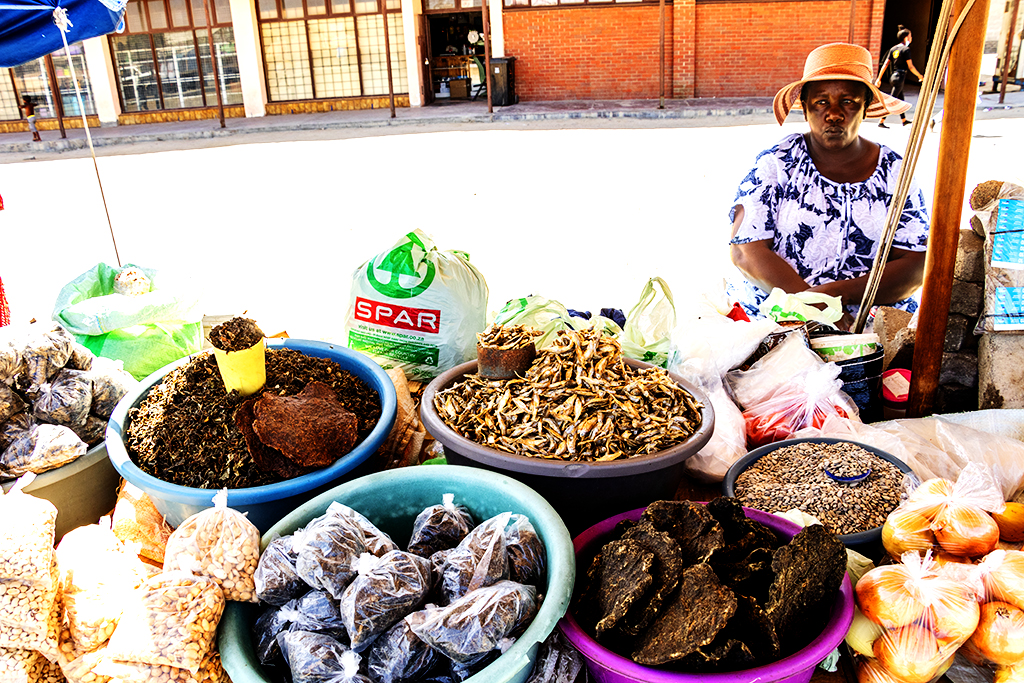
After eight minutes or so, we arrived in Mondesa. Both sides of the streets were jammed with people selling clothing, household goods and food from basic stalls under tin roofs or vinyl canopies. I noticed dried anchovies and roundish cakes of dried spinach. At a grilled meat stand, we nibbled a bit.
“Vietnam is a lot like this,” I said. “I should have gotten a room here!”
The East has often been said to be swarming, with its people likened to the least animals. Visiting Guangzhou in 1889, Rudyard Kipling writes, “The shops stood on granite plinths, pukka brick above, and tile-roofed. Their fronts were carved wood, gilt, and coloured savagely. John knows how to dress a shop, though he may sell nothing more lovely than smashed fowl and chitterlings. Every other shop was a restaurant, and the space between them crammed with humanity. Do you know those horrible sponges full of worms that grow in warm seas? You break off a piece of it and the worms break too. Canton was that sponge.” Much of Africa also teems.
A closer look, though, shows there is quite a gap between Vietnam and Namibia. 99.4% of Vietnamese homes have electricity, compared to 55.2% for Namibia. As for indoor plumbing, it’s 84% for Vietnam and just 35% for Namibia, a figure I didn’t at all expect, but I had only seen its capital, a boutique seaside town and Rehoboth, where, as I already said, an old broad was ready to marry me without knowing my name. As we walked down the street, she even grabbed my hand to place on her breast. All I wanted was to see any old church. Of course, it was weird, but people might do anything if they’re desperate enough.
She said she had had an affair with a married white South African for ten years. In Namibia on business, he’d see her, then she aged. Thinking we were going out to dinner, she washed her hair. Changing clothes, she left the door open to reveal herself in panties. Traveling or just living, you must leave yourself open for anything to happen, but you must know when to stop.

If you think 35% of houses with running water is bad, consider 17% for Liberia, 16% for Benin and Sierra Leone, 14% for Niger, 11% for South Sudan and Madagascar, 8% for Chad or 7% for Ethiopia. By comparison, the worst in Europe is Moldova, with 76%, and the least in Asia is Bangladesh, with 28%.
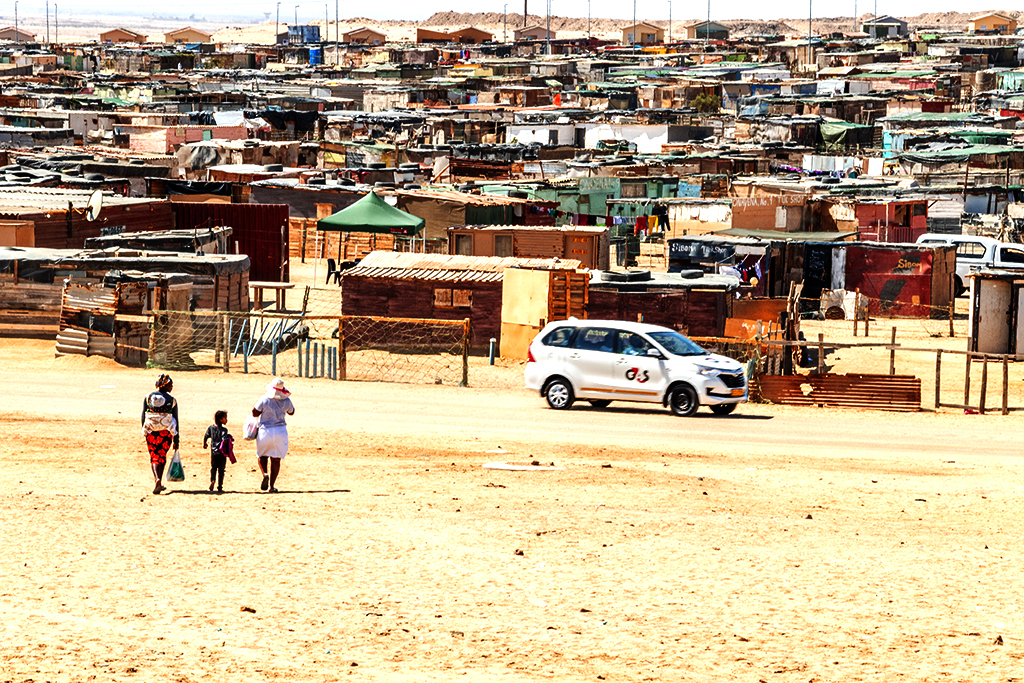
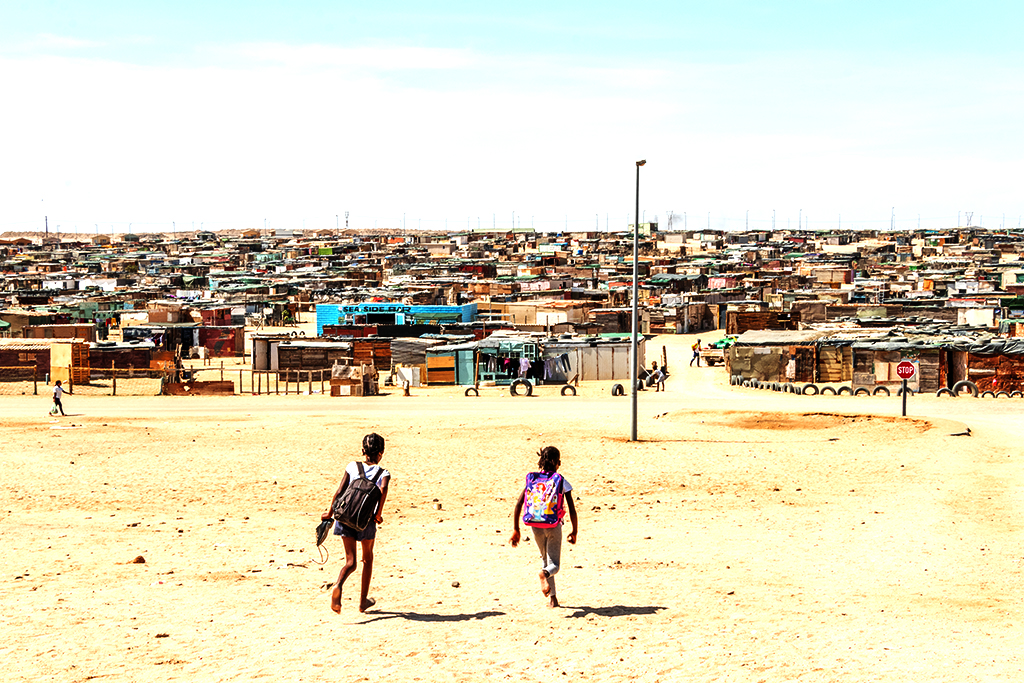
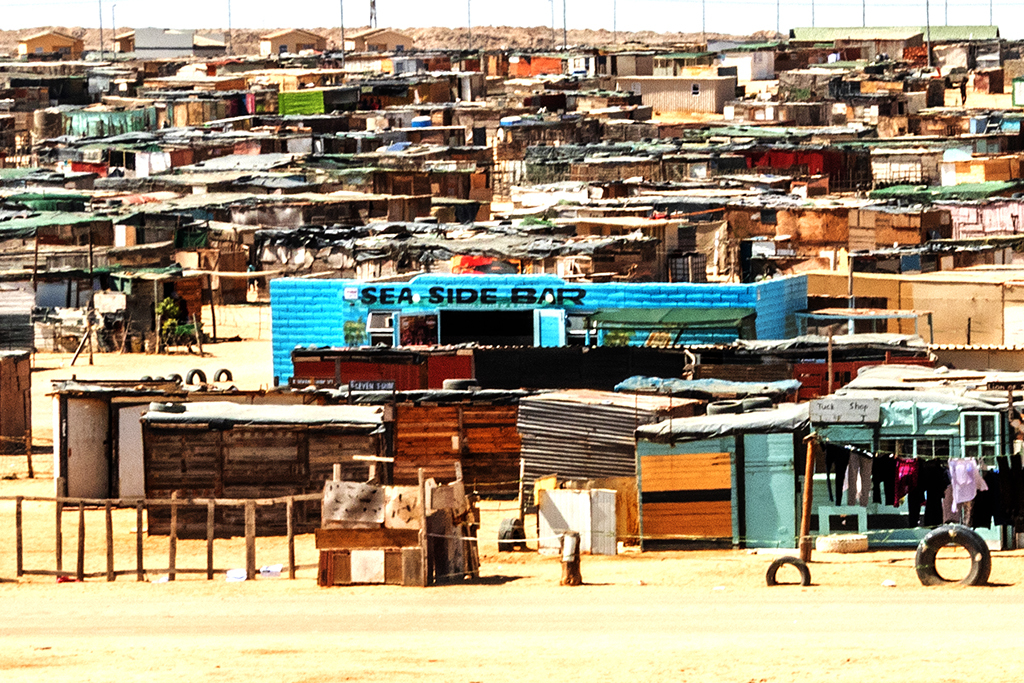
After Mondesa, we drove to a place with a cutely bureaucratic name, Democratic Resettlement Community. From a hundred yards, I could see a spread of wooden, tin or cinder block shacks, all one story, of course, with not a single tree rising above them. There was a corrugated tin building painted cerulean with “SEA SIDE BAR” in black, though the ocean was 3.5 miles away.
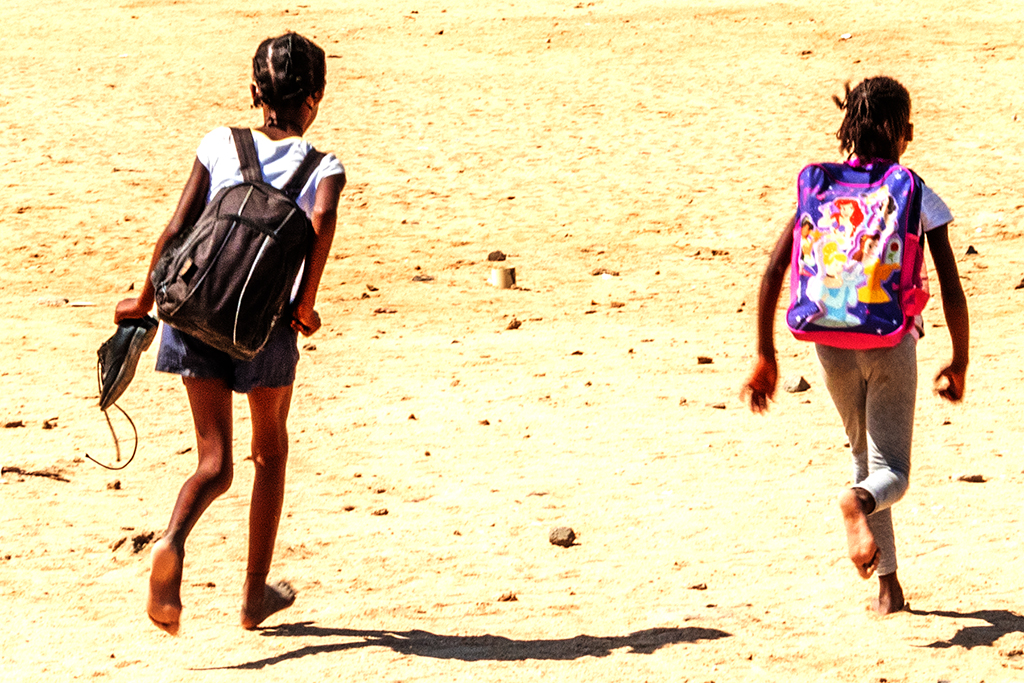
Getting out of the car, I noticed two thin girls, roughly 11 and 10 years old, walking home from school, both barefoot, with one carrying her shoes, to not wear them out, obviously. Europeans used to do this, too. The other probably had hers in her Little Mermaid backpack. Both had neatly braided hair.
As of 2015, Namibia had a literacy rate of 90.82%, so higher than Afghanistan (38.17%), Pakistan (56.44%), Bangladesh (61.49%), Morocco (71.71%), Egypt (75.84%), Cambodia (78.35%), Guatemala (79.07%), Iraq (79.72%), Laos (79.87%), Nicaragua (82.47%), Gibraltar (80.00%), Syria (86.30%), Iran (87.17%), El Salvador (87.65%) and Honduras (88.42%), plus most black majority countries, so pretty impressive. Note also that most Namibians are at least bilingual, for on top of their native tongue, they must learn English to progress through the school system. Many Namibians also speak Afrikaans. In downtown Swakop, I saw a man lugging a cross taller than him, with Biblical quotations in Afrikaans.
“I live here too,” Martha cheerfully volunteered.
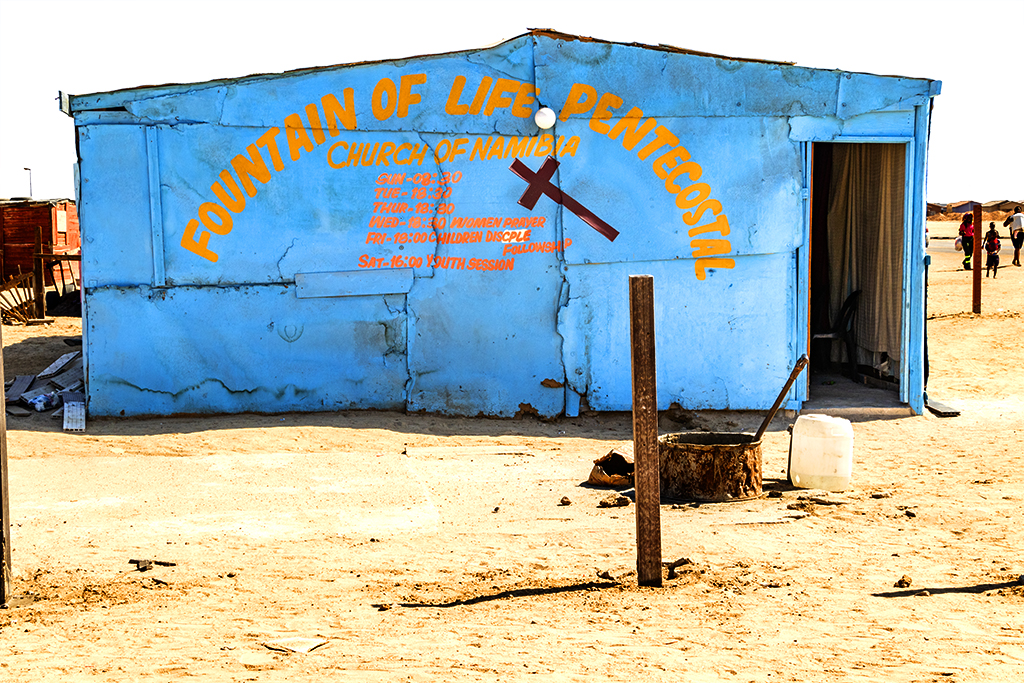
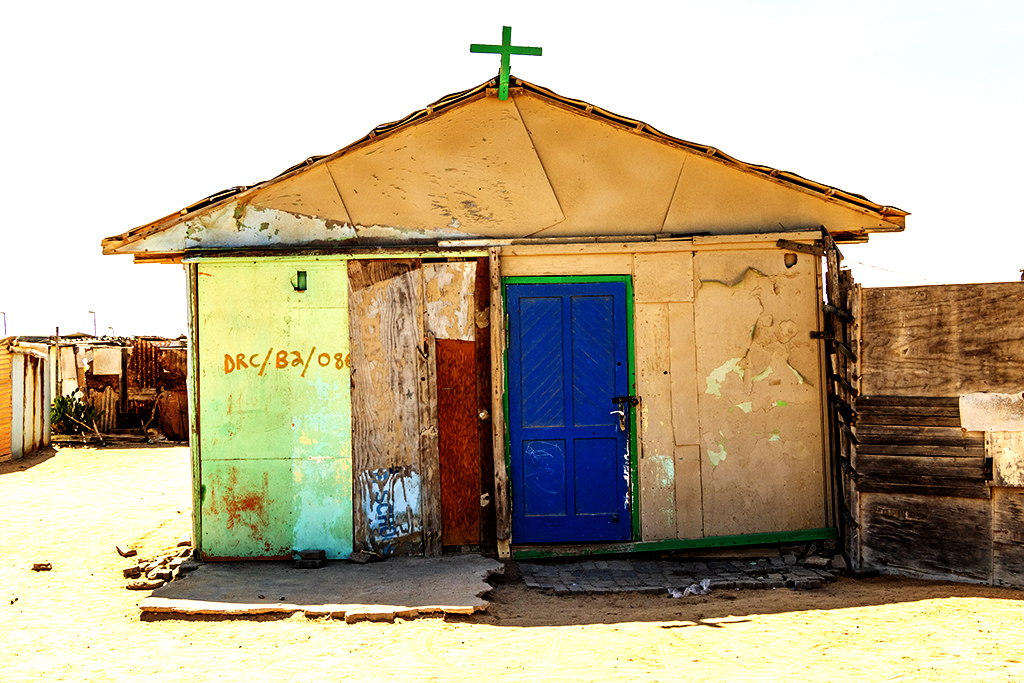
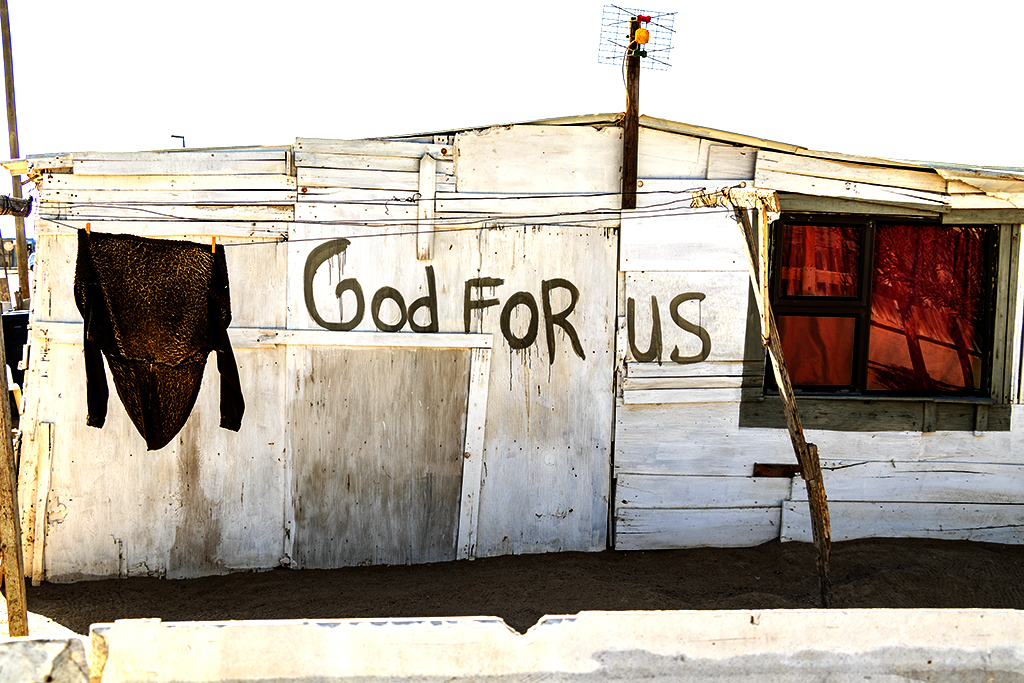
Entering DRC, I noticed it was clean, like the rest of Namibia I had seen. Despite its extreme poverty, there was no visible squalor or foul smells. All the roads were unpaved. The many churches there were cruder in construction than any I had encountered, with whatever planks and boards available slapped together onto a frame. Most were barely painted. Here was a red cross, there a green one. On a whitewashed shanty with a grid TV antenna, “GOD FOR US” was drippily brushed in black.
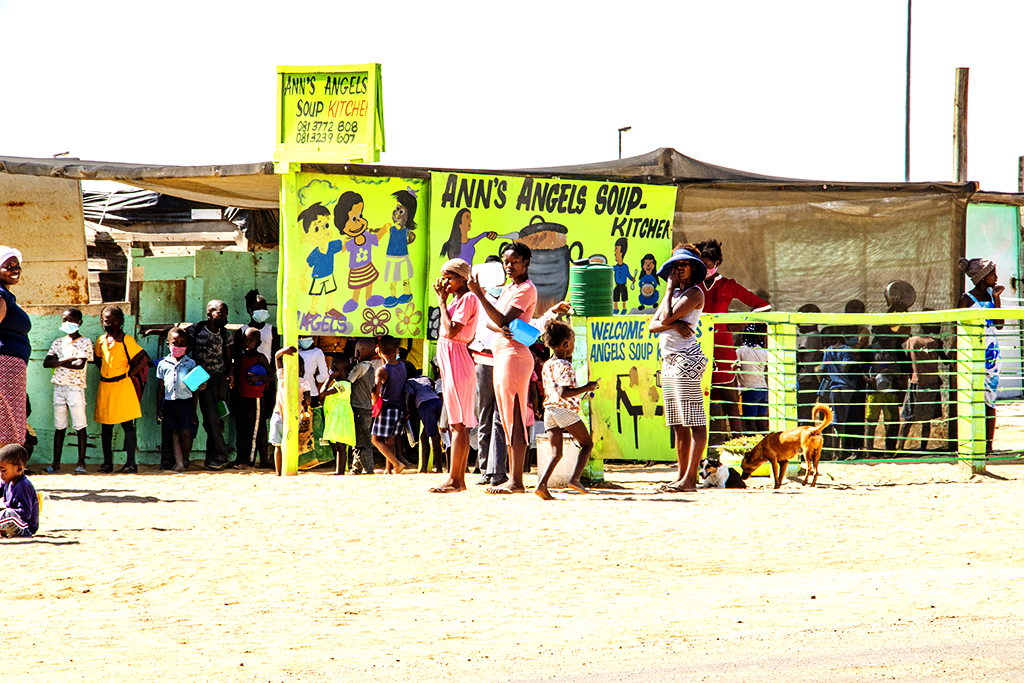
Since black women spend more time on their hair than anybody else, there were also many hair salons. We passed several bars, then a crowd at a soup kitchen, Ann’s Angels, so we got out. Each Wednesday, it serves at least 260 kids. Its bread is primarily donated by Spar Supermarket, rice and spaghetti by Namib Mills, and leftover meat bones by Swakop Abattoir. In a light blue jacket, dark blue pants and deep blue dress shoes, a boy pushed a wire toy car as he carried his plastic container of rice, stew and bread.

Some poverty dilemmas are even more invisible than hunger. On 3/17/22, The Namibian reported, “The problem is known as ‘period poverty.’ Girls miss school, or work, because they cannot afford sanitary pads, painkillers or clean underwear. Some turn to unsafe, makeshift solutions such as newspapers, pieces of cloth and tree bark.” To buy tampons, or just soap and toothpaste, some teenaged girls sleep with older men, so end up pregnant.
By the ocean, two women in their late 30’s said hi. Touching my forearm, one complimented my complexion, then asked if I wanted a massage? Outside an elementary school, a woman of around 40 introduced herself, then said with a worried look, “Do you want to have a good time?” Back in Windhoek, a woman in her mid 20’s shouted, “I need a partner!” Mind you, these happened over four months, so it’s not like Saigon or Naples during wartime. Namibians are overwhelmingly reserved and dignified.
That day with Martha and Chill, we ended up in two bars, not just because it’s impossible to drive around and not get thirsty, but because the quickest way to gain access to any place is to drink and bullshit with the locals. Even when you can’t communicate, just watching people drink and socialize will teach you a lot, so I’ve drank in silence in Prague, Budapest, Cairo and Kiev, etc.
Entering our first DRC shebeen, I immediately felt at home. The bartender was behind a steel grate with its bars too far apart, so a gun could still be pointed at her face, but then, this wasn’t North Philly. A large bottle of Tafel cost just $1.68. I ordered three.
“I feel much better,” I said. “You know, in the city center, there are all these bars, but I didn’t feel like walking into any of them. They were all filled with old people! Namibia should ban old tourists, and ugly ones, too. Don’t let them come in! Of course, that would include me, but still…”
When the conversation veered towards food, Martha said dog was also eaten in Namibia, but only in the north, among the Ovambos. The Hereros and Damaras of southern Namibia find it disgusting. I astounded Martha and the bartender by saying I had eaten cat and, even more astonishingly, snake! I failed to mention the cocopaches beetles and grasshoppers I had in Mexico, silkworm larvae in South Korea, or sparrows, squirrels and rice paddy rats I devoured in Vietnam. It is said the Chinese would eat anything that had four legs and wasn’t a table. Who cares how many legs it has? If it yields protein and isn’t human, just swallow it. To survive, one must be resourceful and waste nothing.

In Swakop, there are hundreds of guineafowls just strolling around, so many, in fact, there are guineafowl crossing signs. Though I’ve been told they aren’t very tasty, I don’t believe it, for with the right seasoning, say, lots of peri-peri sauce, soy sauce, fennel seeds and lime, a wax figure or your night table is a delicacy. Perhaps there’s a law against snatching guineafowls, but as the global food crisis intensifies, these birds will be cooked 16 different ways.
In the US, urban edibles include squirrels, pigeons and sparrows, of course, and an odd possum or raccoon, if you’re lucky. Outside cities, deer, pronghorns, bears, moose, wild pigs and badgers are plenty in various places, so the cannibalism as found in Cormac McCarthy’s The Road shouldn’t be right around the corner, unless that’s your preference. American Indians even ate skunks. Mixing and trading with them, Lewis and Clark’s party of +40 men developed a fondness for dogs.
It’s well known Haitians eat mud pies, but it’s not because of starvation, according to the World Food Program, “Known locally as ‘galette’ these cakes are made out of a special kind of mud that’s rich with minerals. People don’t usually eat them out of desperation, but as a kind of traditional medicine.”
In The Gold Rush (1942), Charlie Chaplin and Mack Swain feast on a shoe for Thanksgiving. Chaplin ladles plenty of “broth” onto the shoe, twirls a lace like spaghetti then nibbles the extracted long nails to make sure there’s no “meat” left.
Back in the car, I suggested we go to a shebeen that served homebrew, which in Namibia usually means tombo. Made of sorghum and brown sugar, it’s ready to drink after just 20 hours of fermentation. There are also alcoholic beverages made from pearl millet (epwaka), bread and yeast (jabula), marula fruits (magou and kashipembe) and makalani fruits (ombike). Since all these drinks were unregulated, it was traditional for the seller, usually a woman, to take the first sip, to prove it was safe, and sharing one’s plastic mug is still standard, to convey sociability. Though this practice can hypothetically transmit strep throat, mumps and the common cold, Namibians reasonably assume the alcohol is a sufficient disinfectant. It’s best to be sociable.
When white South Africans ruled Namibia, they tried to outlaw all homebrews. Coupled with the threatened eviction of blacks from Old Location, near downtown Windhoek, to out of the way Katutura, protests erupted in 1959 that ended with at least 11 blacks killed. This incident became a benchmark in Namibians’ fight for independence, which finally came in 1990. A year later, South Africa ditched apartheid, thus ending all white rule in black Africa.
Even now, homebrews are a contentious issue, but there’s no way they can be banned. Too many Namibians depend on them to get through the day. Like Albanians with their raki, also unregulated, many Namibians gulp some tombo on their way to work, if they have a job. A 2019 study by the University of Namibia revealed tombo drinkers earned less than $33 a month on average!
In a Namibian guest editorial from 2011, this anonymous defender of homebrews amps up his sarcasm, “I also recall that tombo’s skop [kick in Afrikaans] is sometimes embellished by foreign ingredients like battery acid, old shoes and pieces of tyre and if it’s not sifted through the shebeen queen’s dirty underwear it’s not worthy of the name.”
With such a build up, you must be screaming for endless gallons of tombo, so let’s walk in.
The shebeen was crudely constructed with odds and ends, with insulation foam oozing from cracks between its planks and boards, thinly painted in purple. The ceiling was raw wood, and the floor was just sand. About ten men sat on wooden benches.
Following Martha, I walked to the counter. Now, I drink beer almost exclusively, with only rare shots of bourbon or rice wine. When younger, I didn’t mind Southern Comfort or Bailey’s. I have always detested gins and vodkas.
The tombo was a paler red than cherry soda. “How much is this?” I asked Martha.
“Five dollars,” or 34 US cents.
“Wow! I should order ten!” Then I tasted it. With just a slight kick, it was pretty innocuous, so I took a larger gulp. Seeing my enjoyment, Martha and several people laughed. Laughing too, I handed her the plastic mug. She chugged. After another gulp, I gave it to a stranger next to me. Already, the tombo was nearly gone, so I ordered another mug, plus a round for everyone, which cost me but four bucks. So cheap, I would buy one more round.
Curious, a boy walked in. Just outside, a woman started dancing to the kwaito. Swaying and jerking, she mesmerized. Sitting next to Chill, I shook my head, “A Vietnamese can’t do that. Vietnamese can’t dance with their lower body. They just go like this,” and I moved my arms robotically.
“We can dance because we’ve done it since we were children.”
“I don’t know what it is, but Vietnamese just can’t do that. They can’t dance spontaneously.”
Under her pink headgear like a shower cap, Martha started dancing at the counter. Beaming, she looked my way, so I warned, “Don’t encourage me!”
Seeing me drinking so fast, the owner gave me a free mug. Feigning outrage, I grimaced, “There’s no alcohol in this! I don’t taste anything. You’re cheating us!”
The guy next to me said, “You must come back. Come see us again.”
“I’ll try, but I don’t know if I can.”
Red eyed from too much tombo, he added lugubriously, “I will be very sad.” Running two fingers from the inner corners of his eyes, he mimicked tears falling.
Leaving Swakpop three weeks ago, I thought there was a good chance I would return, since I loved it so much, but Vietnam has just reopened to the “unvaccinated,” so I’m ready to say goodbye to Namibia and Africa. I had wanted to continue north to Angola, but that will have to wait until my next life, when I come back as a baboon, lily or paperweight. After two years of bouncing across the globe, I’m simply exhausted.
With insane Covid policies and now a volatile war in Ukraine, the global economy is in turmoil, resulting in outrageous price hikes in oil, natural gas, wheat, corn, soybean and fertilizer. Record droughts and floods for several years have also reduced agricultural yields worldwide. David M. Beasley of the World Food Program, “Ukraine has only compounded a catastrophe on top of a catastrophe. There is no precedent even close to this since World War II.”
Since millions in Sub-Saharan Africa were already malnourished before this food crisis, why would anyone want to stay here, as this situation gets much worse? Food security, though, is a strictly personal issue. As long as you have enough cash, or meat in your deep freezer and bags of rice, etc., you’ll eat even as all your neighbors go hungry. If some of them decide to break into your house, though, you have a serious problem.
Despite its poverty, there have been very few riots in Sub-Saharan Africa, as compared to, say, the United States of America. The rioting last year in Durban didn’t spread to the rest of South Africa, and one of its main causes, economic hardships resulting from Covid lockdown, was hardly mentioned. In the US, the next black man killed by a white cop, justified or not, will likely cause riots.
Whether they admit it or not, Americans tend to associate riots with blacks, so in black Africa, there must be so many riots, they’re liable to think, except that here, the Jewish press has much less influence. Namibia has had just two synagogues, ever. The last one closed in 2015. Racist Jews divide and hollow out. Just look at Ukraine.
On 3/15/22, a reader asked, “Won’t Africa starve if WW3 breaks out?”
I replied, “The markets [in Windhoek] are well stocked, and there’s a thriving black market with people selling produce on many sidewalks. I see fewer homeless in downtown Windhoek than any American city […] Although there are many poor Namibians, including those living in shacks without indoor plumbing, the potential for mass disturbance here is not as great as in most American cities. How many Americans have enough food to last a week, or have relatives nearby who can help them out?”
Atomized, righteous and enraged, they’ll loot and burn down their own communities.