If you have a PayPal account, please send your donation directly to linhdinh99@yahoo.com, to save me the fees. Thanks a lot!

Sample article at SubStack, "The Unliving."
Showing posts with label Chicago. Show all posts

Friday, August 28, 2020

Jewish Shell Games, Mind Rapes and Final Solutions

As published at Unz Review and TruthSeeker, 8/29/20:


You mixed up farewell to an epoch with the beginning of a new one,
Inspiration of hatred with lyrical beauty;
Blind force with accomplished shape.
--Czeslaw Milosz (“Dedication”)

There’s a rather innocuous painting by Peter Saul called “Bathroom Sex Murder,” so this article’s title is also a harmless joke. It’s better than “My Summer Vacation,” no? Of course, I’m not anti-Semitic. Jew canceled, I’m just trying to uncancel myself, bits by bits, with tads of cutesy sensationalism.

Walking into a bar, a guy shouts, “Women are all bitches, I tell you.”

Bartender, “Why, what happened?”

“I’ve just got a divorce.”

“That’s not unusual.”

“You don’t understand. This is, like, my 100th divorce. I’ve lost count.”

“You must be the world’s greatest asshole.” The bartender shakes his head.

“Fuck you, man, and fuck every woman! I’m the greatest guy ever.”

No Jewish comedian, I’m just a chopped liverish travel writer. It is beyond pitiful. We begin:

Because of the Iron Curtain, Communism exuded a dark allure, born of mystery. Growing up in Saigon in the 60’s and 70’s, I often wondered about Hanoi, my mother’s hometown. I never thought I would see it. When I finally visited Hanoi in 1995, it felt positively magical, starting with the ride from the airport.

Much older than Saigon, Hanoi has 36 ancient streets with names like Flower, Coffin, Sail, Silver, Barrel, Paper and Pen, to designate the merchandises sold on them. There are long “tube” houses that resemble indoors alleys. Hutongs are just like fallopian tubes, uteruses and, well, you know, for the whole neighborhood.

My first night, I stayed at a private home. I had my own room, but no toilet. In fact, there was none in the entire house. The communal shitter was down the alley. That wasn’t so magical. As well documented by Orwell, many Londoners lived that way in the early 20th century.

(Listen, man, I’m the least picky about accommodations. In the Mekong Delta, I paid about four bucks to sleep in a plywood box. In the US, I curled up under a truck in near freezing weather. I’ve used many buses and bus stations as hotels. To save a few bucks, I simply bought alcohol and walked around nearly all night, until the train or bus station opened. The sun rose, the sky blushed and I was on my way, on a cushioned seat.)

Anyway, a key paradox of Communism is that it retards progress. Under it, China smelled Taiwan’s and Singapore’s exhaust. North Korea is decades behind South Korea. Guided by Pol Pot, Cambodians marched into the Stone Age. A Canadian friend told me that when he arrived in Laos in 1993, the country only had one working traffic light, and he could identify each car in Vientiane, there were so few.

State monopolies stunt collective and individual growth. How can they not? Worse, government tyranny degrades individuals, when not killing them, by the millions. Still, Communism seduces, because it’s “progressive.”

In Belgrade, I’m again in a Communist-era dwelling. Paying just $385 a month, I get a reasonably spacious room, kitchen and bathroom, with even a washing machine and free wifi included. My kitchen faucet has no hot water, but that’s no biggie. I simply boil water to pour on my dirty dishes. My shower stall is like an upright coffin, which is fine. With only a few ticks left, I can use the rehearsal. I’m getting a great deal, so don’t kill my landlord.

At my first supermarket here, I bought some instant “wedding soup,” I kid you not, but svadbena supa turned out to be just soggy croutons in a salty bouillon. Each packet was, like, less than a buck. You can get addicted to anything, I swear, for should I ever turn into a disgusting vegetable, I want that broth intravenously dripped into my aspiring cadaver. Thank you, Lord.

Hirsute and becalmed, my Serbian landlord seems a stereotypical Druid priest. In the correct lighting, plus a tab of acid, there’s a golden, swirvy halo hovering above his beatific face, but when we finally had a chance to chat over coffee, Wuk, let’s just call him that, admitted he was just an old hippie.

“When I grew up here, with my long hair and beard, people often said, ‘You belong in America,’ but when I finally went to America, I was told to cut my hair and beard off.” He laughed. “I had a job with Mister Softee.”

“Mister what?!”

“Mister Softee, the ice cream truck.”

“That’s hilarious. Where was this?”

“Chicago. I was in a student exchange program.”

“Did you go anywhere else in the States?”

“I went to New York, and Ocean City, Maryland. That was nice.”

“How come there are so many Serbs in Chicago?”

“They went there after World War II, to work in the steel factories.”

“In Gary?”

“I don’t know.”

“Gary is a mess, man. There are no more steel mills in America. The biggest American steel mill was in Pittsburgh, but that’s shut down, and the one in Bethlehem is a casino.” I paused to let this sink in. “Sands Casino bought Bethlehem Steel, built a casino on its ground, but they never tore it down, so the chimneys, you know, the stacks, are still there, because they look cool.”

Wuk smiled. I laughed, “So every day, there are all these buses coming into Bethlehem from New York City, carrying Chinese, mostly. New York doesn’t have a casino, you see, so all these Chinese have to come to Bethlehem, to lose all their money!”

Wuk is well-traveled. Beyond Europe, he had visited Lebanon and Israel. “With a Yugoslavian passport, I could visit both Communist and Capitalist countries!”

In the 60’s, Tito issued passports quite freely. In nearby Albania, if someone managed to escape, the state arrested a family member.

Wuk had just returned from Greece, “I was on a beach, and it was almost empty, because of the coronavirus!” The next day, he was headed for Kosovo, “I’ll be in the mountains. I love nature.”

“Is there any problem with you going there as a Serb?”

“No.”

It was pretty ugly not so long ago. Wuk remembered, “I had a pizzeria in Brac. That’s in Croatia now. The Muslims wanted to build a mosque there, but the Croatians didn’t want it, so there was a problem. The Muslims had to run into my pizzeria and hide.”

“Wow.”

“Then there was a problem between Croatians and Serbs. All these people came into my restaurant and threw my chairs into the ocean!” Wuk shook his head. “I knew these people. I drank beer with them. Soon after that, I put everything on a truck and left.”

“So you knew these people?”

“I knew them all! We were friends. My wife always went to Brac for vacation, since she was a child.” Wuk lowered his right hand to the height of a dog.

“That’s amazing. What do you think caused all this?”

“The politicians.”

Henry Adams did say, “Politics is the systematic organization of hatreds,” but those divisions must already exist.

Wuk, “Three years after the fighting, my wife returned to Brac, and everything was OK.” He laughed. “Before she went, she was a little nervous, you know, because the people she knew, maybe they had a relative, a husband or a brother, who died during the war.”

“But everything was OK? They were friends again?”

“Everything was OK. I don’t understand it. If I talk to somebody about politics, and we don’t agree, it’s OK. Let’s just play football!”

We talked about the States some more, about the bloody chaos erupting daily in too many places to list.

“Just look at what’s happening in Chicago, man,” I said. “Did you go all over when you were there? There are neighborhoods people just avoid. Black neighborhoods.” I chuckled. Wuk flinched slightly.

“No, I didn’t go to too many places.”

“Good for you. In Philadelphia, I went everywhere, because I’m a writer, and I was curious.”

“Once when I was waiting for a bus, a police car stopped. The cop asked what I was doing there, then he gave me a ride to where I was going. That actually happened twice.”

“He could see you didn’t know where you were!” I laughed. “Here in Belgrade, I can walk anywhere, any time, but you can’t do that in most American cities, man. Every day in Philly, there were, like, two murders, and almost all of the murderers were black. I’m not kidding. You know, the black murder rate is six or seven times higher than whites’.”

Clearly frowning, Wuk said, “That’s because they’re poorer.”

“It’s not just that… Most Americans don’t have time to figure it out, man. They just avoid black neighborhoods. Most blacks also avoid black neighborhoods, if they have a choice.”

We moved on from the uneasy topic.

Checking New York and Chicago news for my last article, I discovered two trivial items, by American standards. A 28-year-old black man had just been arrested for stabbing four sleeping homeless people in neck, killing one. Collecting aluminum cans, an 81-year-old man was slashed in the face by a black, totally unprovoked. The attacker and his two companions have not been caught.

Here in Belgrade, there’s a Patris Lumumba Student Dormitory, and the Red Star’s leading scorer, for 2+ seasons, is a Comorian, El Fardou Ben. (The Partizan’s leading scorer is a Japanese, Takuma Asano.) On the streets, I seldom see blacks, and though the Chinese are clearly here (1,373 according to the 2011 census), they’re hidden inside their restaurants and stores. Before the current tourist drought, Chinese were quite visible in major Serbian cities, I’ve been told, and signs in touristy areas are in Serbian, English, Chinese and Russian. (In South Korea, subway train announcements are in Korean, English, Chinese and Japanese.)

What I haven’t seen in Serbia is a Tito statue, though I’m sure there must exist a few somewhere. Without uproar, his bronze likenesses had been removed.

Tucked into a corner of Café Liberte, there’s a small double portrait of Tito and Ceaușescu, the Romanian Communist dictator. Thanks to Jewish brainwashing, only right-wing despots are condemned, while genocidal Commie leaders are lionized as great leaders of “the people.” Communism bred, challenged and inspired Fascism.

Looking so harmless and gay, Ceaușescu reminded me of Liberace, but the dude jailed and killed plenty of people. At age 71, this vampire finally sniffed garlic. With mobs howling for his neck, and hundreds of soldiers volunteering to shoot him, Ceaușescu and his wife were executed together.

As for Tito, he’s often depicted as not so bad, but any man who runs a country for nearly three decades without an election is clearly a dictator.

Belgrade’s most monumental building is The Church of Saint Sava. Began in 1935, its construction was interruped by World War II, then banned by the Communists, so that it could only resume in 1984, four years after Tito’s death. In 1985, a hundred thousand joyous Serbs attended a liturgy at this magnificent temple.

Though the writer Momo Kapor never suffered the worst of Tito’s reign, he still describes it as an era “full of deprivation and misery—a time when beautiful things were so scarce,” when “the bravest fled to the West across mountain ranges or by hiding between the wheels of a railroad coach heading west.”

Recently trapped into renting a depressing room by the ocean, Kapor laments, “It reminds you of your shattered youth, a psychic space you’ve spent a lifetime fleeing, only to return to it now, on your vacation.”

Even when praising the folksy šajkača, Kapor contrasts it with “the terrorism of Tito’s caps.”

Though Yugoslavia’s Communism was mild compared to perhaps everywhere else, it was evil enough, so Kapor’s bitterness is understandable.

Even when you’re not killed, jailed or starved, your psychic integrity is continually violated, so just imagine enduring that for year after year, or even an entire lifetime. No man anywhere likes to be told how to think correctly about everything.

With its budding political correct idiocy, America is just getting a taste of this Jewish poison.

Jewish bullshit is truth! Jewish war is the spreading of democracy! Jewish brainwashing is higher education! Jewish revenge is healing! Jewish us-against-them is universal brotherhood! Jewish destruction of your heritage is the new enlightenment! Jewish divide-and-conquer is more dining options! Jewish slave trading is Black Lives Matter! Jewish genocide is Remembering the Holocaust©! What a gas!

Although Jewish thinking seared the 20th century, the bloodiest ever, it was also an era of petrochemical affluence, so for those whose lives weren’t wrecked, it may have been fantastic even, but that joy ride is over.

With your politicians all bought or browbeaten by Jews, your Jewish media perverting all facts, your cities in chaos and burning, your kids addicted to porn or sexually confused (and hating themselves if they’re white), your common folks savagely caricatured and your religion relentlessly mocked, it should be clear by now you’re living in a world of Jewish shell games, mind rapes and final solutions.

Jewish hell is utopia, for morons, corpses and hypocrites.

Wake up, man, and I don’t mean woke, obviously.

Man up before it’s too late.

Failing to do so is worse than toxic.

It’s almost midnight.


Thursday, November 23, 2017

Obscured American: Helen the Writer and Aspiring Prepper

As published at Unz Review, 11/24/17:


Millions of Americans still have ties to their ancestral country. Two years ago, I met an 54-year-old man who would periodically visit his family home in Abruzzo. Its grape vines and olive trees had been sold a long time ago, and the house itself was little more than a husk, thanks to thieves, “Locals, not gypsies, have broken in to steal just about everything. Each time they see me, they shout, ‘Ecco l’americano!’ They ask all kinds of questions about this country. I love Italy, but I love America more. Everything is better here. Everything.” Despite all that, he still owned the house, so Italy still held him.

My friend, Nguyen Qui Duc, had a successful career in radio broadcasting. He worked for the BBC and NPR. In his mid 40’s, however, Duc decided to move back to Vietnam. Now, he owns two houses and three businesses there, including a Hanoi bar, Tadioto, that has been featured in TIME Magazine, the New York Times and on CNN, etc. When I saw Duc a month ago, he was happy and relaxed, so it’s safe to say he won’t head back this way.

In Hanoi, I met several Vietnamese-Americans, including Helen, a 33-year-old Chicago native who had been living in Vietnam for three years. She told me about her ordeals in Vietnamese public hospitals, where you must tip each nurse and doctor to get decent treatment. Used to American standards, Helen had no idea.

My father is a very traditional Vietnamese man. He was born in the 30’s. He also had a really strange life, because he was an orphan. His parents both died when he was eight or nine.

His father's body was never recovered because he died on a mountain in a landslide caused by Japanese bombings. His mother's body was never found because she was on a train that was bombed by the Japanese. The last time he saw his mother, she came by the pho stand where he worked and they hugged, then she got on a train.

So, he grew up alone, and his whole goal was to have a family. He thinks a lot of security comes from family because he didn’t have it. He married my mother because she was, you know, a hot, traditional Vietnamese woman, and I think later in life, he realized that maybe you should get married to people for other reasons. They’re still together though.

My father doesn’t talk about it very much, but he was a part of the South Vietnamese Army. He didn’t see combat. He worked in logistics. He also taught English to other Vietnamese people because he had studied English at university. After his parents died, my father decided to become a poet and changed his name to Văn Sơn [Literature Mountain].

He was an extremely handsome young man and would juggle five to seven girlfriends at a time. I like the story of his first love: he was tutoring a beautiful rich girl who was a few years younger. They’d leave each other love notes in the tree outside her gate. One day, he went to go pick up the love note and it was a letter from her parents, informing him that they’d shipped her away to France and that they’d never accept a penniless orphan as a son-in-law.

In fact, I think of this often because I don't think I'd exist had there not been an exodus in 1975. Given the class distinctions, my parents would have never met. There was a big class difference between them. I think it was a big chip on his shoulder. He was like a Charles Dickens orphan or whatever.

My mother’s family has been, I think, always connected to the government, under the French, and before that, mandarins in the imperial government, way back. They were always very wealthy. My grandmother lived in the Old Quarter of Hanoi and her family owned a fish sauce operation. During World War II, my grandmother told me that people were starving, pushing dead bodies in carts on the streets. Her family made congee for everyone on the block.

In 1954, my mother was a year old when her parents decided to move to Saigon. They got into a car accident and flipped off the mountain road into a river. French soldiers heard her crying and helped them out. Everyone survived.

In the years leading up to 1975, my mother had been set up with the sons of rich families by matchmakers. She tells me that she didn't like any of them and would botch the tea ceremony to make herself look like an unacceptable candidate for daughter-in-law.

On April 30th, 1975, my father left on a helicopter from the US Embassy in Saigon, thanks to an American friend of his. My mother's family boarded a boat after a harrowing drive through the city, all 10 of them crammed into their luxury vehicle. She was narrowly missed by bullets on the boat. My parents met on Wake Island in the South Pacific, and then they met again in Chicago at a mah jong and pho party on Argyle Street. At the time, my mother's family was living in Milwaukee.

She was 22 when she came to the US. My father is much older. They’re about 20 years apart. They were married a year or two later. My mother moved from Milwaukee to the West Side of Chicago. She was terrified by all of the gunshots from gang wars in the 1970s, so my father moved them over to Elmwood Park, a suburb. They opened a restaurant. It started out as a hot dog stand in Oak Park, but my father thought, because he had learned how to make pho as a kid, “Why don’t we switch over to Vietnamese food?” It was one of the first Vietnamese restaurants in Chicagoland.

The Vietnamese community in Chicago loves my mother’s food. She once sold 2,000 eggrolls at $1 a piece to pay for my braces. She's the type of person who can identify every ingredient in a dish blind-folded and she can also recreate most dishes after tasting them once.

Growing up, I felt like my mother wasn’t the type of girl I would have been friends with. She was like a really hot, rich girl. I mean, she’s a kind person, but there are things she didn’t have to think about when she was growing up. She grew up rich, I grew up poor, so I didn’t connect with her very much when I was a teenager.

So, she grew up very, you know, in her own bubble, in her own wealthy bubble, and even when they moved to Saigon, she lived in a mansion of some sort. They employed a professional chef in the kitchen, someone who had mastered Vietnamese, Chinese and French cuisine. When I talked to her about what had happened during the war, she said she didn’t really experience much of it because she lived in a bubble and went to a private school.

When there are issues to solve, financial issues or whatever, my brother, father and I will jump on and try to figure out what to do, and she’s like, “Everything will work out!” She’s very optimistic in this way that, like, only rich people are, you know? Her big thing is, she really does believe in America. She’s like, “Well, you show up, you work hard, you help people, people help you and everything will be OK.” I think maybe, in some ways, it actually does get her far, like she has a lot of friends from different walks of life. She’s a social worker in non-profit. She’s a really caring and smart person.

My mother scrubbed toilets in a bowling alley, actually, her first year in the US. Then, after she moved to Chicago, she worked for a while for this travel agency run by Japanese Americans, which was really cool. They were old Japanese Americans, who had been interned, so they were really, like, for me, the first non-Vietnamese, Asian Americans I met as a kid.

The restaurant eventually went out of business, and my parents had to declare bankruptcy. My father got a job teaching ESL to new Vietnamese refugees. My mother spent most of the 90’s helping other Vietnamese who were new to the US, as a translator, and there was a lot corruption at that time, like older Vietnamese refugees would try to charge newer refugees a lot of money for services. There were guys who were like, “If you want me to drive you to the health department or welfare office, you’ll have to pay me a hundred bucks!” It’s like, “If you want me to translate this for you, if you want me to help you get your benefits.” My mother was the only one, she told me, who was doing everything pro bono.

She wasn’t around a lot when I was a kid, because she was out helping the other families. She had a lot of, like, I want to give back mentality. She’s a very kind and generous person. In some ways, she’s kind of naïve, maybe. I think I’m a lot more cynical.

Yeah, there was always a struggle with money. It was OK, we managed, but in my early 20’s, my parents were losing their house because of the housing crisis, so they kind of guilt tripped me into buying them a house. They were like, “We’re going to lose our house, but this is what we’re going to do. Since you have a job, and you have really good credit, since you’re, like, 23 and you haven’t fucked your credit up, why don’t you find a loan and we’ll pay the mortgage, right?”

I spent most of my 20’s as a homeowner, but I didn’t even live in the house. It was a subprime, 30-year mortgage. I was 23 and making $18,000 a year, working in a non-profit. So I got a mortgage at 23, which is absurd.

Eventually, my parents couldn’t pay the mortgage, so I had to pay most of it. When I was 29, I decided I couldn’t do it anymore, because I had spent most of my 20’s working and paying for this house, in the middle of nowhere, one of those weird new developments in a cornfield. I was like, “I’m going to get rid of this house, you guys have to figure something out, and I’m also moving to Vietnam. I’m done.” So my credit was so fucked, I couldn’t even, like, get an apartment. I couldn’t get a credit card. I couldn’t do anything.

It did cause a tension between me and my parents, but over the years, it has worked itself out. I think they realized that it was a big financial strain, but this is a part of, like, the whole thing where my mother just doesn’t understand how money should work, and my father was a little bit, like, OK, she’s very demanding and whatever, so he kind of went along with it.

I was working for a non-profit in Chicago, an alternative education program for students who are wards of the state. I worked with teenagers who had re-enrolled into alternative high schools after being expelled. Some students were homeless, and we had educational programming for them to get their HS diploma.

One of the students I worked with, Laquan McDonald, was killed by the police in October, 2014. You know, when you work in communities for a while, it’s kind of hard, it’s really draining, and although it was work that was, in many ways, rewarding, I felt I didn’t have any energy to do anything for myself. I wanted to write, and figure out what I wanted to do next. I did feel a little bit trapped.

I didn’t really get a chance in my 20’s to, like, explore what I wanted to do. Maybe I wanted to go back to school or do something else, travel. I was working basically from the time I was out of college until I was 31, and then I sold the house. When the house was sold, I felt like I was untethered, so I could move forward and do what I wanted, so I decided just to move to Vietnam. It’s cheaper to live here, you know?

It is the ancestral home, yeah. I felt I had enough Vietnamese to get by, that wasn’t really a concern. My Vietnamese has certainly improved since I’ve been here. You know, I can get what I want, talk to the landlady and have interesting conversations with people every now and then.

To me, it seems like there is a lack of diversity of thought here. I realize that people are educated in a single system, you know, a single party government, so it’s, like, not encouraged to debate. You memorize stuff. I taught two kids when I first got here, and there was no space for thinking outside what you’re told to think. You can tell many people are unhappy, but no one says much about it. It’s, like, they’re resigned. This is just the way it is.

That’s hard for me, because I was coming from a place where my work was actively trying to change policies in education. I started a student activism group before I left. It’s hard to come from a place where you think you can make a difference. Maybe it’s just an illusion that you can change things, if you try hard enough, but here, it doesn’t feel like there’s much trying to change stuff, you know?

The gender thing is really tough here. You know, women my age are married with four or five kids, so it’s already weird that I’m unmarried and I’m here writing a sci-fi novel. They think it’s weird that I would leave my family abroad. I get annoying questions all the time.

When people here meet me for the first time, it’s always the same questions. I get annoyed, because most conversations seem to go the same way. It’s not them – they’re meeting me for the first time, but for me, it’s always the same – Where’s your husband? Why are you not married? Is there something wrong with you?

Being here has made me feel more American than anything. You know, I never felt very traditional Vietnamese. I feel like in the US, you’re kind of put in a corner, because of the racism. Here, I feel so American. I disagree with everything, and I feel OK saying it, but it’s not OK to say stuff, so that’s really tough.

Body stuff. You’re supposed to be, like, 60 pounds, and you wear, like, white face makeup. I don’t do any of that, you know. There’s a whole beauty thing here where women want to whiten their skin. It’s like a look that you’re supposed to have. It’s sort of a status thing. I have a friend here who’s an accountant. She was told that she was too fat, so she had to lose weight or she’d lose her job.

The craziest thing that happened to me, though, was that a friend of mine, a white American guy, got this lead on a job where you record the voiceover for an English textbook. They were like, “Oh, we need a woman, an American woman,” so he’s like, “OK, I’ll bring my friend.”

When I got there, they were like, “Oh, we need an American!” He’s like, “She is an American.” “No, she’s not. She’s Vietnamese.” I was like, “Wait. I’m not Vietnamese. You’re looking at my passport,” and we got into this long argument, like a two-hour argument, that was mixed with Vietnamese.

I was like, “I’m not Vietnamese. Like, I wasn’t born here. I wasn’t raised here. I don’t speak Vietnamese very well, anyway. My mother tongue is really, at this point, English. And I was an English major in college. I did the voice over for the Vietnam Women’s Museum, in English. Like, I can record your shitty textbook, for three hours! I can read basic English!”

They were like, “No, no, we can’t. We can’t hire you.”

She started doing this thing when she was challenged, “Well, the thing is we need people whose grandparents were American.” And my friend was like, “My grandpa was in fuckin’ Auschwitz! He’s not American! I’m just white, right? If you want a white person, just put it in the job description.”

They were like, “No, no, it’s not about race. It’s not about discrimination. It’s just whether or not you’re American!”

I was like, “What is American? Sitting Bull is dead. English isn’t native to the US, you know.”

Oh my God, it was so fucked up. The conversation was absurd. Everything I said, she would come up with a new reason that I wasn’t an American. It was like every reason that you could think of, that like a birther in the US would come up with. Oh, no, no, no, I need to see your passport! I need to see your birth certificate!

The final thing was, “You have an Asian accent, so I can’t hire you.”

I was like, “You are the first person in the universe to ever tell me I have a quote, unquote Asian accent.” I sound like a fuckin’ Midwesterner.

In Chicago, in my twenties, we’d go to punk houses and, you know, they were rundown spaces where you would go see bands play and hang out with your friends. I really thought that would have prepared me for whatever was going to come my way in SE Asia, and I mean like, you know, needles on the floor and shit on the ground. Like human feces.

In Vietnam, sometimes, yeah, there’d be bits of shit floating. There have been bathrooms where there was, like, an inch of water, and there’d be, like, shit in there. Everything is covered in water. I guess I haven’t gotten used to it. Like, I’ve never seen a bathroom that has not been moist. I go to Tokyo and the bathroom is super clean, and you can piss in a convenience store in Tokyo and know you’re not going to get sick.

I went to the hospital after I had a motorbike crash, and there were doctors playing cards. This was like three in the morning, and they were like, “Hang on a second. I’ve got to play this hand,” and I’m like actually bleeding, like hemorrhaging, from my mouth.

They were like, “Fill out these forms,” and I’m like, “I can’t write on your paper because there’s blood falling from my mouth.” And they were like, “OK, let me take your X-ray,” and all the hospital lights were off, you know, because they were conserving energy.

The nurse got lost on the way to the X-ray, and then at the X-ray, I’m like, “Where is the jacket thing you’re supposed to put on me so that I don’t get, you know, poisoned by the radiation?”

She’s like, “You don’t need that.”

“No, I want the thing,” so I told her to go find it.

You know, you have to share hospital beds, so they put me in a room with, like, a bunch of old grannies, and the grannies were really mad at me because I didn’t take off my shoes. You’re supposed to take off your shoes. I’m like, “I’m not going to take off my fuckin’ shoes!” The floor was really filthy. I’m already bleeding, and I’m not going to take off my shoes.

My friend picked me up and took me home. They were like, “She’s fine. Just give her some cotton.” The next day, it started bleeding again, and my friend took me to the hospital again, and they were like, “Oh, we can’t treat you. You should have gotten stitches last night. Now, you’re infected, and we can’t treat you. We’re not responsible for that. Go to this other hospital.”

The first hospital they sent me to, there was a gang fight outside, so it was a mob fight, OK? Inside, there was a guy screaming on a bed because he had been thrown through a window, and they were pulling glass out of his back, and they were like, “We can’t treat you. You’ve got to go somewhere else.”

So they sent us to another hospital, and at that hospital, everyone was sleeping, and the nurses, when they saw me, they were like, “Argh! Ewww! Like, this is so gross!” Finally, the doctor did give me stitches, and it’s fine. Everything is fine.

This is why I’m writing sci-fi. It actually came out of my accident, that I’m working on this sci-fi novel.

Recently I took a friend to a hospital, and they sent him to this other hospital that was far outside the city. It looks like an evil villain’s high-tech facility growing out of the rice paddies. Taxi drivers were fishing in the stream out front. Inside, all the lights were off and not a single person to be found for six floors. It’s like the zombie apocalypse, like everyone’s dead.

Finally, upstairs, I found a nurse who was sitting in the middle of the hallway transferring blood between two bags, spilling it everywhere. This blood cocktail sat on the ground for six hours, I timed it. When they mopped the floors, they used ONLY detergent and no water, so when you walked down the hallway your feet slid all over the soapy film.

The nurses told me I should learn to change my friend's needle and drip when the medicine ran out because they might be busy. I said no.

They’re like, “Oh well, so here’s your room. You have to make your own bed.” Then, they give you an appointment where you have to go down yourself to get your X-ray. No one takes you anywhere. No one tells you anything. It’s really sad. I guess no one gets paid enough to do stuff.

When I got in a taxi to go home, the driver fucked with the meter and I ended up paying 3x the amount. I was like, “You just picked someone up at a hospital where I was with this sick person for, like, ten hours. Why are you trying to fuck me right now? Like, go do that to a tourist somewhere. Why are you doing that at a hospital?”

He did that thing where he lowered his head in shame but nevertheless demanded the money. It’s really depressing.

Well, I’ve stayed because I had to heal from my accident. Another part is that it’s very cheap to live here, so you get a lot of free time to do stuff. I’ve traveled a lot. I’ve been to every Southeast Asian country except for the Philippines and, I think, Laos. I’ve been everywhere else, in three years, and that’s working on a salary that’s, like, you know, a third of what I used to make.

I’ve been able to travel, paid for surgery and dental work, and, like, travel every other month. Outside of Southeast Asia, I’ve been to Japan and Hong Kong. It’s been really amazing. I don’t know of a situation where I could have done that, any other way.

Before this, I wasn’t a big traveler. I would visit friends around the States, New York, LA, San Francisco, you know, different cities in the States. I went to Europe a few times, Germany and France and, like, Hungary.

I didn’t have preconceived ideas about what this part of Asia was like, so I’d just show up in places. I usually don’t do very much research before going to a new place, and I try not to do very touristy things. I show up and just wander around, and kind of hang out in places, so I haven’t seen many, like, major sites, but I’ve been to cities and hung out with different people. I’ve been in nature, jungle areas and stayed in home stays, that kind of thing, just hung out with people and talked, and it has been really cool. Like, you get a really good sense of how life happens in many different ways, you know. It’s very different from the American way of life, and what you’re told in the US, too, I think.

Asia is the future. I flew into Hong Kong last June, on a transfer to New York. Hong Kong Airport is phenomenal, a beautiful building, and I showed up in JFK, and, like, it’s a shithole. There are so many parts where you can see that the US is in decline, and there are parts of Asia that are building up, like Singapore, Hong Kong and Japan. You go to places in some parts of Asia, and you’re like, “Oh, these are functional, efficient cities with very new, you know, advanced infrastructure. And the US very much feels like old, 20th century. It feels behind.”

I think the US is too insular. It hasn’t had to… It’s like when you’re the popular kid in high school, who has the whole world going for you, and you don’t have to do a whole lot of work. You know, like you think you’re really awesome? The nerds work a little bit harder.

I think Asia has been trying to catch up, I think. It comes at a cost, but you see a lot of beautiful new buildings and, you know, access to a lot of things… You can get anything here. Like, I had an incredible Italian meal in Cambodia, you know, so it’s not not diverse.

When you have to work a little harder to catch up to the Western world, and you still have a lot of ground to build on, things are just fresher and newer, whereas it doesn’t seem to me like the US sees a need to change or grow. I haven’t been to Europe in, like, ten years, but it doesn’t sound great there right now.

If you don’t travel here, I don’t think you know what’s available here, like Bangkok has a really amazing public train system. It’s very fast. It’s very clean. It’s incredible. Then you go to New York, and you’re, like, in this shitty subway that was built in the 19th century, that got flooded during a hurricane. I mean, there are monsoons here. I just think that the American infrastructure is just old, and people don’t invest in it because they don’t feel like they have to. It’s functional, so it’s OK.

Singapore is so beautiful and clean. People respect the space they’re in. I don’t feel like there’s very much of that in Vietnam, or, actually, in the US. I don’t want to bash Vietnam, because I think Vietnam has gone through a lot, and I enjoy a lot of things about being here. I don’t know how to put it, I guess everything feels like it’s very present. In that sense, it’s a charming place to be because everything is very much in the present, but there doesn’t seem to be long-term infrastructure for, you know, the future.

It doesn’t seem like people really care, like you can see that in the bathroom, for example, where it’s like, “You know what? I’m just going to dump this water here or piss on the toilet seat and not care about the person who comes after.”

It’s like, “I take what I can when I can take it,” and I understand why that’s the way it is, but it’s kind of depressing. You see it on the street. The other day, I saw someone hit someone else on a motorbike, and you don’t even stop to help someone because, basically, they’ll just try to milk you for money. That was advice someone gave me when I first got here – don’t stop for anyone. It’s like, “Oh, you’re the one who hit me,” if you stop to help someone. Most people, their immediate instinct is to help someone up, but if you do that here, if you have that instinct, then you’re kind of fucked over.

I don’t feel like a hatred, but it makes me kind of depressed, actually, like I just get depressed a lot here. So you just get to see people at their most present, in a way. We already know that people are really selfish, and self-preservation is really important, so you just see it more so here, because there’s no padding, you know? Of course, I’ve also experienced moments of kindness.

I miss the US’s diversity of culture. I worked in mostly African-American and Latino communities before, in Chicago. I have friends that are from different places, different cultures, backgrounds, and here, in Vietnam, it’s very, for the most part, just Vietnamese. Still, I feel that there’s a lot of ignorance in the US. My motorbike taxi driver, during the hurricanes in Texas and Puerto Rico, asked me if I knew anyone there, and if everyone was OK? How are people dealing? Like, they read the news, and heard about it.

When there was flooding in Hoi An, or in northern parts of Vietnam, not a single person in the US asked me anything about it, like at all. It’s just not reported. Like, no one seems to care or pay attention to anything that happens in other parts of the world.

I actually turned off my Facebook newsfeed, so I’m out of the loop on what happens in the US these days. There have been a couple of shootings in the last few months, and, like, some guy in New York did something, I don’t actually know, but my friend mentioned it to me, and I was, like, “Stop! I honestly… I don’t care.” The US can do something about it, and they don’t.

It’s quite difficult being in your 30’s and making friends with Vietnamese people, because most of them have families and kids already, so I don’t meet many Vietnamese people my own age.

As for the foreigners, you meet other Westerners, mostly, English speakers. I’ve made a few good friends who are foreigners like me, but beyond my small group of friends, I’m really disinterested in most of the other foreigners. Lately I’ve had horrible conversations with, like, just shitty, white European men, like this Belgian guy who actually said that, “King Leopold colonized Africa because all these savages were infighting anyway, so he saw an economic opportunity.”

I was like, “It’s 2017. Like, do you really believe that? Like you believe, quote, people were savages? You’re dehumanizing people, because you expect them to work on your fuckin’ rubber plantations for free.” This guy really thought of it as just an economic opportunity, but refused to acknowledge racism.

These are conversations with, like, white European men here, who are, like, you know, guys who live here because they can’t get fucked in their own country, and they’re, like, just fucking young Vietnamese women because they come off as wealthy white dudes, you know. It’s, like, look at your fuckin’ life, dude. You’re doing meth, teaching English to to 8-year-olds, and fucking, like, a 20-year-old when you’re 55, and you have no idea how history works. I mean, these conversations are just so horrible, and I’m like, I do want to go back to my bubble. I don’t want to talk to these guys. I don’t like them, you know, but these are the options, when you’re out with your friends.

I met a Marine from Texas recently, who broke down in tears. I mean, it was a really sad conversation. He came to Vietnam because, quote, “It’s easier to fuck chicks here,” so we were like, “All right, so what did you do before this?”

He was in Afghanistan, and he went because he was the best shooter in his high school in Texas. He was also on the track team, he was the fastest runner. He honestly doesn’t think women should be paid the same as men. Like, his mother has a PhD in bio something or other, like his father. They’re both PhDs in whatever science field, and he believes his father should be paid more than his mother. Also, he thinks women shouldn’t work. They should be mothers.

I usually don’t encounter people like that, in my community, in Chicago. I’m not saying I want to be closed off to other people, but it’s just like, these conversations are depressing. I’m like, “I understand why you feel this way, this is something you grew up in, but you really think your mother should be paid less? She has a PhD like your father. Don’t you think people with the same skill level should be paid the same?”

He was like, “No!” He also started crying and ran away. He felt like I was asking him difficult questions, and he had PTSD, so he, like, couldn’t deal with it, but I wasn’t talking about combat. I was talking about his mother getting paid the same amount as his father.

I’m leaving here in two months. I’m gonna hang out with friends on the West Coast for a month, then go back to Chicago in February.

I want a Chicago-style hot dog. I miss the cold. There’s no cold here. I miss fresh air. The pollution index here was 390, or something like that, out of 800. You’re dead if you walk outside and it’s 800. Chicago is like 50, so that gives you some scale. I’m going to live in Uptown, which is near Argyle Street, the Vietnamese area. It’s mostly an immigrant community. I’m going to live with my brother, actually, because my credit is so bad, with my house stuff, so I can’t actually rent an apartment.

I want to just be in a quiet place with clean air. I know that I have privilege, that I can leave, and I know that people are suffering here, but there’s nothing I can do about it because if you speak out here, you go to prison.

I actually think I’m going to learn how to shoot a gun, when I go back, and I’m actually serious about becoming a prepper. I actually see myself, like, starting a prepper colony with my friends, and just hoard dry and frozen goods, for the impending apocalypse! That’s actually, like, a long-term goal. Actually, I went to Eugene last summer, and they have a whole grocery store of prepper stuff. They have, you know, like beef chili and enchiladas, so there’s diversity in prepper cuisine.

Vietnamese are hoarders. I learn from the best. My mother is a hoarder, so she has a lot of stuff, but all of it is expired. I don’t know how spices expire but, you know, they do. She has a lot of stuff that expired, like, a long time ago, but she’s hanging on to it. She’s just working through losing everything, you know. She just wants all that padding around her. She wants all her stuff.

The sci-fi novel takes place in Hanoi, in the not-so-distant future, after a climate crisis. Southeast Asia has frozen over because geo engineers have kinda fucked with, like, weather systems. Instead of cooling the planet down, they’ve caused a big freeze, so people living in Hanoi are trying to survive in a frozen tundra.

I think it was Margaret Atwood who said that when she writes speculative fiction, she doesn’t need to do a lot imagining. She just looks at the past, the oppression and the cruelty, and applies what people have done before in a future setting. So really, it’s just Hanoi now, but frozen, you know. Resources are gone, people are being exploited for labor, that kind of thing. There are rebels and revolutions, maybe. It’s a stereotypical, derivative sci-fi.


Thursday, July 13, 2017

A live interview at the Heartland Cafe in Chicago,

from 2012 yet never posted here:


Frans Mark 1 month ago
Powerful poet.


Stephanie Blake 4 months ago
Jesus. Another example of how lame our "intellectual class" is, they didn't respond to anything he said.


.

Wednesday, June 3, 2015

.


Woman-in-pink-in-7-12--Chicago


Photo from July of 2012 and never posted. Though out of place chronologically, it does go with the poem below. We'll get back to California momentarily.


.

Monday, April 20, 2015

.


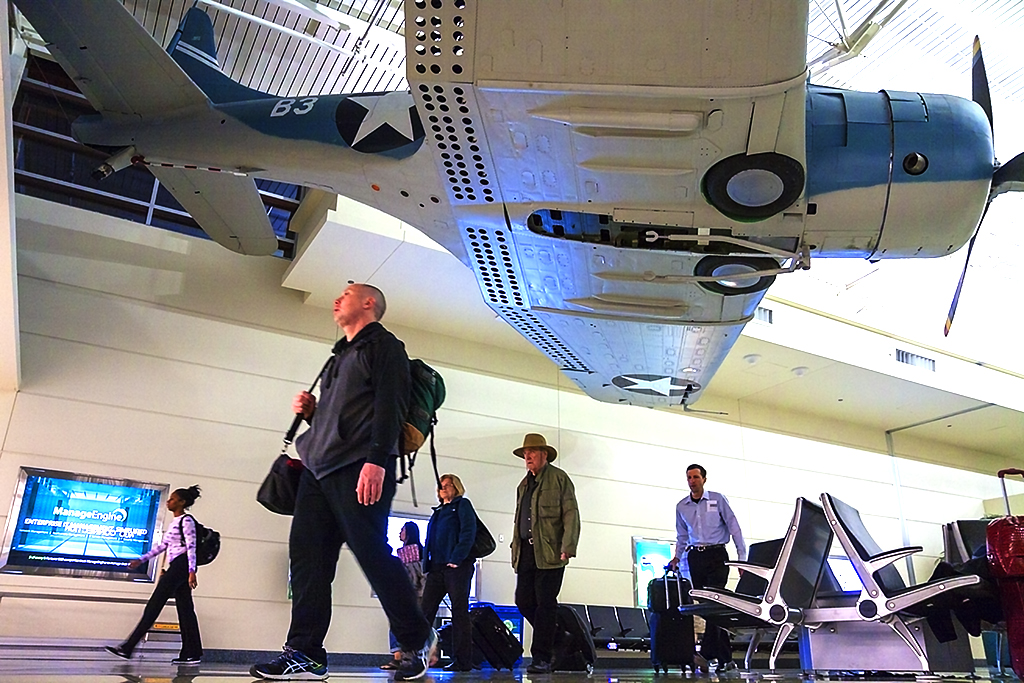
Midway-airport-in-4-15--Chicago-2


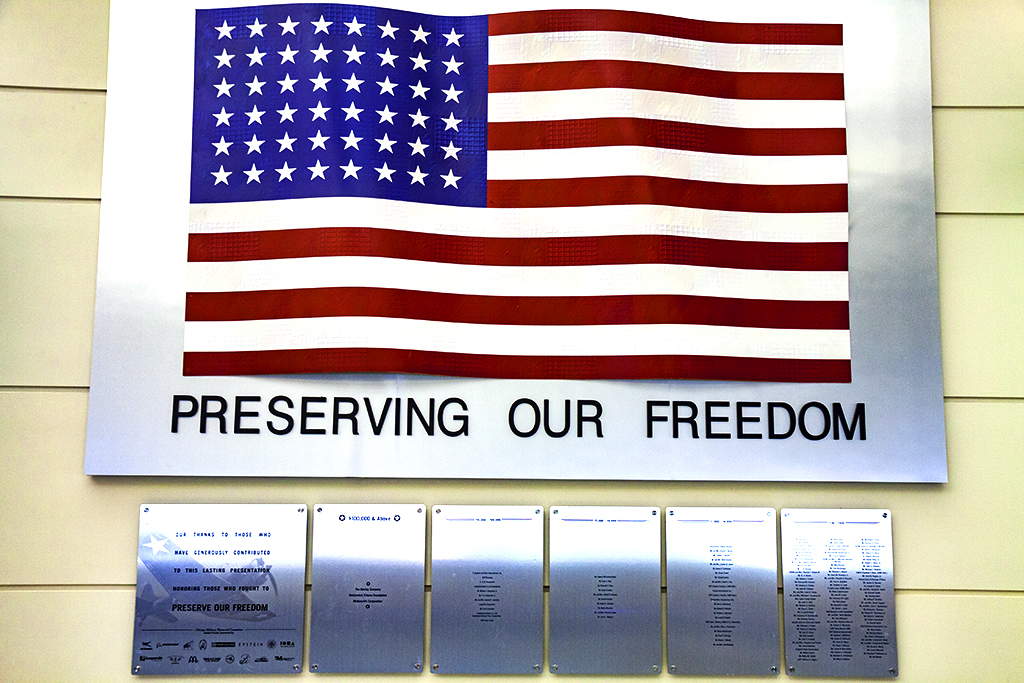
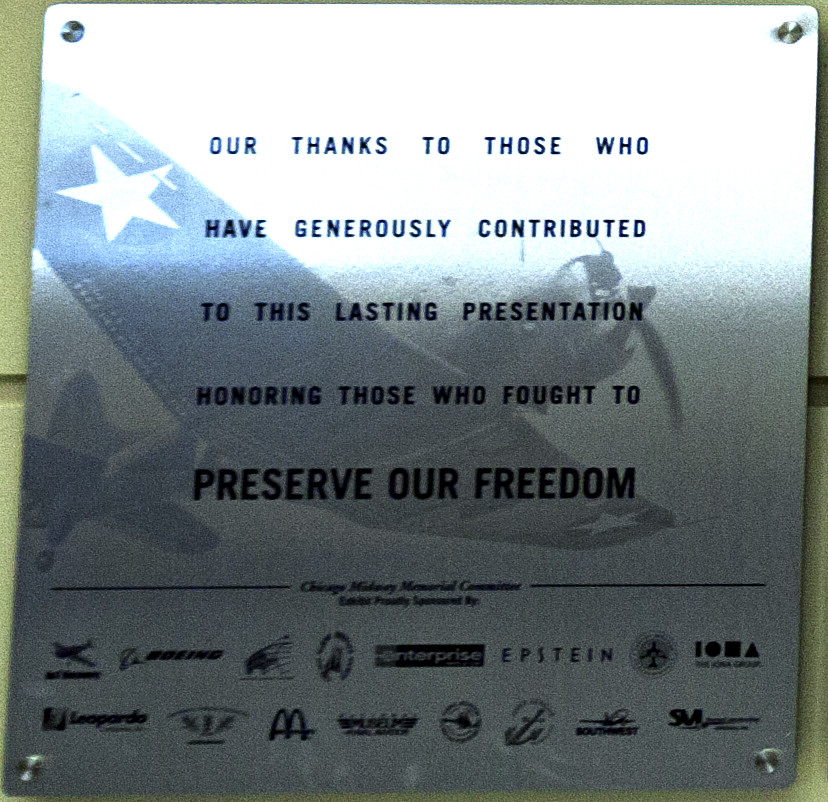
Midway-airport-in-4-15--Chicago-2-(detail)


Part of a memorial to the Battle of the Midway. The airport itself is named after said battle.


.
.


Midway-airport-in-4-15--Chicago


4/10/15 at Midway Airport. Before this trip, I hadn't flown since 2010, and the last time I was at Midway Airport, I was trying to get a job as a baggage handler, a story I've recounted in my Chicago Postcard.


.

Monday, March 9, 2015

Justin from Chicago

.


Please tell us your name, age, where you live, your family situation and how you're paying the bills?

I'm Justin, age 30. I live in Chicago, where I have resided for 2.5 years. I currently live in an apartment with my 14 year old dog, Leo. I came to Chicago because I graduated with my Masters in Urban and Regional Planning from Florida Atlantic University. I joke with people when they ask how I got to Chicago by saying that I don't strip nor work on a cruise ship, so job opportunities were seemingly limited in Florida when I was looking. One of my closest friends, whom I met when we both lived in St. Louis, had returned to Chicago, where he was from. He offered me a place to stay for free while I job hunted, and I took him up on it.

I found a job within six weeks working for the Chicago Housing Authority as a Housing Specialist, doing Section 8 recertifications. This is what a graduate degree will land you these days. Correction - I worked for a private contractor for the CHA. Because that's the neoliberal Chicago way. What a hell hole. I have never worked some place so demoralizing in my life. I could write all day on my three months there, but let's just say when you hand off a public good, a public service, to a private company, they will do whatever they can to squeeze every last penny out of their contract. I escaped and spent two years at a major housing nonprofit agency. I spent my time there assisting homeowners who were losing their homes to foreclosure (and sometimes saving those homes) and I was teaching homebuyer education classes. I lamented working within this system, but if I wasn't there to help my clients navigate it, who would? I recently took a job with a major suburban city government in their community development department. It was quite a large pay increase, and I know I can count myself among the few fortunate ones who are making more now than they did a few years ago. However, my commute one way is 40 miles, so I spend a lot more time at the job and the commute now.

How is your economic situation compared to five years ago? What about ten or twenty years ago?

Five years ago almost to the day I quit my job in St. Louis and left the country for six months. It's hard to explain, but I was miserable, as if I was slowly suffocating, and if I didn't leave, I was going to die. The last five years have generally seen a huge improvement in my personal happiness and fulfillment. This is mainly due to letting go of any preconceived notions of what it means to be successful. I fear that I could always slip back into the mindset that made me so unhappy five years ago, but I know so much more about the world, how it works and why it's so imperative for me to try to remain cognizant of what is important - making time for my friends and family, drawing the line and saying no, knowing when to cut my losses (usually at a job), saving money and living "low key." I have no desire to climb any ladders. I just want to make enough to survive. Unfortunately, this seems to entail working full time. I know how relatively fortunate I am. That doesn't always make me feel better.

Working as an advocate in the foreclosure process, I saw people who thought they were doing what they were "supposed to do" be tricked by loan officers, or discarded by long time employers, or manipulated into believing that everyone has a fair shake at success, however that's defined. What saddened me the most at my last job was the pervasive belief of my clients that it was due to some personal defect or mistake that caused their failure. I made it a habit of reminding people that they can't control these things. It's not a personal failure. We don't control anything, it seems. What a powerful lesson it was for me to learn.

Ten years ago I was an undergrad, and though I knew even then something was amiss, I had no clue as to the depth and severity of what we all face.

If you have children, how are they doing? What are their prospects? You can also talk about your parents or siblings if you don't have children.

No kids. Never. I have a one year old niece and a second niece or nephew on the way. I am scared for them. I only hope I can do something for them. My father is disabled, but also retired military, so he's one of the few groups in this country who has a pension, plus his disability. They do well. He took early retirement from the service because he was asking too many questions and was not towing the line like he was expected to do. I think he's really starting to see things more clearly as he ages, though he and I don't always agree. My mother is financially reliant on his income. She doesn't like to talk about current events. I can't say I necessarily blame her. She worries about us, though not always for the reasons I would worry about.

Please discuss your city, town or neighborhood, its industries and businesses. Is the local economy improving or deteriorating? How are your neighbors doing?

I live in a quickly gentrifying neighborhood in Chicago. Seems like a select few are doing quite well. I could write a book on this one question, but I'll just mention one thing I continuously notice. I live in the near northwest side. Many long time businesses are closing with signs that often say, "moving to 3xxx or 4xxx W. Whatever Street." Twenty years ago, I have been told this was the same story, but it was moving from 1xxx to 2xxx. These are almost exclusively hispanic owned businesses. They come in, they stabilize a neighborhood, and then they are pushed further west. And it's called progress. And yet I won't move further west (or south) because I can afford to live in an apartment that is near a park, across from a grocery and close to all the things I like to do and the people I like to see. And what if I did move? I'm not sure it would make any difference other than give me the satisfaction that I don't live in a gentrifying hood. My neighborhood is still considered rough by many mostly middle class, mostly white people, but single family houses on my block are going for half a million. It's only a matter of time.

Do you agree with my basic contention that the country is unraveling economically, politically and even socially? What is your vision of the future?

I'm not sure we ever were "raveled" to begin with. This country was built on violence and forced labor and exploitation. The chickens are coming home to roost. I half-joke with friends that we'll someday either be underwater (literally, not just figuratively) or we'll be ex-pats in Seoul or Berlin or some other city in "Americatown" or "Little America" type enclaves as we escape. Then again, the more things change, the more they stay the same, so we'll all likely be going down with the ship together. I feel more now than before that leaving won't do any good except I won't have to participate directly in this game or be reminded daily of the challenges we face.

My friends and I know things aren't going to be as good for us as they were for our parents, for most of us, in most ways, especially economically. I hope that as things continue to deteriorate we remember to be there for one another. I hope we reject the most noxious aspects of capitalism and morph towards a more humane existence, as that's all I believe will happen as things stand today. I don't believe change will happen completely or quickly without some major pain.

What can we possibly do to mitigate our problems, whether collectively and/or on a pesonal level? If you're really struggling, please share some of your coping mechanisms and survival tactics. What adjustments, minor or traumatic, have you had to make?

I try to stay knowledgeable on what's happening. I'm cynical but not to a point that causes me to think it isn't worth trying to make others' lives better. I have few illusions that I can affect some sort of macro level change, but I do try to do what I can. I mentor through Big Brothers Big Sisters. I try to not buy new things if I can buy them used. I share with others what is going on in this world in the hope that if enough people know, something might change. I doubt anything I do will make a long term difference, but you never know. I wish I had a better answer. Or approach. Owning my privilege and my hypocrisy has helped me be a little more grounded.


..............................................................................
Please participate in this Readers' Postcards series, as your answers will be very instructive to all of us. Just answer the above questions then send them to me, preferably with at least a photo or two (of your town or just you or your family, in your home or wherever). If you'd rather not state your full name, that's fine. Even a pseudonym is OK. My email: linhdinh99@yahoo.com . Many thanks in advance!--Linh


.

Tuesday, March 11, 2014

Postcard from the End of America: Chicago

As published at Dissident Voice, CounterCurrents, Information Clearing House, Intrepid Report, Daily Dissident and Unz Review, 3/10/14:


I’ve been coming to Chicago forever, but always just for a day or two. The first time was when I was only a teenager and visiting an aunt in St Louis. Another time, it was to take a physical exam for now-defunct Midway Airlines. I was trying to get a job as a baggage handler. The day before, though, I had been at a Philly party where someone handed me a joint. Never one to refuse heartfelt hospitality, I inhaled, but somehow this didn’t prevent me from being hired by Midway. Perhaps they used the same urinalyst, piss parser or golden shower technician as Major Leagues Baseball, you know, the one that kept clearing Sammy Sosa even as he hit, like, 600 home runs in one season. In any case, I never took that Midway job, for I had found another while waiting for their decision. Back in the late 80’s, it was that easy to find work, so even a no-skill, no-degreed, beer swilling and, occasionally, very occasionally, actually, pot smoking, coke inhaling or acid dropping bum like me could pick and choose. If you could lift stuff, no matter how awkwardly, you were hired.

In recent years, I had mostly come to Chicago to do poetry readings. Though my 15 minutes as a fringe poet is rapidly flaming out, there’s still a bit of kerosene left in the guttering lamp. Gone are the days when I could be paid nicely to squeak, squawk and bloviate to a full Santa Fe theater as a guest of the Lannan Foundation, or be flown to Paris, Berlin or Reykjavik to make people wish they had stayed at home instead, but invitations to read still trickle in. Shoot straight, though, and doors will slam in your face, buddy, if not worse, much worse. When I could hardly think and write, I was being published in the Guardian, New York Times and being interviewed on the BBC, but now, I can barely give my seasoned blathering away.

So an invitation to read at Roosevelt University brought me to Chicago this time, and since I wanted to linger a while, I wiggled my way into an additional reading at Wilbur Wright, a community college. Through an informal arrangement with a poet friend, Daniel Borzutzky, I ended up talking to his students after they had discussed Ariel Dorfman’s Death and the Maiden, a play about political torture. To give this work more context, Borzutzky’s also showed us a YouTube video of an escrache demonstration in Buenos Aires.

Started in Argentina, escrache has spread to other Latin American countries as a popular movement to oust, shame and ostracize retired generals, politicians and other powerful figures who have committed unpunished crimes. After locating the criminal in question, the organizers would inform his neighbors that here lives a state-sanctioned mass murderer or torturer, or a looter of public funds. Later, thousands of people would converge on this man’s house to publicly indict the blood-drenched fat cat. Though this Latin American version of a Cheney, Rumsfeld, Bush or Obama is never physically attacked, the monster will be shunned by many of his neighbors, with local businesses even refusing to sell him a meal or a newspaper.

Critics of escrache have denounced it as a form of vigilante justice and, as the outburst of an angry mob, should be declared illegal, but the protesters are only reacting to acts that are themselves clearly illegal, not to mention outrageously immoral. The protester’s public harassment does not compare to their targets’ torturing and/or raping, then throwing their victims from airplanes into the ocean, or kidnapping their children and erasing their identities.

Too often, the state will use the legality argument to bind its opponents, while doing whatever it pleases, legal or not. Not satisfied with a monopoly on violence, the state also wants to be the sole interpreter of what’s right and wrong, as implied by the often bandied about legality question, and the more criminal this state is, the more illegal, the more it will shriek about the need for everyone else to walk the straight and narrow, according it its own power-drunk markings. Talking to Borzutsky’s class, I asked the students to consider escrache in the North American context. Who are our criminals in high places and what should we do about them? Unlike our southern neighbors, we have neither the clarity to identify our enemies from within, nor the courage or unity to confront them. To be fair, though, our top criminals don’t move among us, with many never even mentioned by our obfuscating media, as great a killer of brain cells as any, and worst than any glue. Even when not anonymous, however, the most malignant Americans are hidden behind guarded gates, bullet proof glass or acres of real estate, so that it would take considerable enterprise to target them.

When faced with an illegal and ultra violent enemy, we must resort to any and all tricks, be extra clever and strike hard, for real, but most of us are too tightly bound to our bifurcated harness to do more than jiggle, every once in a while, an electronic voting machine. Geez, I wonder who they’ll let us pretend to vote for the next time, if there’s a next time?

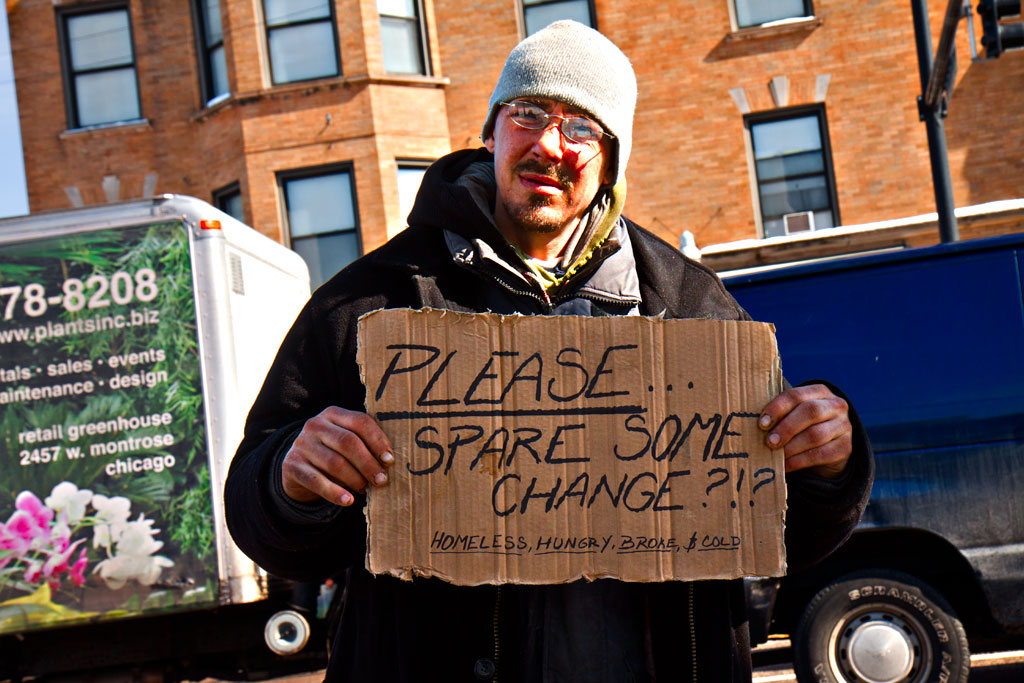
On one of my three days in Chicago, I wandered around West Town. I began in Wicker Park, a Polish neighborhood and Nelson Algren’s old haunt turned barrio Boricua turned hipster haven turned, finally, into the yuppy bastion it is today, but not before considerable acrimony and even vandalism from the retreating hep cats. Lawdy, I know it’s awfully silly to regurgitate black slang from nearly a century ago, but hep cats are no more hooey than the hipster tag. On snowy, icy or slushy sidewalks, I then trudged into Humboldt Park, Chicago’s current San Juan. There, I spotted New Life Covenant, with its large banners announcing that it is a “CHURCH FOR THE HURTING.” Aren’t we all, my fellow collateral damages or direct hits? Finally, I found myself in what’s left of the Ukrainian Village. At the corner of Western and Chicago, there was a man of about 40-years-old walking with a cardboard sign in the middle of the street, between cars. Increasingly common across America, this sight will be ubiquitous soon enough. I got close enough to read, “PLEASE SPARE SOME CHANGE?!? HOMELESS, HUNGRY, BROKE & COLD.”

Chris was his name, and he told me had been homeless for 14 months, and usually made about $20 a day, panhandling. Wanting to hear more, I offered to buy Chris lunch. Bacci was nearby, but Chris said, “I can’t eat pizza. I have no front teeth.” To prove it, Chris flashed his nude gums. Across from Bacci, there was Village Pizza, and since it also served submarines, we went there instead. Needing something hot, I ordered a modest heap of ravioli that turned out God-awful, while Chris went for Italian beef with French fries. They looked much tastier than my red slop, that’s for sure.

“So, man, what did you use to do?”

“I was a bike courier. That’s how I lost my front teeth. Someone rear-ended me!”

“Holy shit! So did you get, ah, compensation from your employer?”

“No way, man!”

“But you were at work. You were working!”

“No, no, that’s not how they saw it. This is how it works. If I had a package on me, then they would count it as me being on the job, but I was between deliveries, so I wasn’t technically working for them.”

“But you were only out on the streets to do deliveries. You weren’t just riding your bike around!”

“I know, but that’s not how they saw it.”

“OK, OK, so they hired you as a contractor, and not as a regular employee on the clock?”

“Yeah, that’s basically it.”

“Man, that’s ridiculous!”

“Yeah, so one second I’m on the bike, then suddenly I’m in an ambulance, and since I had no health insurance, I still owe the hospital all this money.”

“So what did you do when you got out?”

“I didn’t feel like being a bike courier any more, so I got a job with Allied, the moving company. That lasted for a few years. Then I got a job at another moving company, but business was so slow, they had to let me go eventually. That was my last job. The accident, though, wasn’t the only reason I quit being a bike courier. I really got out because the money wasn’t as good any more.”

“What do you mean?”

“I used to make about 750 a week, for only four days of work, but then it got down to only 225, and I had to work all five days. Everything changed after 9/11.”

“Hmmm, how did that affect your job?”

“The security, man! Before 9/11, I could go into an elevator and take my package directly to the office, so I would be out of there in two minutes, but after 9/11, I had to go through all these people, from the front desk to the mail room, just to deliver my stupid package, and I had to fill out all of these forms, too, so what used to take me two minutes to do now took me 15 or even 20, so at the end of the day, I couldn’t deliver as many packages, and I was being paid by the package.”

“And it’s not like terrorists are itching to send package bombs!”

“Yeah, but people were so scared then. Plus, you have the internet now, and that has hurt also. Before, companies had to hire bike couriers to deliver everything, but now, they can send all these images and documents through the internet.”

“So what’s the plan now? What are you going to do?”

“I’m on three waiting lists to get into these recovery houses. I’m hoping it won’t be more than another month.”

“Are you an addict?”

“I’m in AA, but I haven’t drank in a while.”

“So the recovery house is just a way to go inside.”

“Yeah, and to have an address, because you can’t even get a job without an address.”

“Are you from Chicago originally?”

“Yeah, born and raised here, in McHenry, and I have never left except for when I was a roadie for these bands.”

“Oh, yeah? Which bands?”

“You ever heard of Alkaline Trio? No? Well, that’s the most famous one, but I’ve also worked for Sidekick Kato and Apocalypse Hoboken.”

As this civilization goes into serious decline, even its band names get really uninspired and stupid. We can’t even do nihilism right. Around 1990, I was the road manager for indie-folk Baby Flameheads, but I only lasted for half a tour. Night after night, we’d hit another bar, and there was nothing for me to do but get juiced up, through two or three sets, but then I was expected to safely drive the van away after last call. Yes, curse me all of you who are blame-free! As a young man, I made many sapling mistakes, but now that I’m older, I’m blundering as a middle-aged fool.

“Chris, don’t you have family that can help you out? Where are your parents?”

“My mom’s still alive, but she’s remarried, and my stepfather hates my guts. He gets really pissed off if he thinks she’s giving me money, so I don’t want to bother her.”

“What does he do?”

“He was laying concrete until he was laid off about five years ago, but he’s about to retire anyway, so it doesn’t really matter. He’s saved a lot of money.”

“How much money did this guy make?”

“A lot, man! He was making $38 an hour at the end.”

“Wow!"

“Yeah, and he’d put half of each paycheck into the bank, but with what’s left, he still bought whatever he wanted. He’s not hurting. He’s loaded!”

“$38 an hour! You’re lucky to make 10 these days.”

“I know.”

“And how about your mom? What does she do?”

“She works in a bar in McHenry.” Immediately cheered by this thought, Chris beamed his pink smile. “If I was still drinking, I could get drunk for free each time I go see my mom!”

“Hey, it’s very good you don’t miss drinking. How much did you drink?”

“Oh, man, I can’t even tell you. I’m half Slovak and half Bulgarian. Both sides of my family are drinkers. You ever heard of rakia? It’s a Bulgarian brandy. Try it sometime. It will knock you out!”

By this time, I had managed to ingest my ravioli, plus the equally bad accompanying salad. Chris, however, had only eaten half of his sandwich and fries. If I had less manners, I would have grabbed at least a few of his fries to chase away the bad taste in my mouth. Chris ended up throwing half of his lunch away.

Unlike what his sign said, Chris wasn’t that hungry after all, but this penchant for wasting food and everything else is very indicative of our culture. Coming from Vietnam to the States as an 11-year-old, I was immediately struck by how much food was wasted each day in the school cafeteria. Quite casually, my classmates would toss away even unopened cartons of orange juice or milk. Later, a girlfriend would laugh when she saw me struggling to finish my dinner, “You don’t have to eat it all, you know!” She thought it was cute. To this day, I won’t throw away anything that may have a milligram of nutrient on it, and that includes fast food ketchup packet. It’s not just that I will eat absolutely everything I’ve paid for, but that a bunch of people have gone through a tremendous amount of trouble and coordination to make and deliver, for example, this roll of bread, red onion, string bean or slice of (sorta) cheese to (sorta) nourish me, so I won’t insult them by throwing even a speck of it into the trash can, though those ravioli surely deserved to be flung from the top of the Sears Tower.

Among the minor quirks of an empire in decline is its gross celebration of gluttony, hence our huge restaurant portions and thousands of eating contests, with some of these revolting spectacles even shown on television. We also have celebrity chefs, just like the Romans in decadence, but before this American Century, however, before this epoch of oil-fueled prosperity and endless war, people were also fascinated by the spectacle of not eating. They would pay to see Starving Artists and Living Skeletons. Soon enough, though, these types will reappear in ballooning numbers among us, and we won’t even need tickets to gawk. Too feeble to mount even an escrache, we deserve nothing less.

All over Chicago, there are these posters that plead for donations to food banks, with “1 in 5 kids faces hunger,” and I’ve seen enough homeless Americans rummaging through dumpsters for bits of meat and limp French fries to know that hunger has become a serious issue in this greatest of nations, the indispensible one and global beacon, but too many of us will keep squandering all resources as if the worst is not coming, for even as we sink into Third World status, we can’t or won’t shake imperial habits.

Perhaps we’re only mirroring our obscene leaders, for they routinely issue pompous pronouncements and threats as the rest of the world laugh in incredulity or contempt. Even as we support Neo-Nazis in the Ukraine, for example, Hillary Clinton sees fit to compare Vladimir Putin to Hitler, and Chris Murphy, a Democratic senator from Connecticut, huffs that “Europe is not where they need to be right now. I think they are willing to give Putin a much longer leash than we are.” Nice word choice, eh? I wonder how “leash” translates back in Moscow. Personally, I think we should apply the tightest of leashes to Obama, Kerry, Hagel, Holder, Pelosi, McCain and the rest of our psychotic leadership, for only after we’ve roped them all in, then away, very far away, can this increasingly sad country be rediscovered and rebuilt.


.