If you have a PayPal account, please send your donation directly to linhdinh99@yahoo.com, to save me the fees. Thanks a lot!

Sample article at SubStack, "Shit Show Promised!"
Showing posts sorted by relevance for query press tv. Sort by date Show all posts

Friday, February 19, 2016

Ukraine article is coming, but here are my two statements to Press TV about Ukraine:

I was supposed to have a debate with Taras Kuzio, but Kuzio was so offended by the first question from our Iranian hostess that he terminated the studio feed right after his answer, and even before I had chance to respond. Among Kuzio's titles is Head of Mission of the NATO Information and Documentation Centre in Kiev, and Marzieh Hashemi had asked him if Russia had a right to enter the Crimea. Do watch if you want to see this odd exchange, and much more. Iran's Press TV, 3/8/14:


Press-TV


Press TV has interviewed Linh Dinh, an author and political analyst from Philadelphia, to discuss the situation in Ukraine.

What follows is a rough transcription of the interview.

Press TV: Your take on that same question; of course, our guest [Mr. Taras Kuzio] said that the Russians, those who speak the Russian language are never threatened, but of course we did see that one of the first acts that the new government in Kiev actually started to do was to make illegal the Russian language. But going back to the original question, let’s look at why do you think, first of all, that Russia is even in Crimea?

Dinh: Another question to ask is does the USA have a right to interfere with the Ukrainians? As Victoria Nuland admitted, the US has spent five billion dollars in this regime change in Kiev. The USA is also heavily involved in this chaos.

As for Crimea, Sevastopol has been a Russian naval base going back to the 18th century, so they do have a history there. And most of the people there happen to be Russian – you know, Russian speakers. So if they want to be reincorporated back into Russia, then that’s an expression of the popular vote.

The US is calling that illegal, and yet it is supporting the protesters in Kiev. Why do they support the illegal deposing of the Ukrainian president in Kiev, and yet call the popular vote in Crimea illegal? There’s a hypocrisy there; there’s an inconsistency there.

It’s not as simple as Putin going into Ukraine and taking Ukrainian territory.

Press TV: Let me expand on something you just mentioned because you asked why was the US dealing with the protesters and supporting them? I want to look at that. Why was the United States, as coming from the other side, obviously, of the world – why were they so intent on supporting the protesters in Kiev? What do they want to gain?

Dinh: Well, you have to look at the big picture. Since the Soviet Union collapsed in 1991, the US has been relentlessly trying to incorporate the countries of the former Warsaw Pact into its domain, into its sphere of influence, into NATO. You’re talking about Poland, the Czech Republic, Bulgaria, Romania, on and on, and now it’s including Ukraine.

Georgia, a little while ago, the US also instigated a war to encircle and provoke Russia. This is part of the grander scheme of the United States to encircle, isolate Russia, and to place missiles right next to its border.

It’s not as simple as Ukraine’s internal issues are at stake here, but the US design on Russia.

Press TV: Do you think that if, for example, Moscow had not moved into Crimea, really do you think the United States would pose a threat to the Russians by actually having that sphere of influence expand?

Dinh:
Certainly, also because of the Russian naval base in the Black Sea. That is a crucial Russian asset. There is no way Russia will allow that to be taken away.

This is very paradoxical because by moving into the Ukraine, the US has allowed Russia to take Crimea for free, so to speak, and to not pay the annual rent for using the naval base in Sevastopol.

So, this is already backfiring for the USA. Putin, by not firing a shot so far, by shedding no blood so far, is already gaining from this.

Press TV: You talked about backfiring; I want to look at that. We know that Moscow has already threatened Kiev with cutting off the gas. What would happen right now if that would actually take place, if Moscow would put the pressure on the Ukraine and demand all the back pay for the gas and basically cut off the supplies right now? Tell me the type of effect that that could have on Ukraine right now.

Dinh: Before I go on, I want to say that I’m not trying to make light of the Ukrainians’ genuine hatred of the Russians from the Soviet years. They have legitimate beef against the Russians.

But by joining NATO, they will not gain from this because they thought they were deposing a kleptocrat in their own president.

The Western bankers will come in and loot them, impoverish them much worse because the Western banks will loan them money but impose austerity plans which will hurt the ordinary Ukrainians.

So, the Western banks are not going to come in to save them. The Western countries are not going to come in to save them. Just look at what happened to Greece.

Ukraine will become a basket base, will become impoverished, and the regular people will suffer. That’s just from the Western side of the equation.

As for the Russians, they can retaliate also. They’ve been selling natural gas to the Ukraine at a 30 percent discount. They can take that back. That would hurt the Ukraine considerably.

They’ve also been lending the Ukraine a lot of money. They have a lot of economic leverage.

By siding with NATO, they’re hurting themselves.

Press TV:
Your take, sir, is it all about Russia’s interests and also the United States’ interests, or are they genuinely concerned about the situation in Ukraine?

Dinh: The US is definitely not concerned about Ukraine because here you find it supporting neo-Nazis and fascists, just as in Syria they’re supporting terrorists. The US has no ideological foundation for this. It’s just using this situation to harass Russia and also for its own financial interests.

What the US really wants to do is to bring natural gas and oil from the Caspian Sea to Europe through the Ukraine, if possible - but that’s for the long term - and also to use its banks to loot yet another country. It has financial and military objectives in mind. It’s not about helping Ukrainians. It’s always talking about freedom and democracy, but the US is never about that because you find it supporting terrorists in certain situations, and now supporting neo-Nazis, which is highly farcical considering that Hillary Clinton actually called Putin “Hitler” when the US is actually supporting neo-Nazis.

Press TV: What do you think, in general – we have seen for example during the demonstrations in Kiev several protesters killed, and now we have heard this leaked conversation between EU Policy Chief Catherine Ashton and the Estonian foreign minister saying that the former President Viktor Yanukovich was not responsible for the killing of protesters.

I want to look at this modus operandi because it appears that if we look at countries around the world, where there are some local demonstrations, usually the turn of event comes when individuals start getting killed and then the Western media has its play on actually that particular government trying to kill its own people. Do you see this as an MO that seems to be repeated when we see it time and time again in different parts of the world?

Dinh: Yes, just like in Syria with the poison gas, here you have it again. They want to escalate the situation. Some protest leaders had snipers shooting at protesters and also the police to escalate the situation and to place blame on the incumbent government.

Who does this serve? This serves the US media, serves US interests; it gives them a pretext to come in to intervene here.

There’s no proof of the CIA involvement, but it certainly looks like there are CIA fingerprints all over this.

Press TV: I just want to say really quickly to our viewers that our previous guest, Mr. Taras Kuzio, who was in Kiev, actually left the program and refused to speak because he felt that it was biased. It was unfortunate that he didn’t stay so we could really have a debate about this subject.

Mr. Dinh, what happens now? We know that now in Crimea they’re calling for a referendum in eight days. What happens if that takes place and in eight days the people say they want to become a part of Russia? Tell me possible scenarios coming from the EU and the United States at that point.

Dinh: It looks like it’s going to go back into Russia. -But what about other Russian-speaking regions in Ukraine? Ukraine is definitely going to lose Crimea, it appears. It’s running the risk of losing other parts of its country as well.

Already it’s losing its territory and it will not benefit from an incorporation into the European Union...

Press TV: You don’t think Washington will prevent that from happening?

Dinh: What can it do? I mean, it’s threatening sanctions.

The Russians also have economic leverage against the USA. China and Russia are united in this. They can devalue the US dollar.

The US is indebted to these countries. By dumping US bonds, they can devalue the US dollar and really hurt the US economy.

Europe is also not on board Washington’s threat of sanctions because Europe is very dependent on Russian natural gas. The Germans are not speaking as belligerently as Washington, and even the English, even the UK is not speaking as -

Press TV:
We know that President Francois Hollande, in talking to US president Obama, is saying it appears that he is on board with putting more pressure on Moscow. Your take on that and on Holland’s perspective in general; could it backfire on Paris?

Dinh: Of course it can backfire on Paris because Hollande is not even that popular in France. Your regular French citizens are not behind this.

Some of the European leaders are giving a bit of lip service to Washington.

But there is nothing to gain for regular citizens in the European Union because why do they want Ukraine in the European Union?

Ukraine is already a struggling country. There is nothing to gain by the European Union incorporating Ukraine. So, I think this is a lot of hot air.

Most of the hot air is coming from Washington DC itself. But, it has to be careful because Washington [a slip of the tongue here. I mean Russia] can retaliate, and China is behind Russia.

Even Japan, normally very much behind Washington, is being very cautious.

Instead of isolating Russia, Washington might find itself more isolated after this incident and during this incident.

It’s very funny because Putin is so composed during this whole episode, and Washington is talking so hysterically.

There are very few options it can resort to short of outright war, which would be suicidal for everybody. I don’t think that would happen but you never know because the leadership in Washington DC is so insane right now, so psychotic right now.

Press TV: This whole event, the situation now with Russia and, of course, we have seen over the last three years, up and down, with Washington dealing with Syria and saying they’re going to have war, and then not, and then again threatening, tell me about, as far as Washington’s global image right now, do you think that it has taken a beating, that perhaps the majority of people around the world no longer see Washington, as Washington likes to believe it is, in taking the lead in the world? Do you think that Washington has lost its credibility?

Dinh: Certainly. A lot of this posturing is played up for this domestic audience. You know, it’s to convince the people back here that the US has a lot of leverage.

But worldwide, every time it starts to bluster and talk like this, people simply laugh because it does not back up anything and it just shows how out of touch the Washington leadership is.

A lot of this posturing is done for the American audience.

Press TV: Just one minute left, I want to know your perspective, your take on the future of Moscow-Washington relations. We have seen not that long ago Hillary Clinton with Sergei Lavrov pushing the reset button. It seems that button is stuck now. Where do you see it going from here?

Dinh: Russia knows full well Washington’s bad intentions. I think more consolidation between China and Russia, and former US allies moving closer to China and Russia, because it realizes that by being Washington’s puppets there is very little to gain.

The US is a sinking empire. Moving forward, it would drag its allies down.

I think many of these countries are already hedging their bets. They’re trading with China, for example, in their own currencies.

I just mentioned Japan and Russia, Japan is also dependent on Russian natural gas and oil. These countries are rethinking their alliance with Washington.

Press TV: We are sorry that Ukraine’s expert, Mr. Taras Kuzio out of Kiev, decided not to participate in this program because we at Press TV pride ourselves in having a debate, and pride ourselves in actually having two very different perspectives on every subject. Perhaps another time Mr. Kuzio would like to join us here on Press TV.

GMA/HSN


...................................................................


Iran's Press TV, 4/19/14:
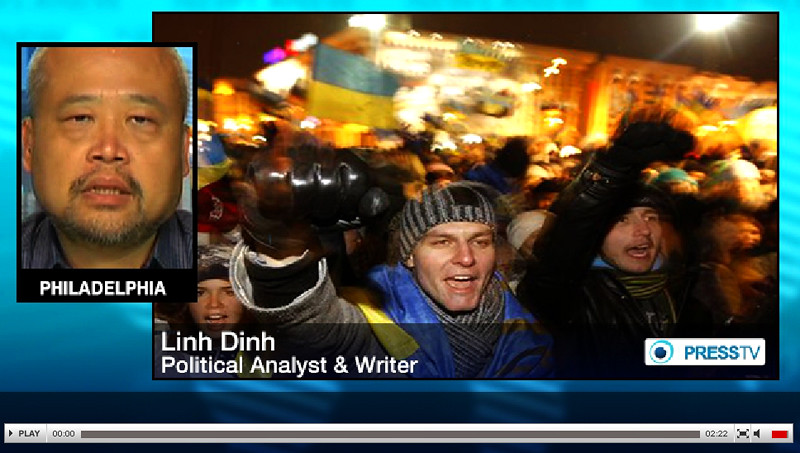

Press-TV


The US has been a “destructive and disruptive force in the world” and will become “even more violent as it collapses,” a political analyst and writer in Philadelphia says.

America “brings ruination to each country it interferes with. Just look at Iraq, Afghanistan, Libya and now Ukraine. Just look at the continuing war in Syria,” said Linh Dinh in an interview with Press TV on Monday. “While posing as a force of good and democracy, the US brings nothing but destruction and death. My fear is that America will become even more violent as it collapses.”

Referring to the ongoing unrest in Ukraine, Dinh noted that “the US has instigated this entire crisis, but it is blaming everything on Russia each step of the way.”

“After it staged a violent and illegal coup against the Kiev government, it accused Russia of fomenting unrest in the Eastern and Southern parts of the country, but it is only natural that ethnic Russians in these regions would want to be reabsorbed back into Russia. They don’t want to be second class citizens in a country that’s wrecked by American economic manipulation, and they don’t want to be a pawn in a dangerous game of provocation against Russia, maybe even war against Russia, whom they identify with,” he said. “Ukraine is being used by the US to disrupt the economic integration of Russia and Europe. The US is trying to prevent both Russia and China from becoming vital economic partners of Europe, because this would leave no room for the United States.”

On Friday, White House National Security Advisor Susan Rice said that Moscow would face the consequences of tougher sanctions if it sent Russian troops into the eastern part of the country or if it failed to make good on its commitments made under a new international deal reached in Geneva on Ukraine.

Both the US and the EU have imposed travel bans and financial sanctions against Russia and a number of Ukrainian officials since the reunification of Crimea with Moscow in early March.

AHT/ARA


.

Sunday, March 9, 2014

‘Greater US scheme to encircle Russia’

I was supposed to have a debate with Taras Kuzio, but Kuzio was so offended by the first question from our Iranian hostess that he terminated the studio feed right after his answer, and even before I had chance to respond. Among Kuzio's titles is Head of Mission of the NATO Information and Documentation Centre in Kiev, and Marzieh Hashemi had asked him if Russia had a right to enter the Crimea. Do watch if you want to see this odd exchange, and much more. Iran's Press TV, 3/8/14:


Press-TV


Press TV has interviewed Linh Dinh, an author and political analyst from Philadelphia, to discuss the situation in Ukraine.

What follows is a rough transcription of the interview.

Press TV: Your take on that same question; of course, our guest [Mr. Taras Kuzio] said that the Russians, those who speak the Russian language are never threatened, but of course we did see that one of the first acts that the new government in Kiev actually started to do was to make illegal the Russian language. But going back to the original question, let’s look at why do you think, first of all, that Russia is even in Crimea?

Dinh: Another question to ask is does the USA have a right to interfere with the Ukrainians? As Victoria Nuland admitted, the US has spent five billion dollars in this regime change in Kiev. The USA is also heavily involved in this chaos.

As for Crimea, Sevastopol has been a Russian naval base going back to the 18th century, so they do have a history there. And most of the people there happen to be Russian – you know, Russian speakers. So if they want to be reincorporated back into Russia, then that’s an expression of the popular vote.

The US is calling that illegal, and yet it is supporting the protesters in Kiev. Why do they support the illegal deposing of the Ukrainian president in Kiev, and yet call the popular vote in Crimea illegal? There’s a hypocrisy there; there’s an inconsistency there.

It’s not as simple as Putin going into Ukraine and taking Ukrainian territory.

Press TV: Let me expand on something you just mentioned because you asked why was the US dealing with the protesters and supporting them? I want to look at that. Why was the United States, as coming from the other side, obviously, of the world – why were they so intent on supporting the protesters in Kiev? What do they want to gain?

Dinh: Well, you have to look at the big picture. Since the Soviet Union collapsed in 1991, the US has been relentlessly trying to incorporate the countries of the former Warsaw Pact into its domain, into its sphere of influence, into NATO. You’re talking about Poland, the Czech Republic, Bulgaria, Romania, on and on, and now it’s including Ukraine.

Georgia, a little while ago, the US also instigated a war to encircle and provoke Russia. This is part of the grander scheme of the United States to encircle, isolate Russia, and to place missiles right next to its border.

It’s not as simple as Ukraine’s internal issues are at stake here, but the US design on Russia.

Press TV: Do you think that if, for example, Moscow had not moved into Crimea, really do you think the United States would pose a threat to the Russians by actually having that sphere of influence expand?

Dinh:
Certainly, also because of the Russian naval base in the Black Sea. That is a crucial Russian asset. There is no way Russia will allow that to be taken away.

This is very paradoxical because by moving into the Ukraine, the US has allowed Russia to take Crimea for free, so to speak, and to not pay the annual rent for using the naval base in Sevastopol.

So, this is already backfiring for the USA. Putin, by not firing a shot so far, by shedding no blood so far, is already gaining from this.

Press TV: You talked about backfiring; I want to look at that. We know that Moscow has already threatened Kiev with cutting off the gas. What would happen right now if that would actually take place, if Moscow would put the pressure on the Ukraine and demand all the back pay for the gas and basically cut off the supplies right now? Tell me the type of effect that that could have on Ukraine right now.

Dinh: Before I go on, I want to say that I’m not trying to make light of the Ukrainians’ genuine hatred of the Russians from the Soviet years. They have legitimate beef against the Russians.

But by joining NATO, they will not gain from this because they thought they were deposing a kleptocrat in their own president.

The Western bankers will come in and loot them, impoverish them much worse because the Western banks will loan them money but impose austerity plans which will hurt the ordinary Ukrainians.

So, the Western banks are not going to come in to save them. The Western countries are not going to come in to save them. Just look at what happened to Greece.

Ukraine will become a basket base, will become impoverished, and the regular people will suffer. That’s just from the Western side of the equation.

As for the Russians, they can retaliate also. They’ve been selling natural gas to the Ukraine at a 30 percent discount. They can take that back. That would hurt the Ukraine considerably.

They’ve also been lending the Ukraine a lot of money. They have a lot of economic leverage.

By siding with NATO, they’re hurting themselves.

Press TV:
Your take, sir, is it all about Russia’s interests and also the United States’ interests, or are they genuinely concerned about the situation in Ukraine?

Dinh: The US is definitely not concerned about Ukraine because here you find it supporting neo-Nazis and fascists, just as in Syria they’re supporting terrorists. The US has no ideological foundation for this. It’s just using this situation to harass Russia and also for its own financial interests.

What the US really wants to do is to bring natural gas and oil from the Caspian Sea to Europe through the Ukraine, if possible - but that’s for the long term - and also to use its banks to loot yet another country. It has financial and military objectives in mind. It’s not about helping Ukrainians. It’s always talking about freedom and democracy, but the US is never about that because you find it supporting terrorists in certain situations, and now supporting neo-Nazis, which is highly farcical considering that Hillary Clinton actually called Putin “Hitler” when the US is actually supporting neo-Nazis.

Press TV: What do you think, in general – we have seen for example during the demonstrations in Kiev several protesters killed, and now we have heard this leaked conversation between EU Policy Chief Catherine Ashton and the Estonian foreign minister saying that the former President Viktor Yanukovich was not responsible for the killing of protesters.

I want to look at this modus operandi because it appears that if we look at countries around the world, where there are some local demonstrations, usually the turn of event comes when individuals start getting killed and then the Western media has its play on actually that particular government trying to kill its own people. Do you see this as an MO that seems to be repeated when we see it time and time again in different parts of the world?

Dinh: Yes, just like in Syria with the poison gas, here you have it again. They want to escalate the situation. Some protest leaders had snipers shooting at protesters and also the police to escalate the situation and to place blame on the incumbent government.

Who does this serve? This serves the US media, serves US interests; it gives them a pretext to come in to intervene here.

There’s no proof of the CIA involvement, but it certainly looks like there are CIA fingerprints all over this.

Press TV: I just want to say really quickly to our viewers that our previous guest, Mr. Taras Kuzio, who was in Kiev, actually left the program and refused to speak because he felt that it was biased. It was unfortunate that he didn’t stay so we could really have a debate about this subject.

Mr. Dinh, what happens now? We know that now in Crimea they’re calling for a referendum in eight days. What happens if that takes place and in eight days the people say they want to become a part of Russia? Tell me possible scenarios coming from the EU and the United States at that point.

Dinh: It looks like it’s going to go back into Russia. -But what about other Russian-speaking regions in Ukraine? Ukraine is definitely going to lose Crimea, it appears. It’s running the risk of losing other parts of its country as well.

Already it’s losing its territory and it will not benefit from an incorporation into the European Union...

Press TV: You don’t think Washington will prevent that from happening?

Dinh: What can it do? I mean, it’s threatening sanctions.

The Russians also have economic leverage against the USA. China and Russia are united in this. They can devalue the US dollar.

The US is indebted to these countries. By dumping US bonds, they can devalue the US dollar and really hurt the US economy.

Europe is also not on board Washington’s threat of sanctions because Europe is very dependent on Russian natural gas. The Germans are not speaking as belligerently as Washington, and even the English, even the UK is not speaking as -

Press TV:
We know that President Francois Hollande, in talking to US president Obama, is saying it appears that he is on board with putting more pressure on Moscow. Your take on that and on Holland’s perspective in general; could it backfire on Paris?

Dinh: Of course it can backfire on Paris because Hollande is not even that popular in France. Your regular French citizens are not behind this.

Some of the European leaders are giving a bit of lip service to Washington.

But there is nothing to gain for regular citizens in the European Union because why do they want Ukraine in the European Union?

Ukraine is already a struggling country. There is nothing to gain by the European Union incorporating Ukraine. So, I think this is a lot of hot air.

Most of the hot air is coming from Washington DC itself. But, it has to be careful because Washington [a slip of the tongue here. I mean Russia] can retaliate, and China is behind Russia.

Even Japan, normally very much behind Washington, is being very cautious.

Instead of isolating Russia, Washington might find itself more isolated after this incident and during this incident.

It’s very funny because Putin is so composed during this whole episode, and Washington is talking so hysterically.

There are very few options it can resort to short of outright war, which would be suicidal for everybody. I don’t think that would happen but you never know because the leadership in Washington DC is so insane right now, so psychotic right now.

Press TV: This whole event, the situation now with Russia and, of course, we have seen over the last three years, up and down, with Washington dealing with Syria and saying they’re going to have war, and then not, and then again threatening, tell me about, as far as Washington’s global image right now, do you think that it has taken a beating, that perhaps the majority of people around the world no longer see Washington, as Washington likes to believe it is, in taking the lead in the world? Do you think that Washington has lost its credibility?

Dinh: Certainly. A lot of this posturing is played up for this domestic audience. You know, it’s to convince the people back here that the US has a lot of leverage.

But worldwide, every time it starts to bluster and talk like this, people simply laugh because it does not back up anything and it just shows how out of touch the Washington leadership is.

A lot of this posturing is done for the American audience.

Press TV: Just one minute left, I want to know your perspective, your take on the future of Moscow-Washington relations. We have seen not that long ago Hillary Clinton with Sergei Lavrov pushing the reset button. It seems that button is stuck now. Where do you see it going from here?

Dinh: Russia knows full well Washington’s bad intentions. I think more consolidation between China and Russia, and former US allies moving closer to China and Russia, because it realizes that by being Washington’s puppets there is very little to gain.

The US is a sinking empire. Moving forward, it would drag its allies down.

I think many of these countries are already hedging their bets. They’re trading with China, for example, in their own currencies.

I just mentioned Japan and Russia, Japan is also dependent on Russian natural gas and oil. These countries are rethinking their alliance with Washington.

Press TV: We are sorry that Ukraine’s expert, Mr. Taras Kuzio out of Kiev, decided not to participate in this program because we at Press TV pride ourselves in having a debate, and pride ourselves in actually having two very different perspectives on every subject. Perhaps another time Mr. Kuzio would like to join us here on Press TV.

GMA/HSN


.

Tuesday, November 27, 2012

Public anger in Europe may split the European Union

Iran's Press TV, 11/25/12:


Press-TV-on-11-25-12


People in Europe are frustrated at the central authorities as they feel that regional interests are not being met by these distant bureaucrats and bankers.


In the background of this, Catalonia citizens are being asked to vote for their self-determination with the Catalonian government wanting to separate from Spain and create its own state to avoid the economic misery dealt out by the central Spanish government through its austerity policies dictated by its global lenders.

Press TV has interviewed Linh Dinh, political analyst and writer from Philadelphia on this issue. Joining Mr. Dinh in this news analysis is Mr. Mark Mason, political commentator from San Francisco and Press TV’s correspondent Mr. Guy Hedgecoe from Madrid. What follows is an approximate transcript of the interview.

Press TV: Our guest Mark Mason has said that a central government serves a few . If we brought in that and we're not talking about individual countries in the central government, but we're talking about Brussels itself that of course is the foundation of the EU - do you think that it is the same concept of what he's just said?

Dinh: Yes. From the United States this is highly interesting because the dynamics that apply here is that there is a growing frustration and anger towards central authorities - towards Washington and in Europe it's towards Brussels. People are feeling that regional interests are not being met by distant bureaucrats and bankers.

This crisis is a crisis of globalism; of centralized control and the Catalonians, they've wanted to be independent for a long time, but when things are going well economically it's not so urgent. But now that the Spanish economy is collapsing the Catalonians are becoming more frustrated than ever and they see a weakness in Madrid. This is an opportunity for them to break away. But I can't see Madrid sitting by and allowing this to happen.

So, what happens when they bring their troops in? And this also allows Madrid to rally the rest of Spain in the struggle to keep the country intact. So it's a way to distract from the economy, but I don't think they will be successful. But what will happen if they bring troops in - because if it gets serious enough they will definitely bring troops in.

Press TV: We have other regions also like Scotland talking about separating from the UK; Flanders region in Belgium wanting a separate country. Are we seeing a reemergence of ethnic and historical differences resurfacing in Europe that also could potentially cause a collapse of the European Union?

Dinh: Yes. We are seeing a resurgence of regional feelings and also ethnocentric feelings. And that is mostly positive, but it can also have negative side effects that are not quite being seen so clearly right now.

Press TV: Why do you think it's positive?

Dinh: Well, on the negative side… a resurgence of racism… you know, people start to see tribally and because the world is so multicultural and you have so many different ethnic groups living everywhere, such a resurgence of tribal feeling could be very harmful to immigrants.

But I want to see this positively as a kind of rebuttal and defiance of central authorities. Americans have a lot to learn from what's happening in Catalonia. One has to remember that the Occupy Movement in America happened after what happened in Spain with the tents, the indignados, so they went from occupation to protests to a general strike to trying to secede from central authorities.

So, I want to see this positively, I want to see them succeed because there is no reason why a regional people should be subsumed to these, like I said, distant bankers and bureaucrats.

Press TV: Some analysts say the formation of the European Union itself was based on false premises of uniformity in the region because of the wide ethnic, historic and economic differences that it will actually cause the downfall of this Union. What is your perspective on it?

Dinh: I guess we can conclude at this moment it is a failed experiment, it's falling apart and it's not going to last much longer although there are people who keep threatening… they keep saying that if Greece defaults on its loans that it is going to be in deep trouble, but…

Look at Iceland. Iceland refused to bail out its bankers, refused to listen to the dictates from elsewhere and is still there today so I think it is possible to break apart and still be viable. I don't think that's going to be a widespread disaster just because all these people are getting sick of centralization.

So this breaking up can have positive results although like I say, the tribalism can be dangerous. We don’t know exactly how this is going to play out, but it's clear that people are very fed-up of being manipulated from elsewhere.

SC/SS


.

Monday, April 9, 2012

‘Racial discriminations continue to rise in Obama tenure’

Press TV, 4/8/12:


Press-TV-4-8-12


Hundreds of protesters have marched in Washington D.C. to demand justice for the late February fatal shooting of an African- American teenager by a Hispanic neighborhood watch volunteer in Sanford, Florida, Press TV reports.


Press TV has interviewed Linh Dinh, political analyst from Philadelphia about the targeting of black youths in particular and resulting tragedies.

What follows is an approximate transcript of the interview.

Press TV: In New York, let's take some particular cases because there are so many unbelievable statistics found when I was researching this subject. Let's look at New York alone, there is still the 'stop and frisk' law, which gives the police the right to stop and search anyone that they may deem suspicious. 85 percent of those stopped are people of color and only 7% of those stopped were ultimately arrested.

What exactly does this mean - how are they allowed to just stop people at random and at the end obviously the majority of them have not even committed a crime?

Dinh: I'm glad you're bringing this up because one of the issues that we should address here is the increasing abuse of civil liberties in the US. The police are becoming more militarized; they're becoming more out of control because of the laws.

You can be arrested for any or no reason at all and you have no rights to a trial and can be strip searched etc. This erosion of civil liberties is a very serious issue and it's affecting the black community the most because the black community is always the most vulnerable to any kind of abuses.

Also, I want to backtrack a little bit… In any multi-cultural society you are going to have racial issues; you are going to have racial tensions. So, the big question here is - Are things improving, is the situation improving?

Paradoxically, with the election of Obama, things have actually gotten worse because many people are using the Obama presidency to become even more racist because they think he's a black president when in fact he's not a black president at all.

To people who defend him, they are also defending him because he happens to be a black man. But Obama is not a black president - He does nothing for the black community. In fact he does nothing for poor people. In fact he does nothing for anybody; he does nothing for the American people.

So, it is sad that the first black president that we have is exacerbating the racial tension in this country.


Press TV: I'm going to read to you more statistics: An estimated 5.3 million Americans are denied the right to vote based on past felony conviction and of course most of these being African American men; more black men are imprisoned today than were enslaved in 1850; we have employment and pay disparities; and even there are reports of African American children being aborted at alarming rates - reports say that planned parenthood has killed more black babies than the Ku Klux Klan the racist white group of course, which murdered black people years ago.

Your take on some of these statistics?

Dinh: All those statistics you just cited are very alarming, but the factors are varied so it would take a while to dissect exactly what role institutional racism plays in that.

I would say that… I live in a city that has a black mayor and has had three black mayors in recent history. This could not have happened in the 60s. So, superficially there is some improvement. But then again, like you say, the situation in the black community is very serious and is not encouraging.

I would like to rephrase this as a question of class. I think that the media would like to distract us by scape-goating, by dividing us, pitting us black against white, non-Muslims Vs Muslims etc. But I think the more serious issue is class and I think all Americans are being abused and exploited.

Eventually, hopefully, we can see beyond black and white and yellow or whatever and see that we are being abused by the same government.

Press TV: What has to be done at this point in time?

Dinh: Like I just said I think we have to see beyond race and look at the class issue that we are all threatened by the same government. Things are getting so out of control now; everything is criminalized now. You can be arrested for just about anything or for no reason at all. We need like a new John Brown (1850s abolitionist) to stir things up.

SC/GHN


.

Saturday, August 10, 2013

Mass destruction, the way US makes money: Political analyst

Yesterday, I was on Iran's Press TV with Lawrence Korb, Assistant Secretary of Defense under Reagan:


Press-TV-8-10-13


Press TV has conducted an interview with Linh Dinh, writer and political commentator, from Philadelphia over the US atomic attack on Nagasaki at the end of World War II.


What follows is a rough transcription of the interview.

Press TV: Linh Dinh, your response [to the guest of the program Lawrence J. Korb].

Dinh: Well, US has never apologized for any war, so it is no different here. Even then there was disagreement about how justified dropping of the atomic bomb was, even American military officials thought that Japan was already losing and would surrender anyway.

It is not at all clear that even the first bomb was justified, much less second bomb. So to this day the general feeling among the American public, just as Lawrence has articulated, is that, you know, the bomb was necessary to save lives but I think that is a very dubious logic.

Using that logic that the atomic bomb is used to save lives, continued threat of the atomic bomb is seen as a positive, you know, it is not seen as something that threatens the extinction of human kind but something that preserves peace. I think that is a very problematic justification for the atomic bomb.


Press TV: I am getting the feeling from Lawrence Korb that at points he is trying to justify why there has been a use, he says there has not been a substantiated report in the Iraq example, but I have seen for the Nagasaki, Hiroshima example, for example that America was going to use, lose millions of lives in the case of Iraq’s Saddam Hussein was a threat.

It does not seem to justify the reasons why the US continuously seems to be using this in different wars and I would like to ask your reaction to..., why is this going on like this?

Dinh: There is a pattern here. The US is denying the effects of depleted uranium just as it denied that Agent Orange was harmful.

American soldiers had to sue the Pentagon and it took them forever to win very minor compensation for the health effects that American soldiers suffered; much less what happened to the Vietnamese.

So, the Pentagon has always denied basically genocidal effects of its weapons until it cannot argue any longer; so the same issue with depleted uranium.

They would deny there is a problem until 10, 20 years down the line, after so many people have died, it will finally have to admit that yes, it is causing serious health effects for generations, for hundreds of years down the line.

Press TV: And yet we here have the United states, Linh Dinh, who has not signed the Comprehensive Nuclear-Test-Ban Treaty, also the International Nuclear Disarmament efforts, they are not part of that. Why is that?

Dinh: Everyone talks about peace and wanting to eliminate nuclear weapons but the Big Boys meaning the USA; the USA is not serious about that, because by its strategic encirclement of Russia and China, it is pushing the world closer to nuclear war than ever, because it is doing all these provocations of Russia and China. In a sense it is resuscitating the Cold War all over again.

Just recently, there was a military war game between Mongolia and the USA. It sounds bizarre; why would we have these military exercises with Mongolia? What is the justification for that?

But of course Mongolia lies between Russia and China and that is another incident of provocation of these two rivals and the US is consistently provoking these two countries, so it might just get what it wants, a nuclear showdown.

Press TV: Let’s look at this study that I am going to read off to you. This is done by a professor by the name of Dr. Asaf Durakovic, he is a professor of nuclear medicine and radiology and he is a former science adviser to the US military.

He has studied on British and Canadian troops and civilians for depleted uranium poisoning over the past few years and his findings have confirmed significant amounts of this depleted uranium in the subjects urine as much as nine years after exposure.

What is this finding leading you to believe that even the US soldiers is a consequence? I mean that is one of the reactions I get from the findings of this Dr. Asaf Durakovic.

Dinh: Since the atomic bomb, the US has been involved in one war after another; it is somewhat impossible to keep tracks of how many wars the US is fighting at any moment in time, so the US is in the war business.

Conflicts is how it makes money; even Lawrence, who I don’t think would agree with me on too many things, would agree that the Pentagon wastes a lot of money and it is not just that these boys can’t let go of their toys. There is a lot of money to be made.

So destruction, mass destruction, is how this country makes money; so depleted uranium is just another detail, another cost of doing business and the US does not really care about the people it kills or even its soldiers, because there is a lot of money to be made.

So, yes, the soldiers suffer health consequences and of course the people who are invaded by the American military machinery, like the Syrians right now.

They are suffering, there is a hundred thousand dead over there already in the last two years. That is a lot of people and no one is really talking about the tremendous suffering unleashed by the American military machinery.

Press TV: And of course when we talk about war which we have talked about it in different examples here, I believe you, If I heard you correctly, you mentioned Syria and here we have what has been a proxy war that is happening on the ground there.

I am going to name two countries which is pretty obvious the United States on one side and Russia on the other. Of course the US has a host of a lot of countries behind it.

I mean it is a very scary situation when we are looking at that country, especially giving the fact that the chemical weapons as been alleged to be used by the insurgents. There are some facts that back that up.

So very scary situation; do you think there needs to be more done for this reduction of nuclear weapons and of course for the US to be in the lead and perhaps Russia to go long with it?

Dinh: Well, the US still has the most nuclear warheads in the world. No country would give up its nuclear stockpile, because it is a kind of leverage that the nuclear bomb has; that is why North Korea is so anxious to have nuclear bombs.

But the threat is not going to come from these little states, these rogue states, so-called, North Korea, but it’s gonna come from the bigger countries like the USA, China and Russia; because North Korea will not use its nuclear bomb, because as soon as it uses it, it is suicidal.

It is the big players that we have to worry about. So all this talk about nuclear bomb reduction, it is not serious, because no country would give up that advantage that it has. That is what makes the US a superpower. It's that it has all these nuclear bombs.


MM/HN


.

Monday, October 8, 2012

US elections, rigged referendum for everlasting war: Analyst

Iran's Press TV, 10/8/12:


Press-TV


Every election in the United States is basically a “rigged referendum” in an incredibly corrupt system of war profiteers, funding war candidates in order to promote “endless war,” says an analyst.


Press TV has conducted an interview with political analyst and writer, Linh Dinh, from Philadelphia, Pennsylvania to discuss the elections in the US.

According to a Guardian article titled "The US presidential debates' illusion of political choice", contrary to what is commonly portrayed, the two US presidential candidates are in “full-scale agreement” on many of most consequential policies, leaving the American voters with “little choice” on Election Day.

“Wednesday night's debate between Barack Obama and Mitt Romney underscored a core truth about America's presidential election season: the vast majority of the most consequential policy questions are completely excluded from the process,” Glenn Greenwald wrote in the article published on Thursday.

The columnist on civil liberties and US national security said the exclusion is in large part “due to the fact that, despite frequent complaints that America is plagued by a lack of bipartisanship, the two major party candidates are in full-scale agreement on many of the nation's most pressing political issues.”

The program featuring Dinh also offers the opinions of two other guests: managing director of AMT Capital Partners Mr. Mike Harris and Co-founder of the Muslim-Christian-Jewish Alliance, Dr. Kevin Barrett.

What follows is a rough transcription of the interview with Dinh.

Press TV: Mr. Dinh, why would the government even allow these type of changes that have taken place when they know that it possibly is going to lead to more influence by special interest groups, lobbies, corporations. So why did they allow this to happen?

Dinh: Well, the US system is funded by these war profiteers. It’s totally bought out by these big corporations who benefit greatly from Pentagon contracts. They make money from war. So they’re going to fund war candidates. The US election is basically a referendum on this very corrupt system that promotes banking frauds and endless war, so they are going to get basically 98 to 99 percent of the vote.

So no matter who you vote for, you’re voting for this very corrupt system and it has been this way for a while. There is no chance for an alternative voice, for a third party candidate because these third party candidates rarely get more than one percent of the votes, if even that.

If these third party candidates have any chance at all of challenging the system they won’t be allowed to compete because of the media control of what Americans are allowed to know. So basically every election is a referendum, a rigged referendum for their corrupt system.


Press TV: Mr. Dinh, when did all of this exactly happen because as former President Jimmy Carter when he was talking and we’re just talking about the late seventies with his presidency and he was saying that it cost him zero dollars basically to run because of the way the system was set up at that point in time but now it costs 6 billion; what has happened? When did this take place and how did it take place?

Dinh: Well, it has gotten progressively worse but let’s not delude ourselves into thinking that this is a recent phenomenon. It’s been this way for a while, even Carter himself was kind of a war president. Clinton, you know, people look back fondly at Clinton somehow, this peaceful man who promoted prosperity but he was also a war president. So it’s been rotten for a while. You know, it’s just gotten more naked.

For example, Bush, in attacking Iraq pretended that Iraq had weapons of mass destruction whereas Obama just goes ahead and orders a bombing strike on Libya and now he is attacking Syria through his proxies. So it has gotten progressively worse and I’m afraid that the American public is becoming more disinterested and more distracted to know what’s happening to the country.

Press TV: Mr. Dinh, do you agree with our other two guests assessment that the United States has basically gone through a coup d’état? And if you do agree do you think that the average American realizes what has happened?

Dinh: Well, after the last debate there was a CNN poll on who voters want to vote for, Romney or Obama, and interestingly enough 47 percent said neither and these are the ones who bothered to read CNN in the first place so I would suspect that the number who would say neither is even higher. In any election only about half of the eligible voters turn out any way. So the winning candidate gets only about 25 percent of the votes.

So that’s hardly a large mandate to rule. So I’ve been calling for a boycott of the election because it appears that so many Americans are staying home any way but this must not be read as a sign of apathy, as indifference but it should be read as a sign of disgust and protest.

Americans should show up on Election Day but not to vote but to protest just to show the entire world that Americans are not these insane people who cheer and vote for one criminal after another.

Press TV: Well, what about that Mr. Dinh, what our guest there is proposing is basically that the United States needs a revolution, your take on that?

Dinh: In principle of course I support voting for alternative candidates but I would like to point out that they rarely get more than one percent of the votes considering someone like [independent presidential candidate] Ralph Nader or [Green Party presidential nominee] Cynthia McKinney, very compelling candidates who make perfect sense, they got nowhere because the system won’t allow it and it comes down to the media, the manipulations of the media.

Ralph Nader, in 2000 wasn’t even allowed to sit in the audience to watch the debate. They feared him so much they didn’t even allow him to sit in the audience. You know he wasn’t going to say anything. Just the possibility of him being shown in the background was enough for them to lock him out.

So the system is so total, so corrupt and so exclusive that I think Americans should state very clearly that they don’t want any part of this. That they want to divorce from this very corrupt system. That’s my reasoning for the election boycott.

VG/HMV


.

Monday, August 20, 2012

US sides with Japan in resource-rich islands case: Analyst

Iran's Press TV, 8/20/12:


Islands


Tensions are mounting between China and Japan over five islands, called Daioyu by Chinese and Senkaku by Japanese, claimed by both but now under Japan's control.


They lie on a vital shipping lane and have potential natural gas resources. The recent flare-up occurred when a group of Chinese activists sailed to one of the islets to erect their country’s flag to claim China’s sovereignty over them.

The nationalists raised Japanese flags on Uotsurijima just days after Tokyo sent pro-Beijing protesters who had landed on the island back to China. China had warned against acts "harming" its territorial sovereignty.

The Chinese detainees, who are activists from the Action Committee for Defending the Diaoyu Islands, say their move was aimed at countering the plan of Japanese lawmakers to visit the disputed islands.

The Japanese have also responded by staging protests and visiting the islands, an action condemned by China.

Press TV has interviewed Linh Dinh, political analyst from Philadelphia to further discuss the issue.

He is joined by Stephen Lendman, writer and radio host from Chicago and Jim W. Dean, managing editor of Veterans today from Atlanta on Press TV’s News Analysis.

What follows is an approximate transcript of the interview.

Press TV: Mr. Dinh, Japanese activists have been saying that something has to be done about what they call provocations by China, but will the Japanese government take any kind of action of the kind these activists have been demanding?

Dinh: This is so baffling because you have to wonder what does Japan want out of this. What can they gain? Your viewers should be reminded that this was instigated by the governor of Tokyo. He is an ultra-nationalist, he wrote the book A Japan that can say No: Why Japan will be first among equals.

So he is a very belligerent nationalist who has made his reputation by bashing the US as well as China. So it’s just a curious move by him although he has a penchant for making outrageous statements - and now this outrageous gesture.

I didn’t know the governor of Tokyo had within his rights to purchase islands. So it was instigated by this one man . And normally when something like this happens you have to ask who is behind this. It doesn’t appear that the United States is behind this because the man at the front of it, at least initially, is a famous US basher.

So, why now? I mean what can Japan get out of this? because it has a rather weak case because these islands are very close to China.

And I’m not defending China here - China is very chauvinistic and has imperial ambitions itself; but what can Japan get out of this? Perhaps seeing that China is a rising power, Japan is going out of its way to reassert that it is still the top dog in Asia. But I don’t see how this can end well for Japan.

Press TV: Linh Dinh, we know of course Washington has naval bases in the region both in the Philippines, in South Korea.

Again let’s have your view on this - Would you say that the US is actively affecting this dispute?

Dinh: Well, the US is siding with Japan for now. It has claimed for the last several decades that the Pacific is basically its ocean, but I think China will actually challenge that.

But unlike, in the South China Sea where the US is siding with Vietnam and the Philippines in island disputes, it is keeping a much lower profile in this instance.

So, the future of Japan? You know, the US is in decline and Japan is also in decline; so China will be there for a long time, China is not going anywhere and is like an eternal headache for the East Asian nations so in 10 or 20 years when the US can no longer protect Japan and be an ally of Japan, Japan will still have to deal with China.


So, for the long term Japan would have to accommodate China because China is the biggest power in the area and is very resilient so it is an eternal threat to all the other countries.

Japan has to think long term and it cannot depend on the US to protect it even five or 10 years down the line.

Press TV: About this escalating, Linh Dinh, Prime Minister Yoshihiko Noda of Japan, he’s been criticized for not acting strong enough actually and he’s facing criticism that he should take further action.

Even some law makers, we’re hearing, are urging him to take military action.

So do you think that that is going to happen and that Japan may even be considering that option?

Dinh: Well, the last time there was a flare up over these islands China stopped the exports of rare earth minerals to Japan, which Japan needed for its industry so, I’m surprised that China has not retaliated economically yet. So until that happens I don’t see anything but this exchange of rhetorics.

Remember that Japan still has the stronger navy at this point so I guess that gives it some confidence and as has been pointed out it can quickly become a nuclear power, instantly.

China is catching up quickly and it won’t be too long before China will supplant Japan militarily as well.


Press TV: Linh Dinh, Let’s have your concluding remarks on this as well. What are you expecting on the ground?

What is going to happen at least in the near future?

Dinh: Like I said, both countries can be fairly chauvinistic and the nationalist rhetoric has been amped up, but I don’t expect anything to happen really… but you never know. Something that seems fairly innocuous at first can flare into something catastrophic - so I really don’t know, but I do not expect anything really serious to come out of this.


.

Monday, January 2, 2012

'Somalia, beginning of another Libya'

Iran's Press TV, 1/2/12:


Somalia


Interview with Linh Dinh, writer and journalist

The United States has used assassination drones to launch aerial attacks in Somalia where Washington claims it fights terrorism.

Strategically located in the Horn of Africa, Somalia has been without a functioning government since the overthrow of its military dictator in 1991.

Press TV talks with Linh Dinh, a writer and journalist in Philadelphia about the developing situation in Somalia. What follows is an approximate transcript of the interview.

Press TV: Why is this crackdown taking place right now? There have been other military interventions in Somalia since 1993, which have only aggravated the country's unstable internal equilibrium. What makes it different this time around?

Dinh: Looking at the US, you have to conclude that the US is behind this latest push because since 1991 with the overthrow of a US-friendly dictator, the US has been trying to install another government that would be favorable to it.

Just before this ouster Somalia promised two thirds of its territory to four US oil companies, so with that kind of loss the US is trying to get back and has been trying to sabotage and invade Somalia ever since. The kind of chaos in Somalia right now actually works in the US' favor because it gives it justification to come in so that is what it is doing now.

Press TV: What role do you see the al-Shabab fighters playing in all of this?

Dinh: From here (US) all you get is a kind of demonization of al-Shabab and Somalia in general. It's presented as a basket case. Any time the US goes to war or is trying to go to war with a Muslim enemy it accuses it of being affiliated with al-Qaeda. So, I do not know what to make of it. Al-Shabab is again accused of being affiliated with al-Qaeda... you know... so with so much demonization of Somalia and pirates, al-Qaeda...

I want to remind your readers of an incident last Christmas when a Somalia-American was accused of trying to blow up a Christmas tree in Portland, Oregon. This incident was so ridiculously presented with so little physical evidence that at the time I was wondering why the FBI bothered to entrap and make a big case out of this and I concluded that it was preparing the American public for an eventual invasion of Somalia.

And when I was saying this last year there was some ridicule, they were saying that's so far-fetched, but look at what's happening now.

Press TV: Our guest in Cairo talked about how the Somalians are not happy with even regional militaries getting involved - Let's look also at the US factor... We know that the US has stepped up their drone attacks in Somalia, why do you think that is the case?

Dinh: If you look at the two sides in the conflict here, one side is heavily backed by foreign powers including Kenya, Ethiopia and even Ugandan troops and the US is behind all of this. And one side is basically indigenous.

So you have to conclude that the Somali people are behind al-Shabab mostly because otherwise the other side with their massive power wouldn't need to lean on these other countries. I see a parallel with Libya - what happened recently - with the rebels being supported by so many other foreign countries.

I don't know if the US will succeed this time, but with Libya out of the way and Iraq temporarily pacified, it is turning its attention to Somalia.

Press TV:You talked about the oil factor, let's go back to that, you mentioned four major US oil companies and their interest in Somalia - So you think that this is part of this US intervention in Somalia or is it like Washington says that they're basically involved to stop terrorism?

Dinh: You should not take the US seriously when it talks about humanitarian missions. It's never about helping somebody; it's always about money. When you talk about money these days it usually means oil or natural gas, which Somalia has. So, it's all about that and because it's all about that the American press is not mentioning it at all.

SC/GHN


.

Monday, October 29, 2012

‘Relocation of Rohingyas, as senseless as that of Palestinians’

Iran's Press TV, 10/28/12:


Press-TV-on-10-28-12


Displacing Myanmar’s Rohingya Muslims as a solution to the violence against the country’s Muslim community is as appalling and irrational as such a solution would be for the Palestinian people who have “every right to be exactly where they are,” says an analyst.


Sectarian violence re-emerged between Arakan Buddhists and Rohingya Muslims on October 21 and continued all week in at least five townships of Minbya, Mrak-U, Myebon, Rathedaung, and Kyauk Pyu.

Rakhine state spokesman Win Myaing said on Friday that 112 people had been killed in the latest clashes between members of the Buddhist Rakhine and the Muslim Rohingya communities. He said 72 people were reported injured, including 10 children.

The Myanmarese government says more than 2,800 houses were burned down in the violence.

Communal violence and related abuses by state security forces against Rohingya Muslims began in early June.

Myanmar refuses to recognize Rohingyas as citizens and classifies them as illegal migrants, although the Rohingyas have resided in the country for centuries.

Press TV has conducted an interview with Linh Dinh, Vietnamese-American political analyst and writer in Pennsylvania, to further discuss the issue.

The program also offers the opinions of two other guests: Chris Bambery, a political analyst from London, and Maxine Dovere, a New York-based reporter.

The following is an approximate transcript of the interview.

Press TV: We know that Human Rights Watch has released satellite imagery of a certain village in Myanmar showing the exact number of houses that have been torched. More than 800 buildings we are hearing and floating barges being destroyed; set on fire. What do you think is the Myanmarese government’s role in all this and is it actually helping to stop this violence?

Dinh: Well, the US and the West, they are remaining silent on this because they have nothing to gain from intervening. For decades Myanmar, Burma was ruled by a military Junta that was pro-China and anti-West. So now it has a government that is opening up towards the West and moving away from China. So the West is not going to upset this balance, this opening that it has.

So of course it’s going to remain silent on this issue; it doesn’t want to say anything critical of the government although the government is obviously in the wrong.

This Burmese government is obviously in the wrong because these people are native to Burma, native to Myanmar and yet they are not citizens. You know, they are stateless, they are unprotected and they are persecuted against but the US is not going to put the current Burmese government in a bad light so that’s why it’s remaining silent.

And you have to be careful too about asking for the West to intervene because whenever the West intervenes, it only does so for its own interest, for its own benefits, it’s never doing so for human rights reasons. So whenever it intervenes in a situation it usually makes it much worse.

Press TV: Speaking about the 1984 law that Maxine was just referring to there, Linh Dinh that law of course excludes the Rohingya Muslims as one of the countries ethnicities and denies them of their basic civil rights but what should be done about this right now when we are seeing they are part of the population in Myanmar. No other country, even Bangladesh from which a lot of them came actually to Myanmar is willing to accept them back. So what should be done about this law?

Dinh: Well, the UN should do all it can right now to alleviate the human suffering but the bigger issue is the political situation; how are these people going to be acknowledged and enfranchised as a part of Burmese society and there is no one willing to fight for them.

So if they resort to outside help, say to other Muslims’ organizations they will be accused of being terrorists. So what we have is--we don’t have a mechanism, the means to address this situation politically because the UN is basically only willing to fight for US and Western interests.

When it comes to these other groups, it usually sides against them. So we don’t have the means to address this issue politically but at the very least something should be done to help them on a humanitarian basis at the moment because it’s a very urgent emergency.

Press TV: Linh Dinh, a lot of people were saying that what is actually happening in Myanmar now and the government’s opposition to giving citizenship rights to these people is not a matter actually of ethnicity but rather a matter of religion. They don’t want the Muslims as part of religious group to be in Myanmar rather than as part of the Rohingya ethnic group. Now would you agree with that?

Dinh: Well, many people are disappointed that [Burmese opposition Nobel Peace Prize winner and chairperson of the NLD] Aung San Suu Kyi and National League for Democracy (NLD) haven’t spoken up for these Muslims but they rely for their support on Buddhists and mostly the Buddhist monks.

The Buddhist monks are very powerful in Burma. So I’m afraid Aung San Suu Kyi is already thinking like a politician, you know, she might become the next president of Burma so she is not going to speak up for these Muslims because she must rely on the Buddhist vote, the Buddhist support- that’s her base. So she is willing to sacrifice these Muslims for her political ambitions I’m afraid and this dovetails nicely with what the West wants to happen in Burma.

Press TV: Linh Dinh would you say that is a workable and applicable solution. What kind of a solution is needed here that could be lasting. Do you think that the important issue here is to give them the citizenship or to somehow rather take them out of the country and give them a haven?

Dinh: Well, it would be appalling if it comes to that because there is no reason why they should go anywhere. There is no reason why they should be relocated because they belong there. You know this situation is so similar to the Palestinians in Palestine, a people who has every right to be exactly where they are and yet they are stateless and deprived and persecuted. So they should not go anywhere but like I said there is no mechanism to solve this problem politically.

VG/HSN


.

Tuesday, January 31, 2012

'US uses arms for genocide in its wars'

There was a technical problem at Press TV yesterday. Sitting in a Philadelphia studio, I couldn't hear the audio from Tehran for 2/3 of the show. I couldn't follow the discussion and wasn't sure I was going to be on at all. When suddenly, we were connected, I had to jump in and said something, though I had prepared to say much more:


Press-TV-on-1-30-12

The use of depleted uranium (DU) ammunition in US-led wars across the globe is 'genocidal' and a 'tremendous crime against humanity,' an analyst tells Press TV.


A new report shows US forces have used massive amounts of DU in Afghanistan -- causing a huge number of congenital deformities and cancers.

Several UN human rights commissions have prohibited the use of depleted uranium on humans, including during military conflicts.

However, the US government has used weaponized depleted uranium on humans, including: 340 tons during the first [Persian] Gulf war in 1991; every missile used during the 1998 Yugoslavian invasion; at least 1,000 tons in Afghanistan in 2001; and 2,400 tons in Iraq in 2003.

Depleted uranium is radioactive and extremely destructive to humans - with a half-life of 4.5 billion years. In other words, it takes 4.5 billion years for one kilogram of depleted uranium to reduce to a half a kilogram- - meaning that the US has contaminated certain countries almost forever.

Press TV has interviewed journalist and writer Linh Dinh from Philadelphia to get his opinion on the issue. What follows is the transcript of the interview.

Press TV:
Linh, we know that the US government- if you were following the discussions we were making here- the US government has been saying, of course, that it has been using these kinds of weapons, it's been acknowledging it.

At the same time the question arises why would the United States want to use these kinds of weapons which are not just deadly as I said but as our guest in Chicago is also telling us not even recognizing borders, causing a lot of illnesses, cancers in various and in vast, large areas of land and not just depleted uranium but also phosphorous bombs and agent orange was used. Why would the United States resort to these kinds of weapons?

Dinh: It's interesting that you brought up agent orange because during the Vietnam war a vast amount of agent orange was used and the US also denied it was toxic, the same way it is denying that uranium- depleted uranium is harmful.

So it took until 1984 for American soldiers to finally win a partial lawsuit, a settlement with the Pentagon [actually, the settlement was with the chemical companies, primarily Monsanto and DOW] to get compensation and the amount that was given to them was ridiculously small.

For a Vietnam veteran who was completely disabled, he only received 12,000 dollars over 10 years which is absurd. And a widow of a soldier who already died received only 3,700 dollars.

So we are seeing the same pattern again that is using something which is frankly genocidal, denying that it is harmful and once depleted uranium gets into the environment, into the water, into the soil, into the air it remains there for billions of years and it doesn't just stay in these countries although these populations are the ones who are most affected immediately it would spread all over because once airborne it will spread all over across the globe.

So this is a tremendous crime against humanity for generations to come, for billions of years to come literally. US is doing it. Who knows why? The first reason one can speculate is because of money.

Press TV: If I could just jump in here. Yes, that is the question when we are looking at the consequences of these weapons, when we obviously know that these are against international laws, you say crime against humanity, genocide Mr. Miraki [another speaker on the show] has referred to it or the slow genocide of generations of people.

What has stopped the international organizations, international bodies from stopping the United States?

Dinh: Well, the United Nations is under influence of the United States so it's not really raising a voice and most of the European countries are allies of the United States so it's not raising a voice.

So basically the media is not giving this any kind of coverage at all. It is a crime in itself- the lack of coverage of this issue, the neglect of this issue, which is a critical issue.


VG/GHN


.

Tuesday, August 7, 2012

'West, Israel using nuclear arms to wield power'

Iran's Press TV, 8/6/12:


Press-TV


The US, and its Western allies as well as Israel, who have amassed nuclear weapons, use the threat of their nuclear stockpiles to dictate their policies, says an analyst.


Press TV has conducted an interview with Vietnamese-American political analyst and writer, Linh Dinh, to further discuss the issue.

The video also offers the opinions of two other guests: senior editor of Veterans Today (VT) website, Gordon Duff and peace activist, Max Obuszewksi.

The following is a rough transcription of the interview.

Press TV: Mr. Dinh, many have been saying in a lot of articles that I’ve been reading today when it comes to the issue of nuclear disarmament that nuclear weapons are useless, therefore they’re harmless. Would you agree with that?

Dinh: Well, how can they be harmless? Nuclear energy itself is harmful and these countries that possess nuclear weapons and nuclear energy have a competitive advantage, that’s why they hang on to these weapons. If you look at the countries that are major nuclear powers, Russia, China, the USA, the UK, France and you have to add Israel which also has nuclear weapons--those are the countries that are most powerful right now.

They call the shots so that’s why they hang on to nuclear bombs so they can dictate world events. If you look at the US and UK and France and Israel, you should count all their nuclear warheads together because they are one block, so that is the most belligerent force right now and they’re using their nuclear leverage to dictate world events.

Press TV: Mr. Linh when we are speaking about reducing stockpiles, downsizing stockpiles, reminded of the START (for STrategic Arms Reduction Treaty) the new START treaty between the United States and Russia, now a lot of observers were saying that although that treaty is about downsizing or rather reducing stockpiles, it is also about creating more tactical and smaller nuclear weapons. Do you think they’re viewed as any kind of improvement in the issue of disarmament?

Dinh: Well, these treaties are meaningless because unless you get rid of all nuclear weapons as long as you have some nuclear weapons then we stay in danger.

Like I said these major powers such as Russia, the United States and China, they’re not letting go of their military advantage, their tactical advantage and I think the world is in more danger of these three major powers, again China, Russia, the United States, engaging in indirect or direct wars than ever because the United States for example is in a serious crisis, economic and political crisis, so the only survival tactic right now is to ensure military hegemony worldwide.

So there is no reason for it to give up its nuclear advantage so I see it as provoking China and Russia even more intensely in the near future and thus provoking a possible nuclear showdown. So these treaties are just symbolic and they are quite meaningless in my mind.

Press TV: Linh Dinh, let’s have your view on this as well. One major question is why the United States won’t be using these kinds of weapons in the form of (Depleted Uranium) DU or in other forms that we may not know that much about in war zones. Is this about some kind of nuclear testing and is the United States actually acting beyond the principles of international law or treaties on nuclear weapons?

Dinh: Well, the United States spends trillions on weapon research it’s always trying to find better and more lethal weapons. So just take cluster bombs for example. Most countries in the world don’t want cluster bombs but the United States insists on using cluster bombs because it’s useful in its warfare.

So the movement is not towards less lethal weapons and more peace but towards more violent, more lethal, more genocidal weapons because these are the tactical advantages that an empire like the United States has and it’s not going to let go of that. Actually all the major countries are in competition with each other to produce more lethal weapons. So the world is moving towards more warfare and not less.


.

Friday, January 11, 2013

China-Japan Island row spells disaster for Washington and Tokyo: Linh Dinh

Iran's Press TV, 1/10/13:


Press-TV


Both Japan and the United States, despite Washington’s short term gains through arms sales, will ultimately suffer from the dispute between Japan and China over the Diaoyu Islands, says an analyst.


The comment comes as Japan and China have long been in a dispute over the sovereignty of a group of islands in the East China Sea, which would give the owner exclusive oil, mineral and fishing rights in the surrounding waters.

The disputed islands are known as Diaoyu in China and Senkaku in Japan. On December 15, China presented the United Nations with detailed assertion as to its sovereignty over the islands.

Press TV has conducted an interview with writer and political analyst, Linh Dinh, from Philadelphia to further discuss the issue. He is joined by London-based political commentator, Chris Bambery and Mike Billington with the Executive Intelligence Review weekly magazine from Arlington, Virginia. What follows is an approximate transcription of the interview.

Press TV: The problem on these Islands keeps escalating; the Japanese government summoned China’s envoy to Tokyo to protest the presence of these Chinese ships in waters around the disputed Islands that’s claimed by both nations. Aren’t the islands just part of the story?

Dinh: Well, this is very baffling because it seems to be a miscalculation by both the Japanese and the Americans because in the long term what can they possibly gain by this? China is Japan’s biggest market and already Japanese exports are decreasing since this dispute started. So the Japanese are already hurting and the Chinese are the biggest lenders to the US.

So in a sense Americans are dependent on Chinese money to keep on functioning and so many American companies have relocated to China that they need that arrangement between China/US to be stable. If anything becomes disrupted then the US corporations will also suffer. So what can they possibly gain by this?

I can see that what they are trying to do to China is what they have done with Russia by surrounding Russia with these missiles. So they are trying the same tactic with China and any kind of an arms race benefits the USA because the USA is the biggest arms dealer but in the long run I can only see disaster for both Japan and the USA.

Press TV: Well, Linh Dinh quite a mouthful there that Mike Billington threw out. Do you agree with some of the statements that he made there regarding the stances by the different countries in particular Britain being the one that perhaps is causing it; with the US following into this confrontation?

Dinh: Well, I would only agree with bankers being behind this as far as they are above any kind of national loyalty. I wouldn’t call it they’re serving British interests so much as they’re serving their own interest.

So there is a Wall Street/ City of London nexus; so I would agree with that totally; that they are serving their own interests and not American or British interests. They tend to benefit from wars and they are themselves in trouble; so this is one of their moves but I would not agree that it is necessarily serving British interests.

Press TV: Well, Linh Dinh, it’s a pretty bleak picture there that Mike Billington has painted but you know there is some truth to... well when we look at for example these contractors, Lockheed, Boeing, Northrop and Raytheon; they’re the ones that are going to reap the benefits of what is in the works of these huge arm sales that’s going to happen. Do you agree with this scenario?

I mean when we look at on the other hand the economies; how they would suffer, Japan’s economy and other Asian nations’ economies in terms of their economic relationship with China. Do you foresee all of this happening in terms with this scenario that Mike Bilington has painted?

Dinh:
Yes, I agree that the US government is the most dangerous player globally right now. I would go further not just impeach Obama but to change the entire system because Obama is merely a figure head if we get rid of him we get another guy who will act just the same.

So as the US economy declines further and it is collapsing fairly rapidly the US might even act more dangerously, you know. You would think that it would become saner and retreat militarily just to protect itself domestically but it might even act more recklessly.

So we are living in very dangerous times right now but on the slightly more positive side the Asian allies of the USA are hedging their bets somewhat because Obama went to Cambodia recently to try to insert himself into the economic agreement that they were about to sign and that agreement was signed by every one of the major Asian countries also including Australia and of course Japan but the US was prevented from being a part of it.

So these Asian countries know that they must make peace with China, must accommodate China for the long term although they dread China also as a potential bully and as a historical bully. So although they fear China and that’s why they are still looking to the US for some kind of protection, they know that the ultimate future is with China.

VG/JR


.

Tuesday, November 15, 2011

'The Pentagon is as corrupt as Banks'

Iran's Press TV, recorded live yesterday:


On-Iran's-Press-TV


The Occupy Wall Street (OWS) movement in the US should also place some focus on the Pentagon, as it is as corrupt as the banks that caused the country's financial crisis, an analyst says.

Press TV has interviewed with Linh Dinh, an author from Philadelphia, to further discuss the issue.

The video also offers the opinions of two additional guests, Sara Flounders as well as Joel Kovel.

What follows is a transcript of the interview.

Press TV: More Americans are losing their homes we know; a recent Gallup poll finds that only forty-four and a half percent of Americans adults received health insurance from an employer in the third quarter of 2011.

Another recent Gallup poll report shows that twenty percent, or over sixty million of them, were not able to bring food for themselves, or their families over the past year.

Now against this backdrop, what do you think will be the future of the protester movement against the economic, social, and the political inequalities?

Dinh: Just like you are saying, many Americans are directly threatened by this collapsing economy.

The situation is so precarious that they can be fired tomorrow; they are making less money. So the occupy movement is a kind of symbolic homelessness, so these people are living so poorly, and are camping out in the hearts of American cities, to vividly demonstrate to the rest of the world, that they are just a step away from being homeless.

And what's interesting is that the actual homeless people are moving into these camps. So there's a blurring of the real homeless people and those who are for now only symbolically homeless.

But what's interesting is that, if you think about it, every homeless person is already a protester, whether he has a sign in front of him or not.

Because in a country that wastes so much money on the Pentagon, on the military, there shouldn't be that much homelessness. In every American city, in every American town you can see the homeless people.

So these tent cities will only grow as the economy collapses further.

Press TV: The Republican presidential hopefuls had a foreign policy debate the other day, and in that debate, all of them expect for Ron Paul, focused on attacking Iran, and waging another war.

With twenty percent of Americans not having enough money to buy food, why do you think there is so much talk about another war, when of course one of the major demands that has been voiced in these protest movement has been an end to the wars that the US is currently engaged in.

Dinh: Sure the government wants to attack yet another country, to distract attention from problems at home.

And I see a big problem here, you know that this movement is called the ninety-nine percent, and it is that, but there is a kind of a disagreement between the conservative Americans and the liberal Americans.

The conservative Americans are also against corruption but they support the Pentagon, they support the US military foreign policy, whereas the liberals are against corruption but against the Pentagon. So there has to be a kind of consensus reached, in that Americans have to be persuaded, to understand that US imperialism is not just bad for Iran, or Iraq or Libya or so many other countries, it's also bad for the USA.

We are not just killing other people, we are killing ourselves.

So how can you not be against corruption? Corruption is just stealing money. I mean you, how can you be for corruption? But so many Americans are still misled into supporting our military.

Because they are persuaded somehow, that a country like Iran is a threat to the USA. Whereas it's exactly the opposite, the USA is threatening Iran. Iran is not a threat to USA at all.

So I think that hopefully in the future, people can be persuaded to realize that the Pentagon is as bad as the banks, a major source of corruption.

Press TV: Speaking about this major financial and political overhaul in the United States, well one of the demands voiced by the protesters is being against what they call the military-industrial-complex for instance and the military-banking relationship.

If you were to say what is at stake now for the US, is it corporation, is it more about Wall Street, is this military-banking relationship, or is it capitalism as a whole?

Dinh: Well, basically it's corruption; it is the criminal banks which are represented by the Federal Reserve which has a power to generate money out of nothing.

And then the Pentagon, which is this major source of corruption. But anyway, I agree with Joel too, with the ecological issue, in that capitalism is predicated on growth, and I think growth is over. And the United States has to come to terms with that.

In that this country cannot grow anymore, because there are ecological limits, and that is something that most of the public are not aware of.

And there is a huge challenge of how to manage, not growth, but contraction. And that is a very difficult issue and no one is addressing it at the moment.


PM/AZ


.

Monday, May 7, 2012

'‎US bent on weakening Syria, despite reforms'

Press TV, 5/6/12:


Press-TV-5-6-12


Syrians have begun voting in the first parliamentary elections after a public referendum approved a new constitution.


Press TV has conducted an interview with Linh Dinh, a political analyst and writer from Pennsylvania about the response by the US and its allies to the reforms in Syria.

What follows is an approximate transcript of the interview.

Press TV: Our other guest Mr. Ibrahim said they are challenging the violence, but let's look at that with the US actually not particularly happy with this election and basically has supported, along with certain regional countries, armed groups.

How likely are we to see peaceful elections? How likely is it that perhaps those entities that are against seeing a democratic process going forward in Syria may try to cause some chaos on the ground?

Dinh: The view from the US is that NATO countries, the US and the Persian Gulf states are fighting for democracy against a dictator. This is inherently absurd because the Persian Gulf states don't have democratic governance either.

In essence the US is not interested in establishing democracy in Syria; it has been destabilizing and weakening Syria because it wants to take over. Israel is behind this also for regional interests.

Although the US claims to support democracy in Syria, that is not its aim at all. Although tomorrow would be a step forward for Syrian democracy, the US already pre-empted the results by saying that it is illegitimate because frankly the US is not interested in democracy in Syria.

I would like to quote al-Maliki, the prime minister in Iraq who asked hypothetically, since when did Saudi Arabia become interested in democracy?

Also, there are 250,000 Iraqi refugees living in Syria. So, just think about that for a second… They are living in Syria and they're not citizens, they don't have full citizenship, they don't have full rights they are living there as refugees and yet they prefer to live in Syria rather than in Iraq, which is a country that was taken over and destroyed by the US.

So, if the US has its way, Syria will become another Iraq and refugees will flee from Syria instead of trying to come into Syria.

Press TV: Usually in any country, they benefit if their neighbors are stable entities; however, in the situation with Syria we have some of their neighbors actually trying to support these armed gangs and to cause destabilization inside of the country.

Why are we seeing these continued efforts by these types of entities to destabilize Syria in the way that we're still witnessing?

Dinh: Syria has been an enemy of Israel for a long time so Israel has always been trying to destroy Syria. And then you have the Sunni Shiite divide, which is the Persian Gulf states involvement. And then the US is fighting on behalf of Israel and the US benefits from any war - any kind of warfare benefits the military industrial & banking complex that is the US.

So there are many reasons why so many countries are ganging up on Syria, it is incredible. You are basically seeing Libya all over again.

In spite of these enormous military and economic pressures - let's not forget the economic sanctions that have been applied on Syria that is making life very difficult for the average Syrian. In spite of all that, Syria is still intact.

Whatever gains that will be made tomorrow in the elections or in the days and months ahead I don't think it will satisfy these international bullies that are trying to destroy Syria…

Press TV: Let me just jump in here. What does that mean? Let's say the elections go well and there is a massive turnout… But you're saying it is not going to satisfy those entities whose interests are something else. What are you saying - What do you think will happen?

Dinh: They want a weak Syria because Syria is an ally of Iran. Syria is an ally of the Palestinian people. There are many reasons to weaken Syria and so they don't want stability in Syria; they want a weak and chaotic and undemocratic Syria. That is their aim.

SC/GHN


.